Press Release 29/01/2025
SOCIAL PROTECTION ACCOUNT. Advance. 2023
Expenditure on social protection in the Basque Country rose by 7.9%, standing at 24,382 euros in 2023
Spending on Family/Children and Housing registered the greatest growth due to the new financial benefits for families with children and the increase in rent subsidies
The total expenditure on social protection in the Basque Country in 2023 stood at 24,382 million euros, 1,792 million euros higher than in 2022, an increase of 7.9% according to Eustat data. As a percentage of GDP, this expenditure increased from 26.1% in 2022 to 26.3% in 2023. In turn, per capita spending stood at 11,064 euros, 7.3% higher than in 2022.
The Social Protection Account is prepared using the methodology of the European System of Integrated Social Protection Statistics (ESSPROS) and calculates the income and expenditure of the social protection systems in the Basque Country for any public or private body. Expenditure on social protection includes administrative expenses and spending on social benefits; the latter include both cash payments and benefits in kind that households receive from the social protection systems.
Main data and indicators of social protection in the Basque Country. 2021-2023


| | 2021 | 2022 (p) | 2023 (a) | 2022(p)/2021 (%) | 2023(a)/2022 (%) |
| TOTAL EXPENDITURE ON SOCIAL PROTECTION | | | | | |
| Millions Euros | 22.011 | 22.590 | 24.382 | 2,6 | 7,9 |
| In % of GDP p.m | 28,0 | 26,1 | 26,3 | --1,9* | 0,3* |
| In Euros per inhabitant | 10.051 | 10.313 | 11.064 | 2,6 | 7,3 |
| PPP per inhabitant | 10.302 | 10.570 | : | 2,6 | : |
| Expenditure on social benefits by functions (thousand euros) | | | | | |
| TOTAL | 21.746 | 22.309 | 24.080 | 2,6 | 7,9 |
| Illness/Health care | 5.955 | 6.161 | 6.393 | 3,5 | 3,8 |
| Invalidity | 1.368 | 1.383 | 1.459 | 1,1 | 5,5 |
| Old age | 9.281 | 9.770 | 10.796 | 5,3 | 10,5 |
| Survivors | 1.997 | 2.062 | 2.236 | 3,2 | 8,4 |
| Family/ Children | 770 | 802 | 934 | 4,2 | 16,5 |
| Unemployment | 1.493 | 1.158 | 1.201 | -22,4 | 3,7 |
| Housing | 191 | 187 | 210 | -2,5 | 12,7 |
| Social exclusion | 690 | 787 | 852 | 14,1 | 8,2 |
| INDICATORS (euros) | | | | | |
| Expenditure on social benefits per inhabitant | 9.930 | 10.185 | 10.927 | 2,6 | 7,3 |
| Expenditure on social benefits per inhabitant In PPC(1) | 10.177 | 10.439 | : | 2,6 | : |
| Expenditure on the function "Illness / health care" per inhabitant | 2.719 | 2.813 | 2.901 | 3,4 | 3,1 |
| Expenditure on the function "Old Age" per person aged 65 and over | 18.367 | 19.032 | 20.583 | 3,6 | 8,1 |
| GDPm.p. ESA2010. Base2022 (in million of euros) | 78.709 | 86.714 | 92.680 | 10,2 | 6,9 |
| Population (01-07) | 2.189.858 | 2.190.468 | 2.203.629 | 0,0 | 0,6 |
(1)purchasing power parity
(*)difference in percentage points
(p)provisional
(a)advanced data
(:)data not available
Date January 29, 2025
Source: Eustat. Social Welfare Account
Out of the total expenditure on social protection, 24,080 million corresponded to expenditure on social benefits, and 302 million to administrative expenses.
Spending on social benefits registered significant growth in 2023 in all functions, most notably the “Family/Children” function (16.5%)
The increase in spending on social benefits in 2023 amounted to 7.9%, that is, 1,771 million more than in 2022. As a result of the 16.5% increase in spending on “Family/Children”, expenditure rose to 934 million euros, up 133 on the previous year, corresponding primarily to new financial benefits for families with children.
Spending on “Housing”, the function with the lowest percentage in the total expenditure on social benefits (0.9%), also registered a significant rise of 12.7% compared to 2022, up 24 million, as a result of increased financial assistance for rent.
It is worth highlighting that “Old Age” continued to be the function that recorded the greatest rise in absolute values, up 1,026 million on 2022, amounting to 10,796 million, that is, an increase of 10.5%; this growth was due primarily to the rise in spending on retirement pensions (10.9%).
Other functions with positive performance, registering increases above 10% but below 5%, were the following, listed from highest to lowest growth rate: “Survivors”, primarily including pensions for widows/widowers and orphans, which increased by 8.4%, that is, 174 million more than in 2022. “Social exclusion”, which rose by 8.2%, representing an increase of 64 million euros, with expenditure of 852 million in 2023; the largest increase in this spending corresponded to cash benefits, primarily the minimum subsistence income, and guaranteed basic income, which together amounted to 574 million euros in 2023. Lastly, the “Disability” function, up 5.5%, an increase of 76 million on 2022, standing at 1,459 million euros.
The functions with the lowest growth were: the "Illness/Healthcare” function, with a 3.8% increase in spending compared to 2022, that is, up 231 million, standing at 6,393 million euros in 2023; of this, 5,027 million euros corresponded to expenditure on healthcare services and 1,366 million to cash benefits (short-term incapacity benefit). Lastly, spending on “Unemployment” registered the lowest growth in both relative and absolute terms; in 2023 this expenditure amounted to 1,201 million euros, up 43 million on 2022, representing an increase of 3.7%.
There were no significant variations in the percentage distribution of benefit expenditure compared to previous years
Among the functions with an increased percentage in 2023, it is worth highlighting “Old Age”, (a function that includes expenditure on pensions, dependency-related financial benefits and other benefits in kind, such as residential services and home care) which continues to be the most significant function, representing 44.8% of the total amount of social benefits, that is, 1 percentage point higher than the previous year.
As regards the other functions that registered increases, “Family and children” rose from 3.6% in 2022 to 3.9% in 2023 and “Survivors” and "Housing” were both up one tenth of a point, from 9.2% to 9.3% in the former case, and from 0.8% to 0.9% in the latter.
Period availables
The functions that lost ground include “Illness/Healthcare”, which was the second most significant function in 2023 at 6,393 million, representing 26.5% of benefit spending, that is, 1.1 percentage points lower than in 2022. The “Unemployment” function also continued to decrease its share from 5.2% in 2022 to 5.0% in 2023; and “Disability”, with spending of 1,459 million euros, fell from 6.2% to 6.1%. Lastly, “Social exclusion” remained exactly the same as in 2022, representing 3.5% of the total amount of social benefits.
As regards the institutional units that undertook expenditure on social protection, spending by the Social Security System and State Administrations accounted for 61.3% of the total in 2023, an increase of 8.4% on 2022, standing at 14,946 million; of this, 8,980 million corresponded to retirement pensions.
Expenditure by group of institutional units and year (million euros). 2020-2023
| | 2020 | 2021 | 2022 (p) | 2023 (a) | Annual variation rate (%) |
| | | | | | 2021/20 | 2022(p)/21 | 2023 (a)/22 |
| Social Security System and State Administration | 13.380 | 13.487 | 13.788 | 14.946 | 0,8 | 2,2 | 8,4 |
| Basque Administration | 6.665 | 7.064 | 7.290 | 7.828 | 6,0 | 3,2 | 7,4 |
| Private Institutions | 1.419 | 1.459 | 1.512 | 1.608 | 2,8 | 3,6 | 6,4 |
| Total expenditure on social protection | 21.464 | 22.011 | 22.590 | 24.382 | 2,5 | 2,6 | 7,9 |
(p)provisional
(a)advanced data
Date January 29, 2025
Source: Eustat. Social Welfare Account
The expenditure incurred by the Basque Administrations amounted to 7,828 million, representing 32.1% of the total, up 7.4%. On the one hand, this growth was due to the increase in expenditure by the public health system, which was up 3.7%, at 4,753 million euros. On the other hand, spending on the public social services system, which includes the institutions of the Basque Government, Provincial Councils and Local Administrations, amounted to a total expenditure of 3,075 million euros, up 13.6% on 2022, an increase of 369 million, corresponding primarily to the new financial benefits for families, the rise in the Minimum Subsistence Income and increased financial benefits for housing.
Lastly, the expenditure of Private Institutions, with total spending of 1,608 million euros, represented 6.6% of the total and registered an increase of 6.4%.
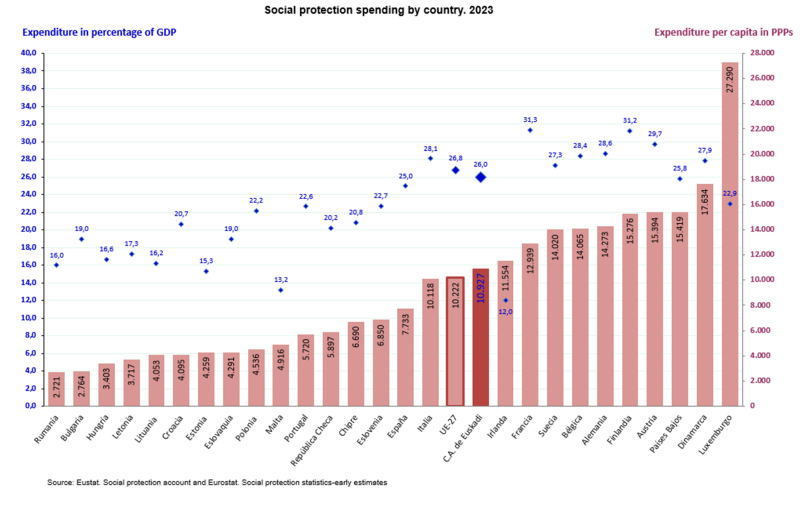
In comparison with Europe, the trend in expenditure as a share of GDP is similar to that registered by neighbouring countries in Europe.
In the Basque Country, spending on social benefits as a percentage of GDP rose by 0.3 percentage points in 2023, standing at 26.0%, which places it above Spain (25.0%) and brings it close to the EU27 score of 26.8%, according to Eurostat estimates for 2023.
As regards the indicator social benefits expenditure per inhabitant, in the Basque Country it stood at 10,927 euros in 2023, placing it above the average for the EU27 (10,222), Spain (7,733) and Italy (10,118), among others. The table was topped by Luxembourg, with 27,290 euros, and Denmark, with 17,634.
For further information:
Eustat - Euskal Estatistika Erakundea / Basque Statistics Institute
C/ Donostia-San Sebastián, 1 01010 Vitoria-Gasteiz
Press Service: servicioprensa@eustat.es Tel.: 945 01 75 62