Press release 31/10/2024
POPULATION AND HOUSING CENSUS. ACTIVITY. 01-01-2023
The unemployment rate fell in every region in the Basque Country as of 1 January 2023
Six out of ten employed people had completed higher vocational or university studies
In 2023, as of 1 January, the unemployment rate fell for the population aged 16 and over residing in all regions of the Basque Country, according to Eustat data. Particularly noteworthy were the low unemployment rates in the regions of Montaña Alavesa (5.8%), Urola Kosta (5.9%) and Estribaciones del Gorbea (6.2%). Conversely, the regions of Encartaciones (10.4%), Gran Bilbao (9.9%) and Rioja Alavesa (9.6%) had the highest unemployment rates. The unemployment rate is the proportion of people who are unemployed in relation to the total working population (the sum of the unemployed population and the employed population).
Unemployment rate of the population of the Basque Country by territorial area according to sex (%). 2023
| | Unemployed population | 2023-2022 |
| | Total | Men | Women | |
| | | | | |
| Arabako Mendialdea / Montaña Alavesa | 5,8 | 5,2 | 6,7 | -1,2 |
| Urola-Kostaldea / Urola Costa | 5,9 | 4,8 | 7,1 | -0,9 |
| Gorbeialdea / Estribaciones del Gorbea | 6,2 | 4,9 | 7,8 | -0,7 |
| Debagoiena / Alto Deba | 6,7 | 5,6 | 7,9 | -0,3 |
| Tolosaldea | 6,7 | 5,5 | 7,9 | -0,4 |
| Durangaldea / Duranguesado | 6,9 | 5,5 | 8,5 | -1,5 |
| Goierri | 7,0 | 5,7 | 8,5 | -0,3 |
| Markina-Ondarroa | 7,0 | 6,8 | 7,1 | -1,2 |
| Donostialdea | 7,1 | 6,5 | 7,6 | -0,7 |
| Plentzia-Mungia | 7,1 | 6,6 | 7,7 | -1,4 |
| Añana | 7,8 | 6,3 | 9,8 | -0,9 |
| Arratia Nerbioi / Arratia-Nervión | 8,2 | 6,8 | 9,8 | -1,2 |
| Gernika-Bermeo | 8,2 | 7,7 | 8,7 | -1,4 |
| Debabarrena / Bajo Deba | 8,4 | 6,6 | 10,3 | -0,7 |
| Arabako Kantaurialdea / Cantábrica Alavesa | 8,4 | 6,4 | 10,5 | -1,1 |
| Bidasoa Behea / Bajo Bidasoa | 8,8 | 7,6 | 10,1 | -1,2 |
| Arabako Lautada / Llanada Alavesa | 9,0 | 7,4 | 10,6 | -1,0 |
| Arabako Errioxa / Rioja Alavesa | 9,6 | 7,4 | 12,4 | -0,4 |
| Bilbo Handia / Gran Bilbao | 9,9 | 8,7 | 11,1 | -1,6 |
| Enkartazioak / Encartaciones | 10,4 | 8,7 | 12,2 | -1,5 |
Date October 31, 2024
Source: Eustat. Population and housing census. Activity
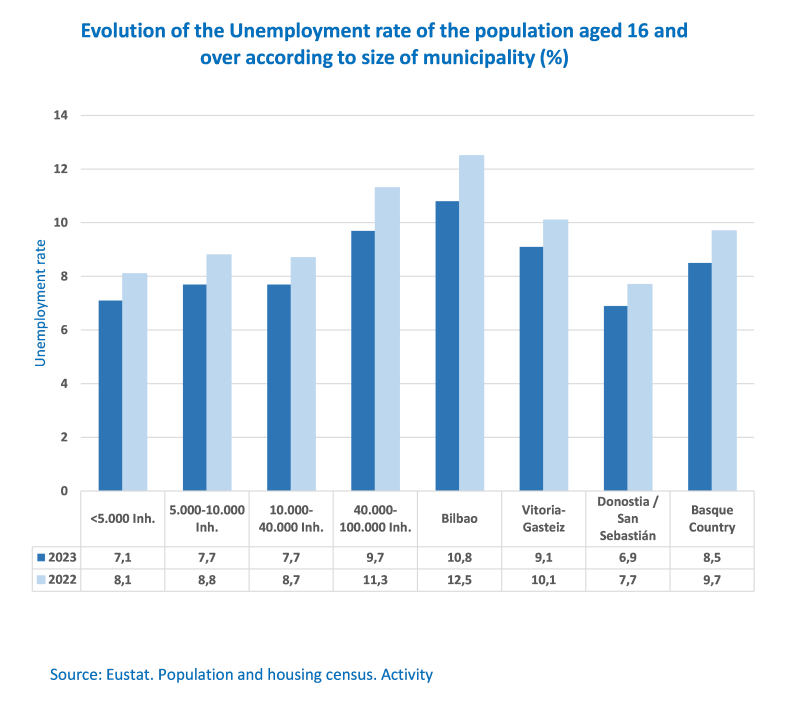
Regarding the size of the municipalities, it was observed that the unemployment rate was lower in the strata of municipalities with smaller populations. Of particular note was the group of municipalities with fewer than 5,000 inhabitants, with an unemployment rate of 7.1%. Next were the strata of municipalities with 5,000 to 10,000 and 10,000 to 40,000 inhabitants, with 7.7% in both cases, 8 tenths of a percentage point lower than the average for the Basque Country (8.5%). At 9.7%, the stratum of 40,000 to 100,000 inhabitants had an unemployment rate above the Basque average.
As regards the capitals, San Sebastián posted the lowest unemployment rate (6.9%), while Vitoria-Gasteiz and Bilbao had unemployment rates higher than the average for the Basque Country (9.1% and 10.8%, respectively). The unemployment rate fell in all three cases: 1.7 points in Bilbao, 1 point in Vitoria-Gasteiz and 0.8 points in San Sebastián.
A total of 197 municipalities recorded an unemployment rate below the average (8.5%), accounting for 78% of municipalities. At one end of the scale, 10 municipalities had an unemployment rate below 3%, which were (from lowest to highest): Leintz-Gatzaga, Kripan, Albiztur, Aduna, Gizaburuaga, Arama, Mutiloa, Baliarrain, Murueta and Garai, all corresponding to the above-mentioned stratum with the smallest population, up to 5,000 residents. At the other end, there were 7 municipalities whose unemployment rate stood above 12% (from highest to lowest rate): Lanestosa, Ikaztegieta, Alonsotegi, Balmaseda, Oyón-Oion, Sestao and Artzentales, corresponding to various municipality size strata.
In 177 municipalities the employment rate was above average (52.2%) and in 4 it was below 45%
The employment rate of the population aged 16 and over residing in the Basque Country (i.e. the proportion of the employed population in relation to the population aged 16 and over) stood at 52.2% on 1 January 2023, representing an increase of 0.9 percentage points compared to 2022. At the regional level, the employment rate rose in 17 of the 20 regions compared to the previous year.
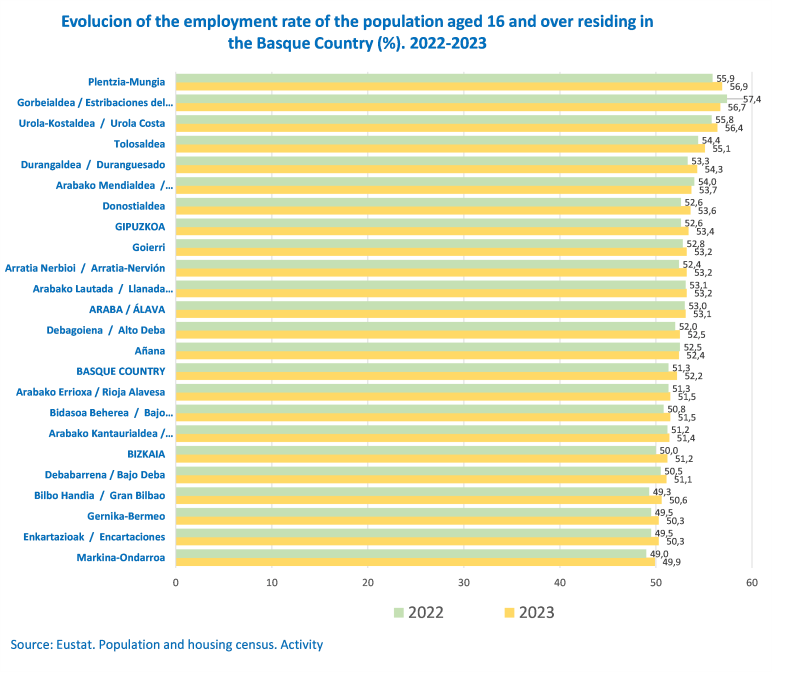
The region of Plentzia-Mungia topped the ranking with the highest employment rate, standing at 56.9%, a rise of one percentage point in relation to 2022. It was followed by Estribaciones del Gorbea with a rate of 56.7% and a decrease of 0.7 percentage points compared to the previous year. In third place was Urola Kosta, with 56.4%, registering a rise of 0.6 percentage points.
By municipality, and taking their size into account, those with fewer than 5,000 inhabitants had a relatively high average employment rate (54.8%). This group included municipalities with significantly elevated rates such as Baliarrain (72.6%), Orendain (68.5%) and Aduna (67.3%), as well as municipalities with the lowest rates such as Lanestosa (39.0%), Lagrán (42.6%), and Elantxobe, with 42.7%.
In the next stratum of municipalities, between 5,000 and 10,000 inhabitants, the average employment rate was 54.1%. At the top end, Astigarraga and Urduliz stood out with 69.2% and 61.4%, respectively. At the lower end of the scale were municipalities such as Balmaseda (47.6%), Ondarroa (48.0%) and Lekeitio (48.5%).
In the stratum of municipalities with a population of between 10,000 and 40,000 inhabitants, there was an average employment rate of 53.3%. Of particular note was Etxebarri with 62.5%, followed by Sopela with 59.3%. In the next stratum, municipalities with more than 40,000 inhabitants and fewer than 100,000, Barakaldo had the highest employment rate (51.5%), followed by Irún, with 51.3%. The average for this stratum stood at 49.7%.
Lastly, as regards the capitals, Vitoria-Gasteiz had the highest employment rate, standing at 52.9%. Next were San Sebastián, 0.7 percentage points behind with a rate of 52.2%, and Bilbao with an employment rate of 49.8%.
Nearly 4 out of 10 employed people worked in their municipality of residence
39% of employed people in the Basque Country worked in their municipality of residence. This proportion rose to 7 out of 10 employed people in Álava (70.3%), but fell in Gipuzkoa, where almost 4 out of 10 residents in employment worked in their municipality of residence (37.3%), as well as Bizkaia, where it was 3 out of 10 (31%). On the other hand, 51.3% of employed people worked in another municipality within their own province. These proportions stood at 60% in Bizkaia and 53.9% in Gipuzkoa. In Álava, this accounted for just 16.2% of the employed resident population.
Six out of 10 employed people had completed higher education
The level of education attained provides additional information when analysing employment and unemployment. At the time of the survey, 59.9% of the working population had completed a higher level of education, which includes advanced level vocational training (20.3%) and university education (39.6%). Among the unemployed population, this level of education represented 36.8%, with advanced level vocational training accounting for 15.5% and university education the remaining 21.3%. Furthermore, 39.8% of people out of work had only completed primary education or had no qualifications at all, while this percentage was much lower (19.6%) among the employed population.
Level of training attained by the employed and unemployed population of the Basque Country according to sex (%). 2023


| | Employed population | Unemployed population |
| | Total | Men | Women | Total | Men | Women |
| | | | | | | |
| A.First stage of secondary and lower education (level 0-2) | 19,6 | 22,3 | 16,8 | 39,8 | 41,3 | 38,7 |
| 0.Less than primary | 0,4 | 0,5 | 0,3 | 1,8 | 1,6 | 1,9 |
| 1. Primary education | 2,0 | 2,2 | 1,8 | 6,0 | 5,5 | 6,4 |
| 2.Low secondary education: up to ESO and equivalent | 17,2 | 19,6 | 14,7 | 32,0 | 34,1 | 30,4 |
| | | | | | | |
| B.Second stage of secondary education and non-tertiary post-secondary education (level 3-4) | 20,5 | 22,0 | 18,9 | 23,4 | 24,1 | 22,8 |
| 3.Upper secondary education: Baccalaureate, intermediate vocational training and equivalent | 19,8 | 21,4 | 18,2 | 22,7 | 23,5 | 22,0 |
| 4.Non-tertiary post-secondary education: level 3 professional certificates and equivalent | 0,7 | 0,6 | 0,7 | 0,7 | 0,6 | 0,8 |
| | | | | | | |
| C.Higher education (including doctorate)(level 5-8) | 59,9 | 55,7 | 64,3 | 36,8 | 34,6 | 38,4 |
| 5.Higher vocational education and equivalents | 20,3 | 23,5 | 16,9 | 15,5 | 16,0 | 15,0 |
| 6.University degrees, diplomas and equivalents | 13,7 | 10,1 | 17,5 | 8,1 | 6,5 | 9,4 |
| 7.Bachelor's degrees, double degrees and master's degrees | 24,2 | 20,5 | 28,1 | 12,5 | 11,4 | 13,3 |
| 8.PhD level or equivalent | 1,7 | 1,6 | 1,8 | 0,7 | 0,7 | 0,7 |
Date October 31, 2024
Source: Eustat. Population and housing census. Activity
An analysis of gender differences in terms of employment and unemployment reveals that 64.3% of employed women had completed higher education, a percentage that was lower for men (55.7%). Among unemployed people, 38.4% of women had completed higher education, a proportion that dropped to 34.6% among men in the same situation.
For further information:
Eustat - Euskal Estatistika Erakundea / Basque Statistics Institute
C/ Donostia-San Sebastián, 1 01010 Vitoria-Gasteiz
Press service: servicioprensa@eustat.es Tel: 945 01 75 62