Press Release 20/05/2021
INDICATORS OF THE 2030 AGENDA FOR SUSTAINABLE DEVELOPMENT. 2021
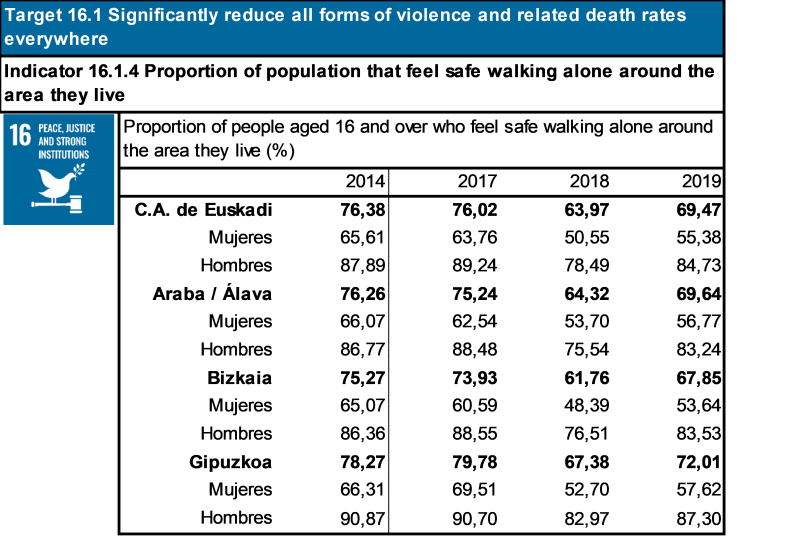
55.38% of women in the Basque Country feel safe walking alone in the area where they live, compared to 84.73% of men
Eustat is starting to measure progress towards the goals and targets of the 2030 Agenda for Sustainable Development at the provincial level and by gender
In 2019, 84.73% of men aged 16 and over in the Basque Country felt safe walking alone in the area where they live, while only 55.38% of women did, according to data included recently in the dissemination platform of indicators of the 2030 Agenda for Sustainable Development of the Basque Country, launched by Eustat on 17 December.
Eustat then provided various social actors with a set of statistical indicators that allow ongoing monitoring of the goals and targets of the United Nations 2030 Agenda for Sustainable Development. One of the main purposes of the dissemination platform is to continuously incorporate indicators regarding the achievement of the 169 targets and 17 goals for sustainable development in the Basque Country, as well as its geographical divisions and various interest groups.
Accordingly, a total of 32 indicators have been broken down by province, 6 indicators are provided for women and men, and 24 indicators offer series disaggregated by province and gender.
The latter two, for example, include the indicator Proportion of people aged 16 and over who feel safe walking alone in the area where they live in the Basque Country. The disaggregation of the indicator by gender and province allows the phenomenon to be visualised from different perspectives, and not only over time. It can be observed, for example, that the proportion of people who feel safe has fallen in the Basque Country from 76.38% in 2014 to 69.47% in 2019, due in particular to the negative trend in how safe women feel, which fell by 10 percentage points over the period analysed.
Gipuzkoa was the province where both women and men felt safest walking alone in the area where they live, albeit to a lesser extent in 2019 than in 2014. In Bizkaia and Álava, around 83% of men felt safe, while the figures for women were lower, standing at 56.77% in Álava and 53.64% in Bizkaia.
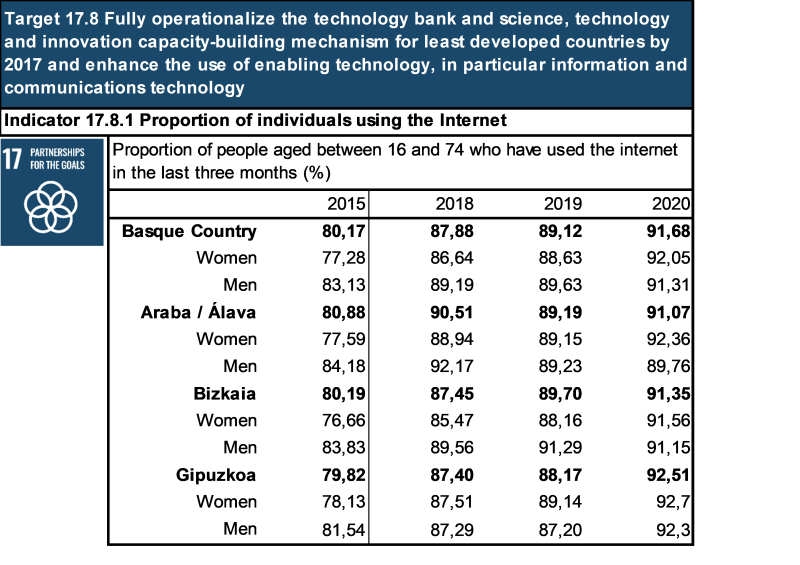
Another indicator, the Proportion of people aged between 16 and 74 who have used the internet in the last three months, has recently been disaggregated by province and gender. When analysed, it offers a visualisation of trends in underlying phenomena. Over the period 2015-2020, trend of varying intensity can be observed among women, who went from being 5 percentage points below men in 2015 to half a percentage point higher in 2020.
This phenomenon occurred across all three provinces, although it was particularly remarkable in the case of Álava, where the proportion of women who had used the internet in the previous three months had surpassed that of men by almost three percentage points (92.36% of women compared to 89.76% of men).
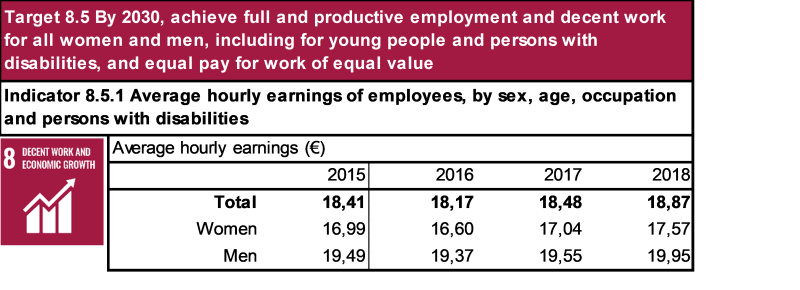
As an example of an indicator that has been broken down by gender and that offers a new perspective is Average hourly earnings, where it has been observed that, while average earnings have shown a tentative increase between 2015 and 2018 for the population as a whole, it rose slightly more in the case of women. Thus, the difference in average hourly earnings has fallen from 2.50 euros in 2015 to 2.38 euros in 2018. There is a clear interest in breaking down this indicator further for more dimensions of analysis.
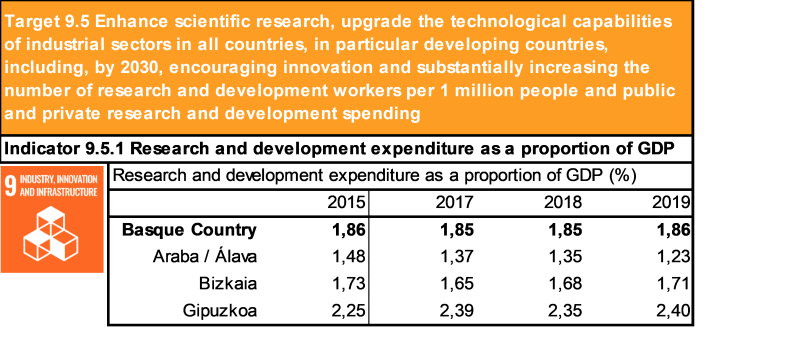
Disaggregation by province presents further scope for expansion of Eustat’s 2030 Agenda indicator platform. There are indicators that the relevant actors can and must highlight, as it is essential to monitor them at the provincial level. They include Research and development expenditure as a proportion of GDP, which reveals differences between the provinces in terms of both level (Gipuzkoa has the highest expenditure) and in trends throughout the 2015-2019 period (in Álava it fell significantly, in Bizkaia it dropped slightly, while in Gipuzkoa it in fact rose). Presenting the indicator only at the Basque Country level may, therefore, hide phenomena of great interest.
In addition to disaggregation by gender and province, 8 new statistical indicators were also included that allow the achievement of Sustainable Development Goals 1 (No poverty), 8 (Decent work and economic growth) and 12 (Responsible production and consumption). These include “Hazardous waste generated per capita”, which provides information about Goal 12 (Responsible production and consumption).
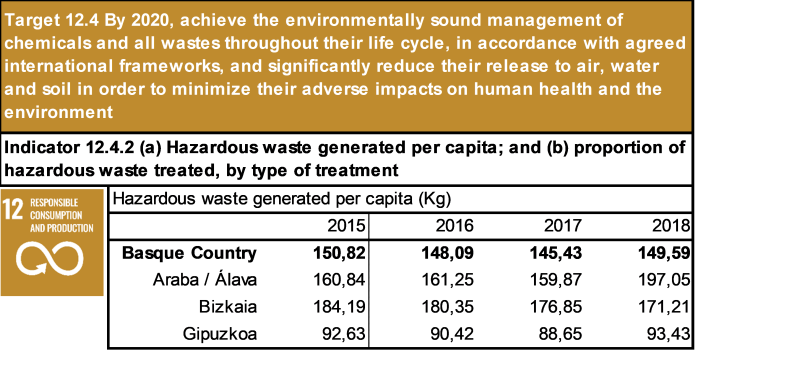
It has been observed that, in 2018, hazardous waste generated per capita reached a level very similar to that observed in the year of reference, 2015. However, disaggregation of this series shows a highly varied trend across the provinces. Bizkaia went from generating 184 kilos of hazardous waste in 2015 to 171 in 2018, while in Álava the amount rose from 160 kilos to 197 kilos over the same period. In Gipuzkoa, on the other hand, the trend was stable, at just over 90 kilos in both years.
Note. Work continues on including new indicators in the dissemination platform of indicators of the 2030 Agenda for Sustainable Development of the Basque Country in order to offer disaggregated indicators and to include new ones that provide information on targets not covered to date. Eustat will publish a press release every time there is a significant development in the indicators platform and will report on steps towards the achievement of the Sustainable Development Goals in the Basque Country.
For further information:
Eustat - Euskal Estatistika Erakundea / Basque Statistics Institute
C/ Donostia-San Sebastián, 1 01010 Vitoria-Gasteiz
Press service: servicioprensa@eustat.es Tel: 945 01 75 62