Press Release 26/10/2022
POPULATION AND HOUSING CENSUS AND MUNICIPAL ACTIVITY STATISTICS. 01-01-2021
The employment rate increased in all the regions of the Basque Country except one in 2021, in respect of 2011
Almost half the population in work held higher qualifications, whether a professional or university qualification
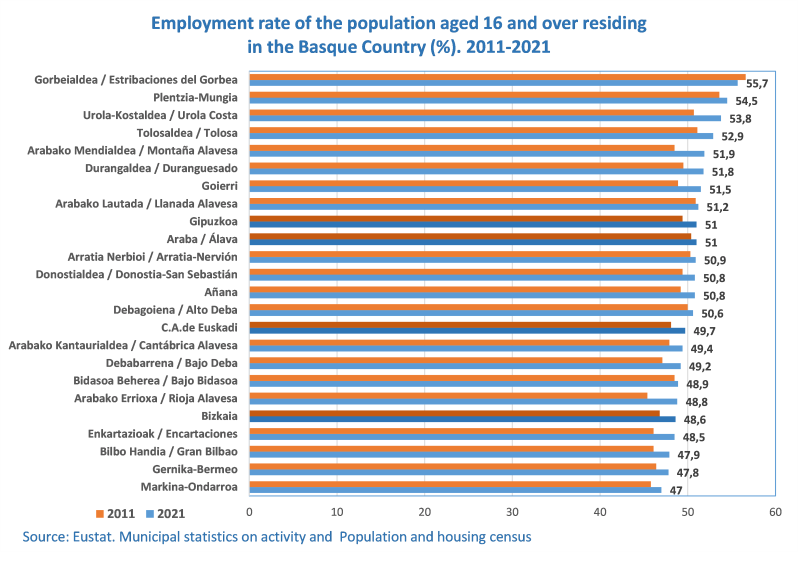
At 1 January 2021, the employment rate of the resident population aged 16 and over in the Basque Country was above the average (49.7%) in 12 of the 20 regions of the Basque Country, with all of them having improved in respect of 2011 except Estribaciones del Gorbea, according to Eustat data.
However, the Estribaciones del Gorbea region shows the highest employment rate (55.7%) although it was down 0.9 percentage points compared to the data of the previous Population Census in 2011. After Estribaciones de Gorbea comes Plentzia-Mungia with a rate of 54.5%, followed by Urola Costa with 53.8%. All three were also the regions with the highest employment rates in their respective territories.
By municipality, and taking their size into account, those with fewer than 10,000 inhabitants registered, on average, a comparatively higher employment rate (52.2%). This stratum includes municipalities with significantly higher rates, such as Astigarraga (67.6%), Orendain (67.4%), Aduna (67%) and Irura (65%), combined with municipalities with low employment rates such as Elantxobe (38.9%), Yécora/lekora (39.8%), Lanestosa (40.5%), Lagrán (40.8%) and Sukarrieta (40.9%).
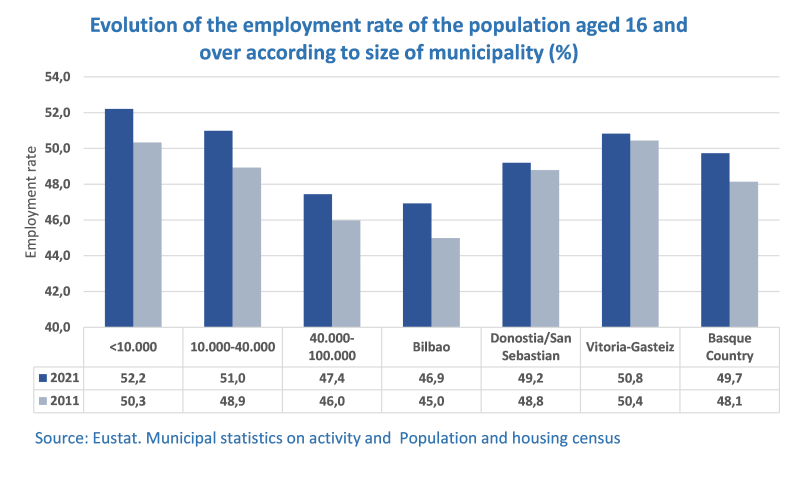
In the next stratum, of between 10,000 and 40,000 inhabitants, where the average employment rate is 51%, the employment rates in Etxebarri (59.9%), Oiartzun (55.8%) and Sopela (55.7%) were of particular note.
The stratum of municipalities with more than 40,000 inhabitants, without reaching 100,000 inhabitants, includes Errenteria, with an employment rate of 50.6%, Irún with a rate of 48.7% and Barakaldo with 48.4%.
Regarding the capitals, the highest employment rate was in Vitoria-Gasteiz, at 50.8%. At a distance of more than one and a half percentage points was Donostia/San Sebastián with an employment rate of 49.2%. Bilbao was in third position with an employment rate, more than two points below the former, of 46.9%.
The difference between men and women was down from 10.6 percentage points in 2011 to 7.2 in 2021
In 2011, the employment rate for men was 53.6% while that of women was 43%. In 2021, i.e. ten years later, the rate for men remained practically the same (53.5%) and that of women increased by more than three points to reach 46.3%. This means that the difference between them, which was 10.6 percentage points in 2011, has dropped to 7.2 percentage points over the course of those ten years.
If the variable of municipality size is introduced into the analysis of the differences in employment by sex, the difference noted above was maintained. Only in the stratum of 40,000 to 100,000 inhabitants was the difference higher than the Basque Country average: 7.8 points more in employment for men versus women, compared to 7.2 in the general average.
Of the capitals, San Sebastián was the capital with the least difference between men and women in terms of the employment rate: women 46.4%, men 52.4% and six percentage points between them. Of the provincial capitals, Vitoria-Gasteiz had the highest employment rate for women, 47.7%, and the difference with the employment rate for men (54.2%) was 6.5 points. Lastly, Bilbao (which showed by far the lowest employment rate for women, 43.5%) had the greatest difference between the sexes, 7.3 points, although the employment rate for men was also the lowest of the three capitals at 50.8%.
As the percentage of employed people increased, so did the level of education
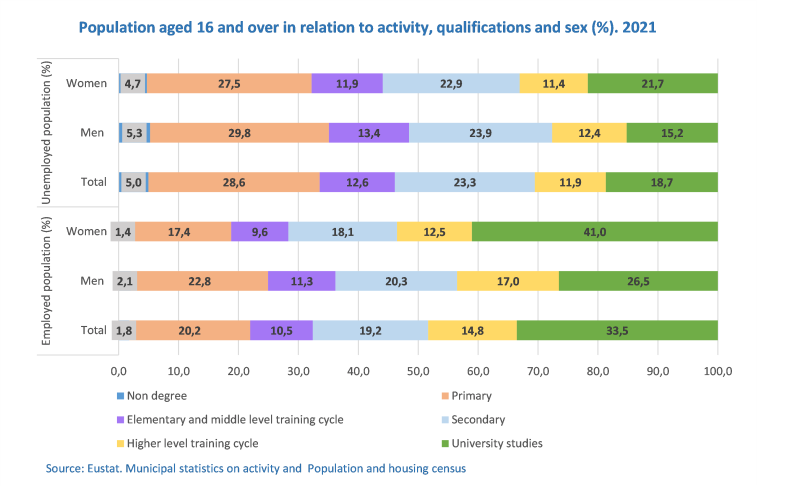
The level of education provides additional information when analysing employment. Thus, almost half the population in work, 48.3%, had higher qualifications (vocational training 14.8% and university education 33.5%) while this education level only represented 30.5% of the unemployed population. Conversely, 33.6% of the unemployed population only had primary education or did not have any qualifications, when among the employed population the percentage is much lower (22%).
Gender differences, in both employment and unemployment, were more pronounced in the case of women with higher qualifications, but in the opposite direction. Thus, 53.5% (more than half the female population in work) had higher education, but this was only 43.5% in the case of men. However, among the unemployed population, the proportion of women with higher education rose to 33.1%, whereas the proportion of men stood at 27.6%.
In 140 municipalities the unemployment rate was below 10% and in 6 it was below 3%
The unemployment rate also dropped between 2011 and 2021 in almost all regions, with half of them registering improvements above the average, which stood at 3.5 points. Of particular note is the case of Rioja Alavesa, with a decrease of 8.8 percentage points, going from being the region with the highest unemployment rate in 2011, to standing below the average in 2021 with a value of 10.1%. Other regions such as Bajo Bidasoa, Encartaciones and Cantábrica Alavesa presented a similar picture, with significant decreases (7.3, 7.2 and 6.3 percentage points respectively) and below average unemployment rates in 2021: 9.5% in the case of Encartaciones and 8.5% and 8.3% for Bajo Bidasoa and Cantábrica Alavesa, respectively. These latter two regions, together with Duranguesado with an unemployment rate of 8.4%, were those with the lowest unemployment rate in 2021.
Conversely, Llanada Alavesa (13.5%), Gernika-Bermeo (13.1%) and Alto Deba (12.9%) were the regions with the highest unemployment rates in the Basque Country and in their respective territories.
By municipality, in 231 of 251 municipalities, the unemployment rate was down in this 10-year period and 195 have rates below the average. Sestao, with a rate of 16.9%, and Oyón-Oión (16.5%) were the municipalities with the highest unemployment rate in 2021.
Regarding the capitals, their positions were maintained with regard to 2011: San Sebastián had the lowest rate (9.7%), while Vitoria-Gasteiz and Bilbao stood above the average with unemployment rates of 12.1% and 13.7% respectively.
For further information:
Eustat - Euskal Estatistika Erakundea / Basque Statistics Institute
C/ Donostia-San Sebastián, 1 01010 Vitoria-Gasteiz
Press service: servicioprensa@eustat.es Tel: 945 01 75 62