Press Release 10/08/2022
MIGRATORY MOVEMENTS STATISTICS. 2021
The positive migratory balance for 2021 stood at more than 3,500 people in the Basque Country
Immigration and emigration increased by 11.9% and 16.7% respectively compared to 2020
In 2021, 39,427 immigrants arrived compared to 35,221 in 2020, up 11.9%. There was also a 16.7% increase in the number of emigrations which rose from 30,709 in 2020 to 35,839 in 2021, meaning the migratory balance stood at 3,588 people, according to Eustat data. As a result of this growth in emigration numbers, this migratory balance was lower than that of the previous year (924 people), despite the growth in immigration numbers.
Migratory movements and balances in the Basque Country. 1998-2021
| | Immigration | Emigrations | Migratory balance |
| | Total | Variation rate (1988=100) | Total | Variation rate (1988=100) | Total |
| 1988 | 8.014 | 100 | 18.103 | 100 | -10.089 |
| 1992 | 9.006 | 112 | 13.668 | 76 | -4.662 |
| 1995 | 11.316 | 141 | 16.130 | 89 | -4.814 |
| 1999 | 16.103 | 201 | 17.291 | 96 | -1.188 |
| 2000 | 20.022 | 250 | 17.462 | 96 | 3.903 |
| 2001 | 25.775 | 322 | 18.696 | 103 | 7.861 |
| 2002 | 25.967 | 324 | 19.730 | 109 | 6.082 |
| 2003 | 28.467 | 355 | 22.216 | 123 | 4.864 |
| 2004 | 30.328 | 378 | 21.304 | 118 | 8.116 |
| 2005 | 33.993 | 424 | 20.672 | 114 | 12.256 |
| 2006 | 37.147 | 464 | 22.689 | 125 | 11.827 |
| 2007 | 41.361 | 516 | 23.669 | 131 | 16.835 |
| 2008 | 44.630 | 557 | 29.941 | 165 | 14.689 |
| 2009 | 38.368 | 479 | 31.815 | 176 | 6.553 |
| 2010 | 38.591 | 482 | 33.425 | 185 | 5.166 |
| 2011 | 41.011 | 512 | 32.819 | 181 | 8.192 |
| 2012 | 34.362 | 429 | 34.589 | 191 | -227 |
| 2013 | 33.987 | 424 | 35.943 | 199 | -1.956 |
| 2014 | 35.491 | 443 | 31.889 | 176 | 3.602 |
| 2015 | 35.917 | 448 | 32.555 | 180 | 3.362 |
| 2016 | 40.126 | 501 | 31.255 | 173 | 8.871 |
| 2017 | 41.861 | 522 | 31.136 | 172 | 10.725 |
| 2018 | 46.982 | 586 | 32.258 | 178 | 14.724 |
| 2019 | 52.306 | 653 | 32.838 | 181 | 19.468 |
| 2020 | 35.221 | 439 | 30.709 | 170 | 4.512 |
| 2021 | 39.427 | 492 | 35.839 | 198 | 3.588 |
Date August 10, 2022
Source: Eustat Migratory movement statistics
The migratory balance reported two different periods during 2021; negative between January and June (2,496 people), and positive in the second half of the year (6,084 people).
By province, Bizkaia, which gained 1,465 people, recorded the highest migratory balance in absolute figures, Álava recorded a positive balance of 1,179 people and Gipuzkoa gained 944 people. In percentage terms, only Álava reported an increase in respect to the previous year, up 85.7%, while Bizkaia was down 12.1% and Gipuzkoa 57.3%. As regards the capitals, the migratory balances were positive in both San Sebastián and Vitoria-Gasteiz, with rises of 665 and 852 people, respectively. Bilbao was down 35 people.
In relation to the movements that occur between the Basque Country and the other Autonomous Regions, there was a negative balance of 573 people in 2021, recovering somewhat compared to the previous year, which recorded -733 people. On the other hand, although the balance with other countries was positive (4,161 people) it was significantly lower than in 2020 (5,245 people).
The external mobility rate remained relatively low
In 2021, external or extra-community geographical mobility involved 34.3 people per thousand inhabitants of the Basque Country and was just over 4 points above that of the previous year, but 6 points lower than the average for the Autonomous Regions, where on average 40.4 inhabitants per thousand moved. By provinces, Álava reached 39.3‰, Bizkaia stood at 33.4‰ and Gipuzkoa at 33.5‰.
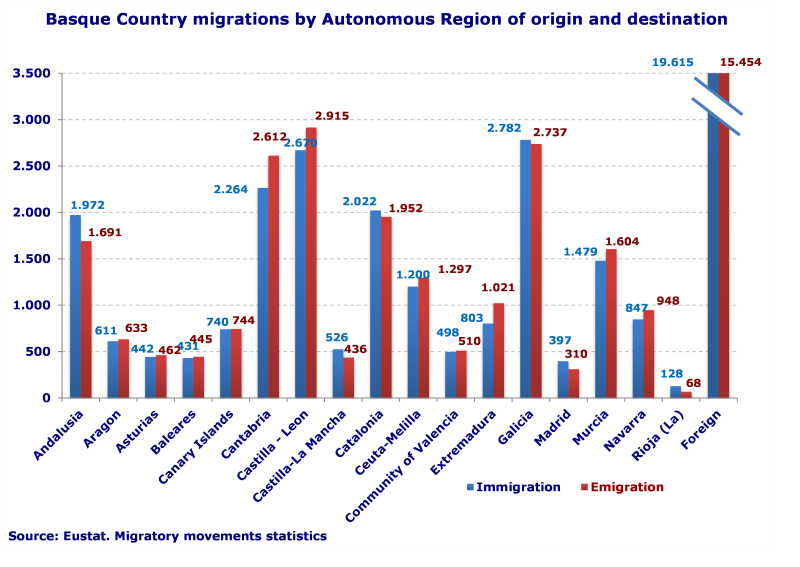
If we take into account the migratory movements with the different Autonomous Regions we see that the Basque Country maintained a positive migratory balance, with 6 of them, while in the other 11 the migratory balance was negative. In 2021, the negative balances were equal to -1,206 people, compared to the more than -2,600 of the previous year.
The Autonomous Regions that attracted the emigrants from the Basque Country were as follows, in order: Castilla y León, Madrid, Cantabria and Catalonia. Between the four of them they received 50% of the people who left this Community for other Autonomous Regions.
The Autonomous Regions that contributed the most immigrants were as follows, in descending order: Madrid, Castilla y León, Cantabria and Catalonia. Between the 4 of them they contributed 49% of the total immigrants from the rest of Spain.
Andalusia is the Autonomous Region that contributed the highest positive balance, with 281 people, and Cantabria contributed the most negative, with -348.
The average age of the emigrants (37.7 years old) was higher than that of the immigrants (34.1 years old). 48% of immigrations and 46% of emigrations were by people in the 20-39 age group.
In relation to gender, the percentages were maintained: men represented 53% of immigrants and women 47%. Similarly, 54% of emigrants were men and 46% were women.
58% of immigrants and 45% of emigrants were foreign nationals
Immigration of foreign nationals stood at 22,721 in 2021, of which 6,408 came from other Autonomous Regions, predominantly Madrid, Catalonia and Andalusia, and 16,363 came from abroad.
Emigrations of foreign nationals rose to 16,167, accounting for 45% of the total. The destination for 72% of them was abroad. Therefore, the balance of foreign nationals was positive by 6,604.
67% of the changes of residence among the Basque population occurred within the Autonomous Region of the Basque Country itself
10.5% of the Basque population changed their place of residence in 2021, with the mobility on 67% of the occasions being within the Basque Country, whilst in the other cases the mobility was extra-community.
In total, 229,926 changes of normal places of residence were recorded in the Basque Country. Of these, 99,981 were changes of address within the same municipality. Intra-community mobility, in other words, where the origin and destination are different municipalities of the Basque Country, increased to 54,679 movements.
There were also 39,427 cases of extra-community or external immigration, which are those that have their origin outside the Autonomous Region and where the destination is the Basque Country. Of these cases, 19,615 came from abroad. This represented an rise of 15.8% compared to figures for 2020.
Finally, there were 35,839 external or extra-community emigrations, or in other words, changes in the place of residence from a municipality of the Autonomous Region to a destination outside the region; 43% (15,454) of which were abroad.
For further information:
Eustat - Euskal Estatistika Erakundea / Basque Statistics Institute
C/ Donostia-San Sebastián, 1 01010 Vitoria-Gasteiz
Press Service: servicioprensa@eustat.eus Tel.: 945 01 75 62