Press Release 14/12/2021
MUNICIPAL GDP. 2019
The Technology Park kept Zamudio as the municipality with the highest GDP per capita in the Basque Country
The industrial sector and services associated with industry were present in the majority of municipalities with the highest GDP per capita
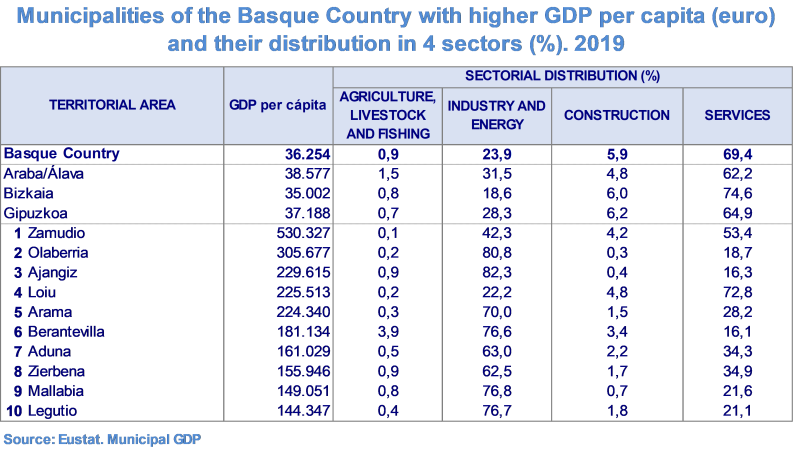
In 2019, the municipality of Zamudio, in the province of Bizkaia, maintained its position as the municipality with the highest Gross Domestic Product per capita in the Basque Country, according to Eustat data. This was mainly due to the combination of its industrial landscape together with the significant weight of services linked to industry, known as Industry 4.0.
Olaberria in Gipuzkoa and Ajangiz in Bizkaia came in second and third place, respectively. These municipalities had a strong industrial character, with the weight of the industrial sector being higher than 75% in all of them.
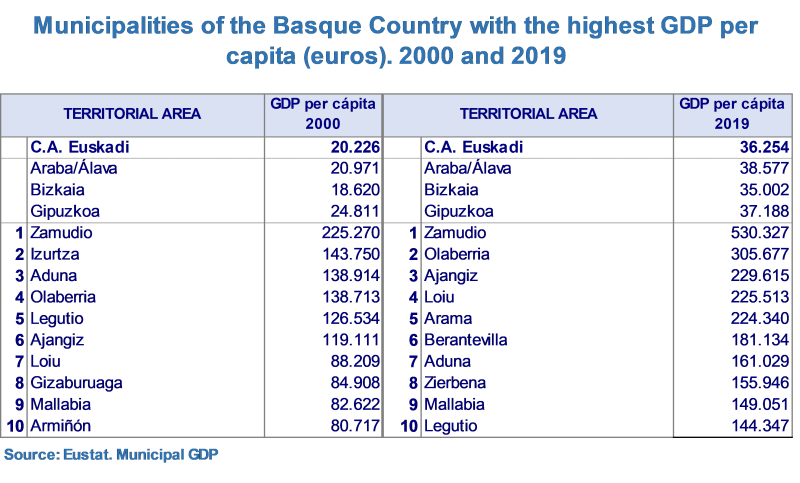
Looking back, there has been little change over the last 20 years. In fact, with regard to 2000, 7 municipalities remained among the 10 with the highest GDP per capita in the Basque Country. Zamudio, maintains the first place throughout these 20 years, except in 2005, while Olaberria, who started in 2000 at number 4, rises to the first position in 2005, and since then maintains the second position until today. Ajangiz and Loiu were in sixth and seventh place 20 years ago, but occupied third and fourth in 2019. Mallabia, Aduna and Legutio also featured in the top 10 positions. The case of Arama is striking in that it was in 234th place in 2000, but as of 2016 it became part of the group of 10 municipalities with the highest GDP per capita. Berantevilla and Zierbena were the other two municipalities to complete the list.
The metal and wine industries were present in the municipalities with the highest GDP per capita in Álava
In 2019, Berantevilla, in the region of Añana, was the municipality with the highest GDP per capita (181,134 euros) in Álava. The industrial sector generated 76.6% of the total economic activity in this municipality; of particular note were metal industry activities such as the manufacture of Transport Material, Metallurgy and Machinery & Equipment.
In the region of Estribaciones del Gorbea, Legutio stood out as the municipality with the second highest GDP per capita in the province and an industrial weight also above 76%, with branches of the metal industry (Mechanical Engineering and Metallurgy) once again generating the most activity.
Furthermore, in the region of Rioja Alavesa, two municipalities were among those with the highest GDP per capita in the province, although in this case their production structure was different to that described for the previous municipalities. Both the municipality of Laguardia and that of Villabuena de Álava were characterised by a more balanced production structure between the industrial and services sectors, although both were closely linked to the wine sector: the industrial side due to the activity of wineries (Manufacture of beverages) and the services side largely due to the accommodation and catering activities linked to them (Hospitality).
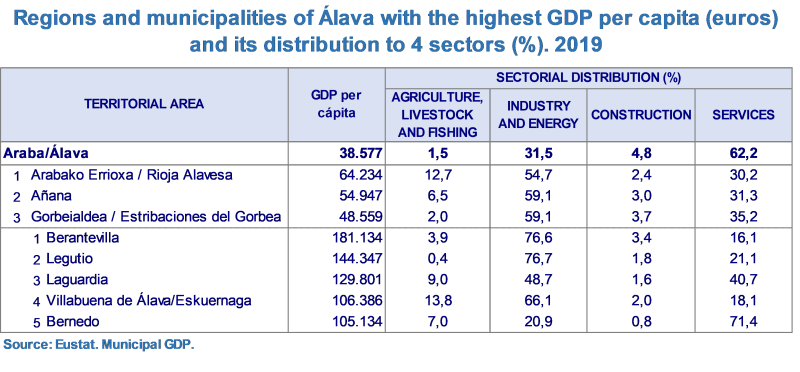
This also means that the region of Rioja Alavesa, with a GDP per capita 66.5% higher than the average for the province, ranked first in Álava as well as in the Basque Country as a whole.
In fifth place among the municipalities was Bernedo, in the region of Montaña Alavesa, with a business landscape based on the services sector (71.4%).
Source: Eustat. Municipal GDP
The municipalities in Bizkaia with the highest GDP per capita combined industry and services activities
Zamudio, located in the region of Gran Bilbao, was the municipality with the highest GDP per capita in the province of Bizkaia, as well as in the Basque Country. Its strong business landscape was underpinned by industry (42.3%), with companies related to the production of Transport Material being of particular relevance, as well as by the services sector (53.4%), primarily due to the presence of companies offering Professional and technical services linked to industry.
Also standing out in Gran Bilbao were Loiu, thanks to services related to Airport activity, as well as the Metal industry, and Zierbena, with industrial activity related to Energy and services related to Transport and storage.
Ajangiz, a municipality in the Gernika-Bermeo region, was the municipality with the second highest GDP per capita in Bizkaia. Its economic structure had a clear industrial character, with a weight of 82.3%, based on the manufacture of Plastic products.
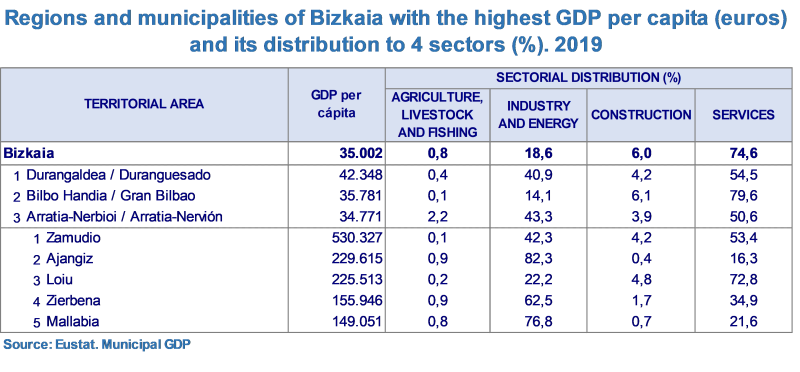
Mallabia, in Duranguesado, occupied fifth place in the Bizkaia ranking with a significant industrial weight (76.8%), mainly due to Mechanical Engineering and Transport Material activities. Duranguesado was the region with the highest GDP per capita in Bizkaia. It also primarily combined industry and services activities, with the most significant being Metallurgy and Trade and Hospitality, respectively.
Source: Eustat. Municipal GDP
The Goierri region includes 3 of the municipalities that generated the highest GDP per capita in the province of Gipuzkoa
Olaberria, with a GDP per capita of 305,677 euros, located in the Goierri region, came in first place in Gipuzkoa and second in the Basque Country as a whole. The weight of industry in the municipality exceeded 80% and activities such as those related to Iron and Steel products and the production of Machinery & Equipment were particularly noteworthy.
Also standing out in Goierri were Arama, with an industrial weight of 70.0%, based primarily on the production of Machinery & Equipment, and Ormaiztegi, where the manufacture of Motor Vehicles had a strong presence, with an industrial weight of 89.2%.
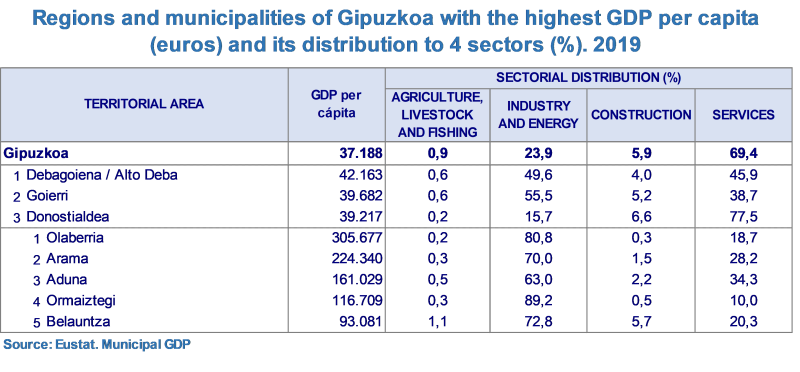
Aduna, in Tolosaldea, occupied third place in terms of GDP per capita in the province as a result of activities such as Non-metal Industry. Also in Tolosaldea is the municipality of Belauntza, which had the fifth highest GDP per capita in Gipuzkoa. In this case, its position was due to an industrial landscape based primarily on the Manufacture of structural metal products.
Alto Deba, for its part, was the leading region in the province in terms of GDP per capita, with a balanced structure between the industry and services sectors, accounting for 49.6% and 45.9%, respectively.
Source: Eustat. Municipal GDP
Methodological note: For a better interpretation of these data, a distinction must be made between Municipal GDP and Municipal Income; GDP is connected to production, to wealth generation, and is concentrated in municipalities with important productive establishments. Income, on the other hand, is related to individuals and their place of residence.
Furthermore, GDP is given in per capita terms in order to rescale the size of municipalities (by dividing the GDP generated in them by their population) and thus provide a comparison between the economic activity of very small municipalities and that of large ones.
For further information:
Eustat - Euskal Estatistika Erakundea / Basque Statistics Institute
C/ Donostia-San Sebastián, 1 01010 Vitoria-Gasteiz