Press Release 31/03/2021
FOREIGN TRADE UNIT VALUE INDICES - IVU. IV/2020
Export prices increased by 2.1% in the fourth quarter of 2020
In the case of imports, prices rose by 2.6%
Export prices increased by 2.1% in the fourth quarter of 2020 compared to the previous quarter, according to Eustat data. If we compare energy products and non-energy products, energy prices increased by 5.4%, while the prices of non-energy exports were up 1.9%.
For imports, the variation in prices compared to the previous quarter was also positive, at 2.6%. If we make a distinction by product, energy products were down 0.6% and non-energy products were up 3.5%.
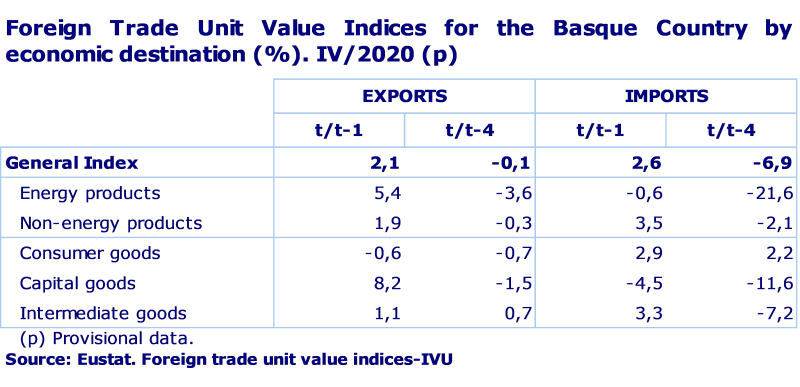
Compared to the previous quarter and taking into account the classification by economic destination of goods, we see that the prices of Capital Goods, i.e. goods that allow intermediate goods to be transformed into consumer goods, increased 8.2%, the prices of Intermediate Goods rose by 1.1% and Consumer Goods fell by 0.6%. For imports, prices of Capital Goods dropped by 4.5%, whereas the prices of Intermediate Goods and Consumer Goods rose by 3.3% and 2.9%, respectively.
If the geographic areas to which exports are sent are taken into account, it can be seen that prices in relation to the third quarter of 2020 rose in all areas, in both the Eurozone (2.0%) and the EU28 (1.4%), in the OECD (1.0%) and, above all, the Rest of the World, where prices rose by 7.1%. Equally, in the case of imports, there were also quarter-on-quarter increases in prices for all geographical areas, especially the Rest of the World (7.8%).
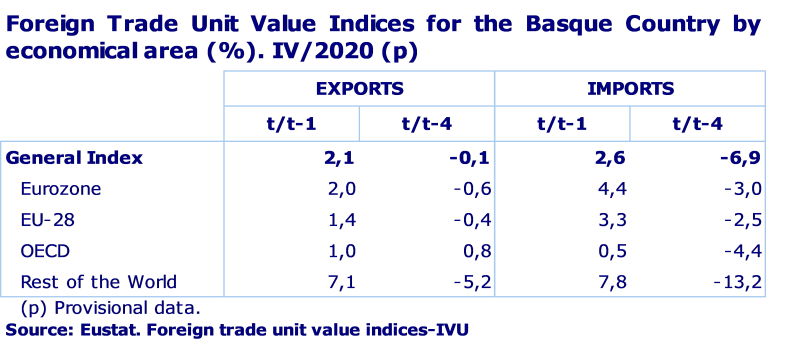
Compared with the same quarter of the previous year, export prices were down 0.1%, while import prices fell even further, by 6.9%.
Prices of energy exports posted a drop of 3.6% and non-energy exports were down 0.3%, compared with the fourth quarter of 2019. In the case of imports, there was a decrease of 21.6% in the price index of energy products, with non-energy products also falling by 2.1%.
By economic destination and for exports, Consumer Goods, which are goods used directly by the consumer as final products of the production process, fell by 0.7% in year-on-year terms, while Capital Goods dropped by 1.5%. Intermediate Goods, however, were up 0.7%.
As for imports, we see that prices of Consumer Goods posted year-on-year growth of 2.2%, but dropped 7.2% in the case Intermediate Goods, and 11.6% in the case of Capital Goods.
Prices of exports have registered an increase compared to the same quarter of the previous year in the OECD (0.8%), but posted a downturn of 5.2% in the Rest of the World, 0.6% in the Eurozone and 0.4% in the EU28, and this decrease has extended, in the case of imports, to all geographical areas, especially the Eurozone, with a 13.2% drop.
ANNUAL BALANCE
In 2020, prices of exports fell by 0.2% and prices of imports dropped by 4.7% compared to the previous year.
The prices of energy products dropped the most once again, both in terms of exports (-9.2%) and imports (-17.0%). The prices of imports of non-energy products also dropped, but it was a more moderate fall of 1.1%. Conversely, exports of non-energy products rose by 0.3%.
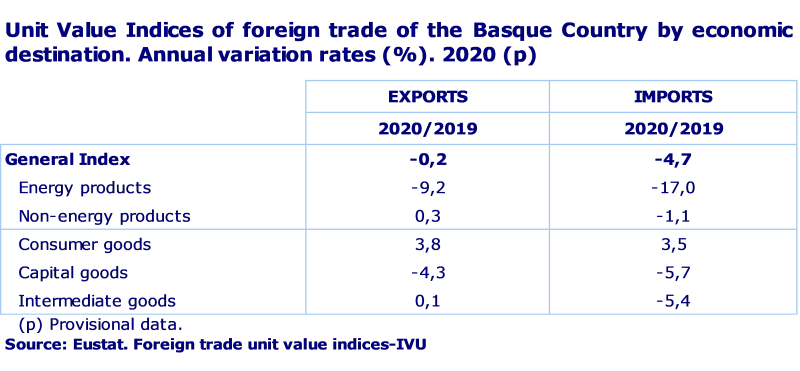
If we take into account the classification of goods by economic destination, we can see that for exports there were price increases in Consumer Goods, at 3.8%, and, to a lesser extent, in Intermediate Goods, at 0.1%. On the other hand, exports of Capital Goods saw a 4.3% drop in prices. Imports of this type of goods declined by 5.7%, close to the drop posted by Intermediate Goods, at 5.4%. Imports of Consumer Goods were the only imports that recorded an increase in price, at 3.5%.
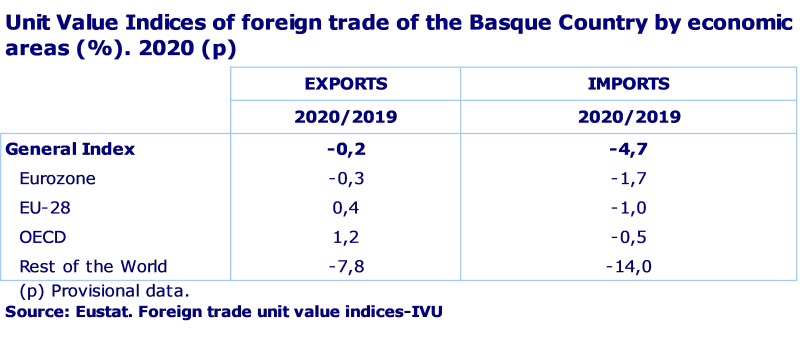
For exports, the geographical area that experienced the largest price increase was the OECD (1.2%). In the EU-28 they were also up, but to a lesser extent (0.4%). For imports, there were price decreases in all geographical areas considered, particularly in the Rest of the World (14.0%).
For further information:
Eustat - Euskal Estatistika Erakundea / Basque Statistics Institute
C/ Donostia-San Sebastián, 1 01010 Vitoria-Gasteiz
Press Service: servicioprensa@eustat.es Tel: 945 01 75 62