Press Release 18/03/2021
MUNICIPAL GDP. 2018
The three Basque capitals accounted for 37% of value added generated in the Basque Country in 2018
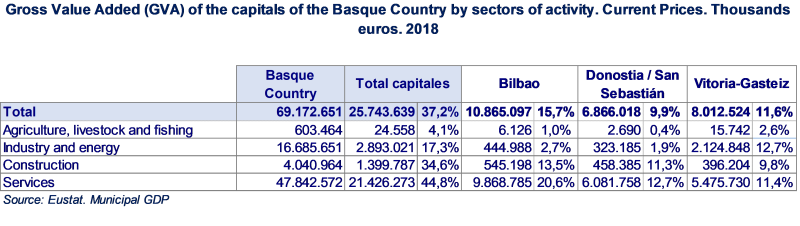
Activity was mostly concentrated in Services (44.8%) and Construction (34.6%), though it varied across the three provincial capitals
Gross Value Added (GVA) generated in 2018 by the municipalities of Bilbao, San Sebastián and Vitoria-Gasteiz, the 3 Basque capitals, accounted for 37.2% of the Basque Country total, according to data published by Eustat. The largest volume of GVA in the three municipalities was generated principally in the Services sector, with the three municipalities creating 44.8% of total GVA. Bilbao was the city that contributed most to services activities in the Basque Country, with 20.6% of the total.
As regards the Industry and Energy sector, the three provincial capitals contributed 17.3% of total GVA of industry, although this contribution was mostly the result of the weight of Vitoria-Gasteiz in the sector. This city accounted for 12.7% of all Industry and Energy in the Basque Country, mainly due to the Automotive Industry and Rubber Products manufacturing sectors.
In 2018, the generation of GVA was unevenly distributed among the municipalities of each Province.
In Álava, activity was concentrated in the provincial capital, which generated 72.1% of GVA in the province
In the province of Álava, the municipality of Vitoria-Gasteiz accounted for 72.1%, with a GVA at current prices of 8,012.5 million euros in 2018.
As a result, activity in other municipalities in Álava was more diluted in view of the high concentration in the provincial capital. The next two municipalities in terms of value added were Laudio/Llodio, with GVA of 595.3 million euros, and Amurrio, with 384.8 million euros, contributing 5.4% and 3.5% to the province’s GVA, respectively.
Source: Eustat. Municipal GDP
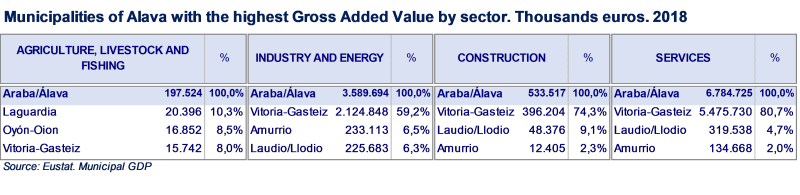
By activity sector, Vitoria-Gasteiz was observed to be the municipality that generated the highest GVA in practically all economic sectors. It accounted for 59.2% of the province’s Industry and Energy sector, 74.3% of Construction and 80.7% of Services.
Only Agriculture, Livestock and Fishing was much more evenly distributed across the province’s municipalities. In fact, the capital contributed 8.0% of the province’s agricultural activity. In this case, it was Laguardia that generated the most GVA in 2018 owing to its major wine sector, accounting for 10.3% of the agricultural sector in the province of Álava.
Services was the activity with the most weight in the province of Bizkaia
In the province of Bizkaia, Bilbao was the municipality that generated the most GVA in absolute terms, with a total of 10,865.1 million euros in 2018, 31.1% of all economic activity in Bizkaia. It was followed by the surrounding municipalities in the region of Gran Bilbao, principally Barakaldo with 2,170.5 million euros, Getxo (1,525.6 million), Zamudio (1,321.9 million), Leioa (1,304.3 million) and Basauri (1,159.1 million).
Source: Eustat. Municipal GDP
By sector, Services was the activity with the most weight in the province of Bizkaia. The municipalities of Gran Bilbao were generally those that contributed the most GVA for this type of activity. As already mentioned, Bilbao came out top, where services activities accounted for 38.1% of the province’s total added value. Barakaldo (7.1%) and Getxo (5.5%), were the two next biggest municipalities in this sector, respectively.
In the case of the Industry and Energy sector, activity was much more distributed throughout the province. Zamudio, with its Manufacturing Industry subsector, and Muskiz, with its Energy subsector, contributed 8.9% and 6.4% respectively to the industrial GVA of Bizkaia.
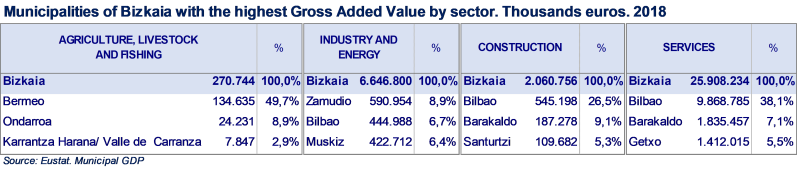
It is worth noting the part played by coastal towns in the case of the Agriculture, Livestock and Fishing sector in the province of Bizkaia, where GVA in this sector is more heavily reliant on fishing than on agriculture and livestock. In fact, the municipality of Bermeo alone accounted for 49.7% of all Agriculture, Livestock and Fishing activity in the province, followed by Ondarroa with 8.9%.
In Gipuzkoa, industrial activities were distributed throughout the territory and a large number of municipalities are worthy of note for their manufacturing activity
Lastly, in Gipuzkoa, as with the other two provinces, the highest volume of GVA was generated in its capital, San Sebastián, which accounted for 29.6% of economic activity in the province at 6,866 million euros.
Source: Eustat. Municipal GDP
Outside of the provincial capital, the municipality of Irun stands out, whose GVA in 2018 was equivalent to 7.3% of the total for the province, at 1,686.8 million euros. Behind it, the municipalities whose companies generated the most value added for Gipuzkoa were Arrasate/Mondragón, with 813.7 million euros, Hernani (799 million) and Beasain (782.2 million). The first municipality contributed 3.5% and the latter two 3.4% to the province’s GVA.
In terms of the sectoral distribution of GVA, Gipuzkoa had a structure more similar to that of Bizkaia than to Álava. Its capital, San Sebastián, generated the most GVA in the Construction (31.7%) and Services (40.1%) sectors. In the Agriculture, Livestock and Fishing sector, coastal municipalities closely associated with fishing were the most significant, such as Hondarribia, which accounted for 19.2% of activity in the sector, and Getaria (17.2%).
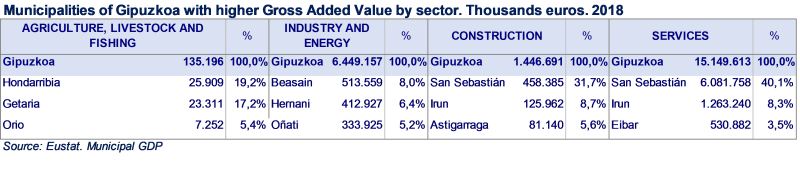
The distribution of Industry and Energy activities throughout the territory was much more diverse, as there were a large number of municipalities with activity principally in manufacturing which made up the industrial landscape of Gipuzkoa. Beasain contributed the most GVA in this sector (8.0%), followed by Hernani (6.4%) and Oñati (5.2%).
For further information:
Eustat - Euskal Estatistika Erakundea / Basque Statistics Institute
C/ Donostia-San Sebastián, 1 01010 Vitoria-Gasteiz
Press Service: servicioprensa@eustat.es Tel: 945 01 75 62