Press release 21/01/2021
Exports from the Basque Country increased for three months, as November was the month with the largest volume of exports in 2020
Compared to November 2019 exports declined by 11.6% and imports by 12.7%
In November 2020, exports from the Basque Country increased by 3.4% compared to October, which places November as the month with the largest volume of exports in 2020 to date, according to Eustat data. The Basque Country thus saw three months of positive month-on-month growth in exports: 53.1% in September compared to August, 2.2% in October and 3.4% in November.
Exports of goods from the Basque Country reached 2,068.5 million euros in November 2020, a decrease of 11.6% compared to November 2019. Imports, on the other hand, at 1,491.4 million, fell by 12.7% in year-on-year terms.
As a result, the Basque trade balance for this month was positive, at 577.1 million, only 53.5 million less than the balance recorded in November 2019.
As in previous months, the performance of energy products contributed to these year-on-year decreases to a large extent. Energy exports fell by 50.8% (74.9 million down on November 2019), while non-energy exports dropped 8.9%.
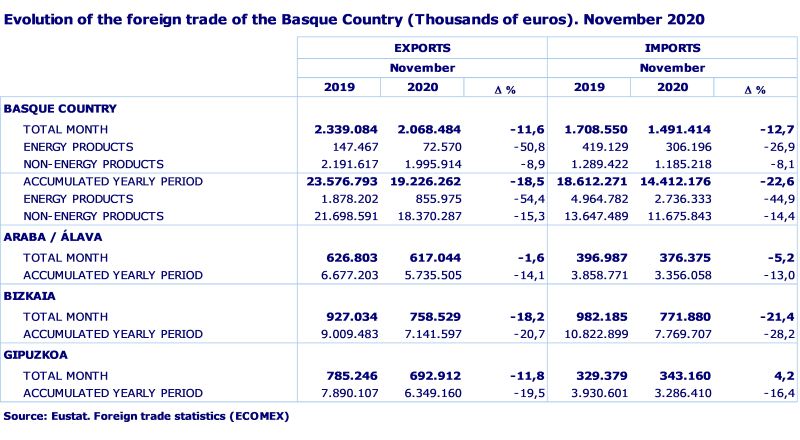
The direct nature of the relationship between imports and exports of energy products explains why energy imports were also down by 26.9% (112.9 million euros), while non-energy imports fell 8.1%.
At the provincial level, Bizkaia was the worst performer in terms of exports, with a drop of 18.2%, due to the downturn both in energy exports (-75.0 million, a 51.2% drop) and in non-energy exports (-93.4 million and down 12%).
Bizkaia’s decline in energy exports was mostly concentrated in products such as “Fuel”, “Naphthalene”, “Lubricating oils” and “Low-octane petrols”. Among non-energy products, exports of “Metals and Manufactured” decreased by 28.5% and “Electrical Material” by 13.6%. On the positive side, exports of “Transport Material” were up 36.6% compared to the same month of the previous year.
Gipuzkoa fell by 11.8%, mostly due to the downturn in “Transport Material” and “Electrical Material”. The former saw an 85.7 million, or 32.8%, reduction in exports, while the latter fell by 27 million, a decrease of 10.3%. On the other hand, exports of “Metals and Manufactured” were up 11.6%, 14.4 million.
Álava is the province with the least negative performance, as its goods exports fell by a moderate 1.6%. The groups related to “Transport Material”, unlike the larger groups in terms of volume for this province, fell by 0.7%, while “Metals and Manufactured” and “Plastics and Rubber” dropped by 11.7% and 2.7%, respectively.
In November, five countries were the main customers of the Basque Country which, with 1,094.1 million, absorbed more than half (52.9%) of total exports. By order of importance, they were Germany, France, United Kingdom, Belgium and the United States. Three of these belong to the EU27, an entity that accounts for 65.7% of exports. This percentage would have been 73.1% for the former EU28.
Exports to Germany grew by 16.4%, to France by 3.5% and by 12.7% to the Netherlands. On the other hand, exports to the other main European countries posted negative year-on-year figures of varying intensity: exports to the United Kingdom were down 39.6%, those to Belgium dropped by 46.2%, Italy 2.6% and Portugal 1.1%.
This month sales to the United States decreased in year-on-year terms by 26.4%, along with those to China (�24.2%) and Mexico (-14.9%).
Meanwhile, over half – 56.9% – of all imports came from the EU27 and would have reached 59.6% for the erstwhile EU28. In terms of positive growth, the standout European countries included Italy, with an increase of 41.8%, followed by France with 6.1% and Portugal with 3.5%. At the opposite end of the scale were Ireland (-39.6%) and Germany (-7.6%). For the rest of the world, imports from China were up 11.8% and imports from Mexico (-26.4%) and the United States (-66.9%) were down.
Products traded in November 2020
A more detailed look reveals that in November the ten main export duty groups accounted for 41.1% of exports, with a combined value of 850.6 million euros.
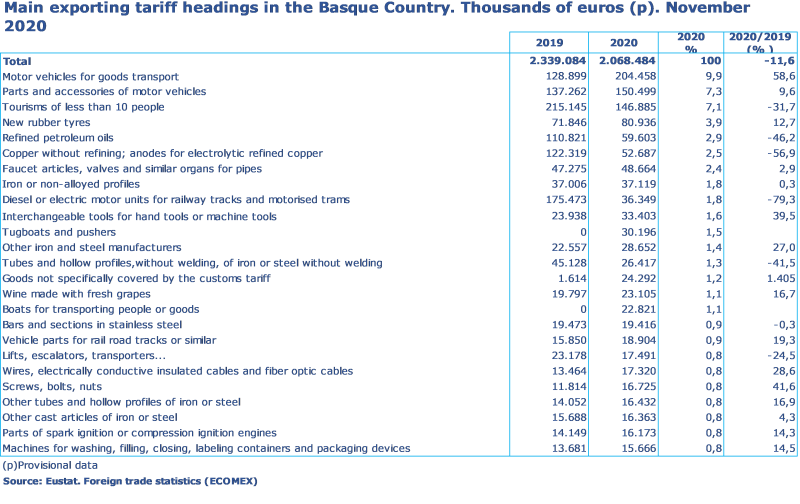
The following groups stood out, having recorded increases of varying magnitude compared to the same period in 2019: “Goods Transport Vehicles” (up 58.6% and 75.6 million on November 2019) and “Vehicle Parts and Accessories” (up 9.6% and 13.2 million). Conversely, sharp decreases occurred in “Diesel and Electric Motor Units for Railway Tracks and Motorised Trams” (-79.3% and down 139.1 million euros) and in “Passenger Cars with Fewer than 10 Seats” (-31.7% with 68.3 million euros).
In November, five of the ten main exported products were included in groups in the vehicle sector which, with a total volume of 619.2 million, accounted for 29.9% of total exports, down 15% on 2019.
We can see that the import with the largest volume, “Petroleum oils or oils obtained from bituminous minerals”, accounting for 13.6% in November 2020, fell by 25.8% compared to the same month of the previous year. This pattern was also observed in 12 of the 25 largest customs duty groups.
Also of significance were the decreases in “Petroleum gas and other hydrocarbon gases” (-74.1%), “Compression-ignition internal combustion engines, diesel or semi-diesel” (-24.4%) and “Vehicle Parts and Accessories” (-10.2%).
Conversely, notable increases were posted in “Refined Petroleum Oils” which, with an increase of 38.2%, was the second most imported product this month, and in “Soya Beans, Whether or Not Broken”, with a 45.2% increase, placing it fifth in the import rankings.
BALANCE FOR THE FIRST ELEVEN MONTHS OF 2020
Up to November 2020, the Basque Country recorded a positive balance of 4,814.1 million euros in terms of foreign trade in goods
During the first eleven months of the year, the Basque Country’s exports fell by 18.5% compared to the same period in 2019. This translates into a decrease of 4,350.5 million euros. The total amount of exports in this period was 19,226.3 billion, equivalent to a trade balance of 4,814.1 million euros. This figure is 150.4 million down on the equivalent for the same period in 2019, and represents a coverage rate of 133.4%.
At the provincial level, Bizkaia recorded exports worth 7,141.6 million euros, followed by Gipuzkoa with 6,349.2 million and Álava with 5,735.5 million for this period.
Compared to the equivalent period for 2019, we observe considerable decreases in all three provinces. In first place was Bizkaia, with a decrease of 20.7% (down 1,867.9 million), followed by Gipuzkoa, with 19.5% (�1,540.9 million) and Álava, where it fell 14.1% (-941.7 million). In the case of Bizkaia, the percentage would fall to 11.9% if we excluded energy products. Excluding these products would not change the percentages for the other two provinces.
The ranking for these eleven months of 2020 placed Germany as the prime recipient of Basque exports, accounting for 17.7% (3,407.1 million euros) of total exports. After Germany came France (15.6% and 2,990.1 million), the United Kingdom (6.5% and 1,257.4 million), the United States (6.4% and 1,231.2 million) and Italy (5.2% and 997.8 million). Between them, these five countries accounted for just over half of Basque exports for this period (51.4%).
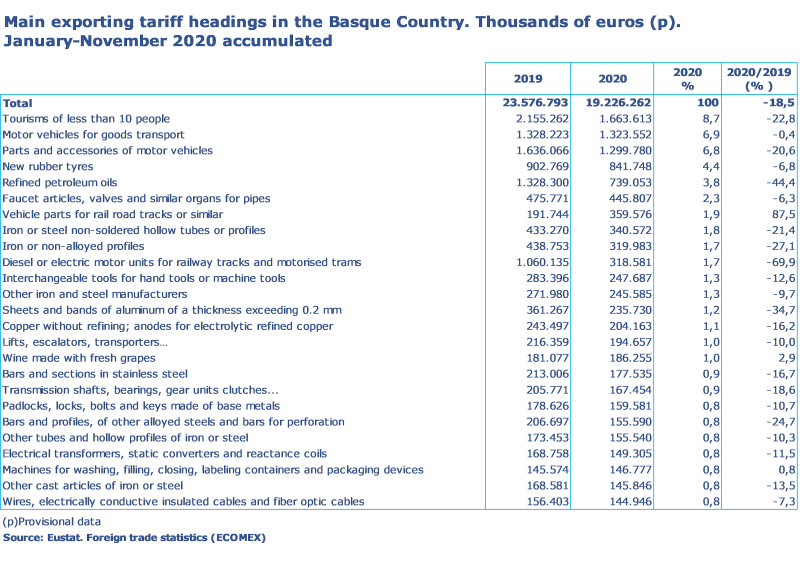
Of the 25 top export duty groups, only three were down. Of particular note is that of “Railway or Tramway Vehicle Parts”, in which exports were up by 167.8 million, or 87.5%. It thus accounted for 1.9% of total exports in the period from January to November 2019. The other two groups were “Wine made with fresh grapes”, up 2.9% and 5.2 million, and “Machines for washing, filling, sealing and labelling containers and packing machinery”, which increased by 0.8% and 1.2 million.
Furthermore, only the ten most exported products (customs duty groups) during the first eleven months of 2020 accounted for 39.8% of all exports, reaching a total of 7,652.3 million euros.
All of the other groups recorded lower figures than the equivalent period for 2019. Six of these posted downturns in excess of 100 million. “Passenger Cars with Fewer than 10 Seats” fell by 22.8% (down 491.6 million euros), “Vehicle Parts and Accessories” fell by 20.6% (down 336.3 million euros) and “Diesel and Electric Motor Units for Railway Tracks and Motorised Trams” fell by 69.9% (down 741.6 million euros). To these five groups related to the vehicle sector we can add products from “Refined Petroleum Oils”, of which imports were down 589.2 million (44.4%).
Cumulative imports for the Basque Country as a whole during the period analysed amounted to 14,412.2 million euros. The year-on-year comparison of this figure revealed that it is 4,200.1 million euros down on the equivalent for the same period in 2019.
This decrease of -22.6% is largely due to the fact that in this period the province of Bizkaia (with cumulative imports of 7,769.7 million euros) registered a downturn of 28.2%, that is, 3,053.2 million euros down on the same period of the previous year. Imports also fell in Gipuzkoa (-16.4%, down 644.2 million) as did those in Álava (-13.0%, down 502.7 million). The value of imports in these two provinces stood at 3,286.4 and 3,356.1 million euros, respectively.
The 44.9% drop in imports of “Energy Products” was most acute in Bizkaia, which imported almost 98.9% of the total. In turn, imports of “Non-energy Products” were down 14.4%.
Foreign trade in goods in the Basque Country during 2020 so far had a positive balance of 4,814.1 million euros. Although this is 150.4 million down on that registered during the same period of the previous year, it enables a positive coverage rate of 133.4% to be maintained.
For further information:
Eustat - Euskal Estatistika Erakundea / Basque Statistics Institute
C/ Donostia-San Sebastián, 1 01010 Vitoria-Gasteiz
Press service: servicioprensa@eustat.es Tel: 945 01 75 62