Press Release 23/06/2020
MUNICIPAL ACTIVITY STATISTICS. 01/01/2019
The improvement in the labour market extended to practically all regions of the Basque Country as at 1 January 2019
In 18 of the 20 regions the employment rate increased and in 19 the unemployment rate fell
The snapshot of the labour market on 1 January 2019 reflected an improvement in the labour market that extended across practically all the Basque Country, according to Eustat data.
Specifically, at a regional level, there was a generalised increase in the employment rate compared to 2018. The regions with the highest growth were Montaña Alavesa (+1.4 points), Valles Alaveses (+0.9 points) and Urola-Costa and Tolosa (+0.8 points). Estribaciones del Gorbea, with a decrease of 1 percentage point, bucked this positive trend, passing from 58.3% to 57.3%, although it remained the region with the highest employment rate in the Basque Country. Neither was there any improvement in Markina-Ondarroa, whose employment rate remained stable at 47.5%.
At a municipal level, the employment rate in 160 of the 251 municipalities increased in relation to the previous year. This increase was higher than the average in municipalities such as Gaintza (+5.4 points), Altzo (+5.1 points), Albiztur and Zambrana (+4.5 points), Moreda de Álava and Mañaria (+4.4 points) and Elvillar/Bilar (+4.3 percentage points), all municipalities with fewer than 1,000 inhabitants. Among the municipalities with 10,000 to 40,000 inhabitants the evolution was relatively homogenous; of particular note were Pasaia, Sestao, Tolosa and Lasarte-Oria, which registered a positive variation of around one percentage point in their employment rate.
All municipalities with 40,000 to 100,000 inhabitants also performed positively, with slight growth ranging from 0.1 percentage points in Getxo to 0.8 percentage points in Barakaldo.
With regards to the capitals, the employment rate increased in all three: by 0.7 points in Bilbao; by 0.4 points in San Sebastián; and by 0.3 points in Vitoria-Gasteiz.
On the other hand, 23 municipalities had an employment rate above 60%. It should be mentioned that all of them pertain to the stratum of fewer than 10,000 inhabitants, except Etxebarri; the top positions correspond to Astigarraga (67.6%), Aduna (65.3%), Baliarrain (65.1%) and Irura (65%). However, the municipalities with the lowest employment rate also appear in this stratum, including Elantxobe (36.9%), Lagrán and Lanestosa, both with a rate of 38.9%.
Among the larger municipalities, only Errenteria, with a rate of 51.3%, exceeded the Basque Country average. Others, such as Irun, Barakaldo, Getxo, Santurtzi, Basauri and Portugalete had employment rates ranging from 45.5% in the latter to 49.9% in the former. The employment rate in Bilbao stood at 47.4%, below the 50.6% of the whole; the employment rate was 50.8% in San Sebastián and 52.3% in Vitoria-Gasteiz.
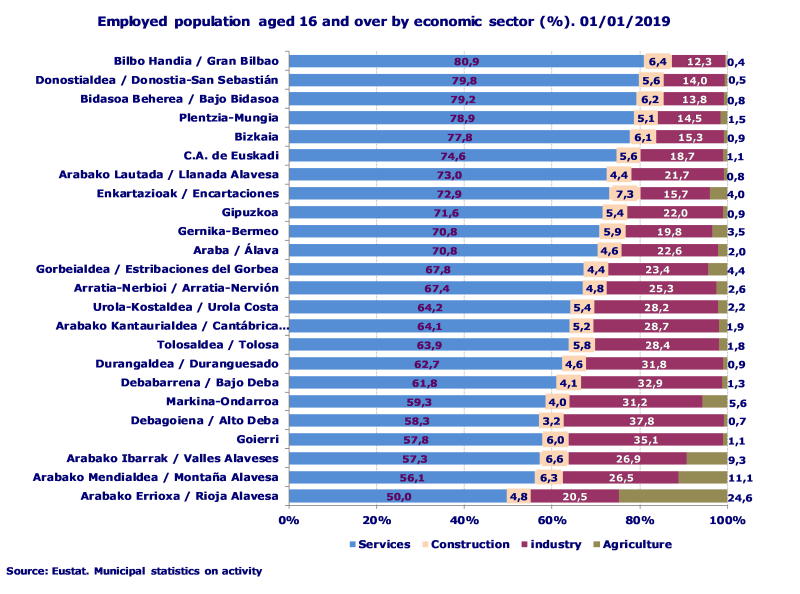
The regions of Alto Deba and Goierri stood out for their industrial specialisation, of note in the agricultural sector was Rioja Alavesa and in the Services sector were Gran Bilbao and Donostia-San Sebastián
The majority of the municipalities with high proportions of employment in the agricultural sector were in Álava, particularly Baños de Ebro/Mañueta, Navaridas and Yécora/Iekora, where six out of ten employed people work in this sector. In turn, there is high industrial employment in some municipalities in Gipuzkoa, such as Oñati (46.5%), Antzuola (43.2%) and Eskoriatza (42.5%), whereas in the municipalities of Getxo, Plentzia, Bilbao, Gorliz, Berango and Sopela in Bizkaia, eight out of ten people work in the services sector; finally, in terms of employment in the construction sector, mention can be made of municipalities such as Gaztelu (19.4%) and Beizama (16.3%).
By regions, it is worth highlighting the industrial specialisation of Alto Deba (37.8%) and Goierri (35.1%) and the agricultural specialisation of Rioja Alavesa (24.6%), whereas the services sector is more prominent in Gran Bilbao (80.9%) and Donostia-San Sebastián (79.8%).
In turn, the unemployment rate fell in practically all the regions, with variations ranging from 2 percentage points in Montaña Alavesa to 0.1 points in Markina-Ondarroa and Alto Deba. In contrast, in the region of Estribaciones del Gorbea this rate increased by 0.7 percentage points, although with 7% this region, together with Moñtaña Alavesa, once again had the lowest unemployment rate in the whole Basque Country.
At a municipal level, as was the case with employment, the lowest unemployment rates corresponded to the smallest municipalities. However, the greatest decrease in the period corresponded to municipalities with a larger population. There was a fall of 1.2 percentage points in the stratum of municipalities with 40,000 to 100,000 inhabitants; standing out were Barakaldo (-1.7 points), Santurtzi and Irun (both -1.2 points). In the capitals, which as a whole account for 35.6% of the population aged 16 and over in the Basque Country, the unemployment rate fell in relation to 2018: it was down 1.4 percentage points in Bilbao; 1 point in Donostia / San Sebastián; and 0.7 points in Vitoria-Gasteiz.
The gender gap in the unemployment rate reduced by two tenths in respect of the previous year, passing from 2.6 to 2.4 points at 1 January 2019
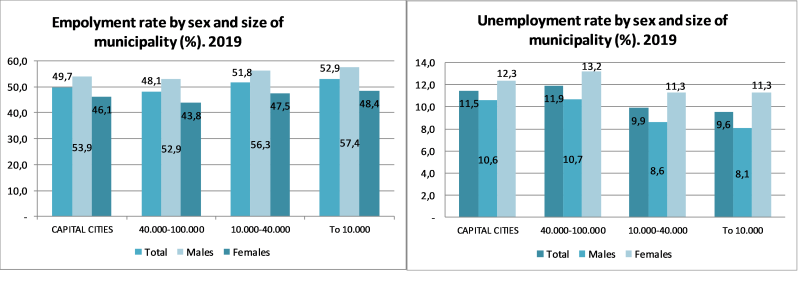
In 2019 the unemployment rate for women was 12% compared to 9.6% for men. The difference in the unemployment rate according to sex appears to be linked to the size of the municipality of residence. Thus, in the municipalities with fewer than 10,000 inhabitants the unemployment rate for women (11.3%) was 3.2 points higher than that of men (8.1%). The difference between both reduced to 2.7 points in municipalities with between 10,000 and 40,000 inhabitants and to 2.5 points in the following stratum, with between 40,000 and 100,000 inhabitants. Finally, the difference reduced in those with more than 100,000 inhabitants, which only includes the capitals, standing at 1.7 points more for women; in this final stratum, the unemployment rate was 10.6% for men and 12.3% for women.
Source: Eustat. Municipal statistics on activity
In 2019 the unemployment rate for women was 46.5% compared to 55% for men, 8.5 points more. The greatest differences between men and women were found in municipalities with 40,000 to 100,000 inhabitants, 9.1 points in favour of the former, whereas the smallest corresponded to the capitals, where the level of employment of men (53.9%) was 7.8 points higher than that of women (46.1%).
For further information:
Eustat - Euskal Estatistika Erakundea / Basque Statistics Institute
C/ Donostia-San Sebastián, 1 01010 Vitoria-Gasteiz
Press service: servicioprensa@eustat.es Tel: 945 01 75 62