Press Release 30/06/2020
FOREIGN TRADE UNIT VALUE INDICES. I/2020
The rate of export prices fell by 1.5% in the first quarter of 2020 compared to the previous quarter
The prices of imports were also down 1.4%
During the first quarter of 2020 the prices of exports posted a decrease of 1.5% compared to the last quarter of 2019, according to Eustat data. In comparison with the same quarter of the previous year, the increase was 0.2%.
The prices of imports also followed this trend, falling 1.4% compared to the previous quarter but rising 3.3% with respect to the first quarter of 2019.
Within exports, it was the prices of energy products that set the performance trend, both in relation to the previous quarter and in year-on-year terms. Energy export prices fell by 7.6% compared with the fourth quarter of 2019, whilst non-energy export prices were down 1.0%. Compared to the same quarter of the previous year, prices for energy products fell again by 7.6% and those for non-energy products rose by 0.8%.
The price index for imports of energy products grew by 0.9% in its quarter-on-quarter rate, and that of non-energy products fell by 2.1%. In the year-on-year comparison, energy products saw price rises of 8.8%, and the prices of non-energy products increased by 1.8%.
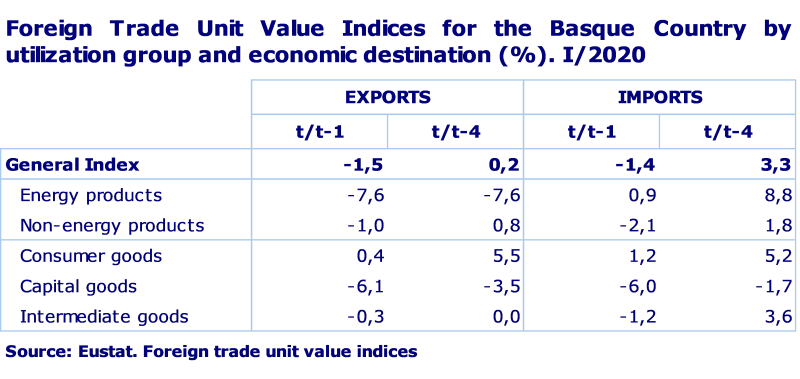
Following the classification of goods by economic destination, of note was the increase in the prices of exports of Consumer Goods (0.4%), and the decreases in those of Intermediate Goods (-0.3%) and, above all, Capital Goods (-6.1%), all compared to the previous quarter. In year-on-year terms, there was also confirmation of growth in prices for Consumer Goods (5.5%), whereas those for Intermediate Goods remained constant (0.0%), and prices for Capital Goods were down (-3.5%).
Analysing imports, it can be observed that the prices of Consumer Goods rose in both quarter-on-quarter (1.2%) and year-on-year (5.2%) terms; the opposite was true in the case of Capital Goods, with downturns of 6.0% and 1.7%, respectively. The prices of Intermediate Goods saw positive and negative variations, down in the quarter-on-quarter comparison (-1.2%), but up with respect to the previous year (3.6%).
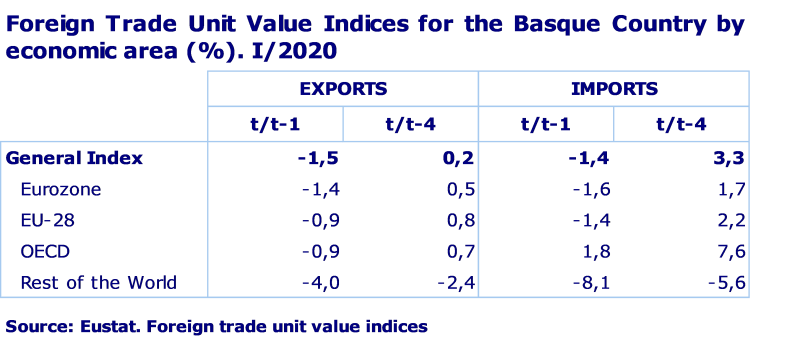
If the geographic areas to which exports are sent are taken into account, it can be seen that prices in relation to the fourth quarter of 2019 fell in all areas: Euro Zone (-1.4%), EU-28 (-0.9%), OECD (-0.9%) and Rest of the World (-4.0%). Compared to the same quarter of the previous year, there were increases in prices for almost all the economic areas with the exception of the Rest of the World, where they experienced a drop of 2.4%.
In the case of imports, attention should be drawn to the behaviour for the Rest of the World, with notable downturns both compared to the previous quarter (-8.1%) and in year-on-year terms (-5.6%). Conversely, the OECD positioned itself with a quarter-on-quarter rise of 1.8% and an increase of 7.6% in its prices, if we compare them to those of the first quarter of 2019.
For further information:
Eustat - Euskal Estatistika Erakundea / Basque Statistics Institute
C/ Donostia-San Sebastián, 1 01010 Vitoria-Gasteiz
Press Service: servicioprensa@eustat.es Tel: 945 01 75 62