Press release 09/06/2020
MUNICIPAL HOUSING STATISTICS 2019
On 1 January 2019 the number of dwellings in the Basque Country had increased by 5,920 units in respect of 2018
28.8% of dwellings were occupied by one person and almost 3 out of 5 (58.6%) were inhabited by one or two people
The annual increase in the housing stock in the Basque Country between 1 January 2018 and 1 January 2019 was 5,920 units, exceeding the levels registered in the last five-year period, close to 5,000 dwellings, but a long way from the almost 8,000 registered in the 2006 to 2011 five-year period and even further from the 20,000 in the 2001 to 2006 five-year period, according to Eustat data.
The housing stock in the Basque Country comprised 1,060,530 dwellings on 01 January 2019, 5,920 more dwellings than in 2018. 549,015 dwellings, 51.8% of the total, were located in Bizkaia; Gipuzkoa, with 345,632, represented 32.6%; whilst the remaining 15.6%, 165,883 dwellings, corresponded to Álava.
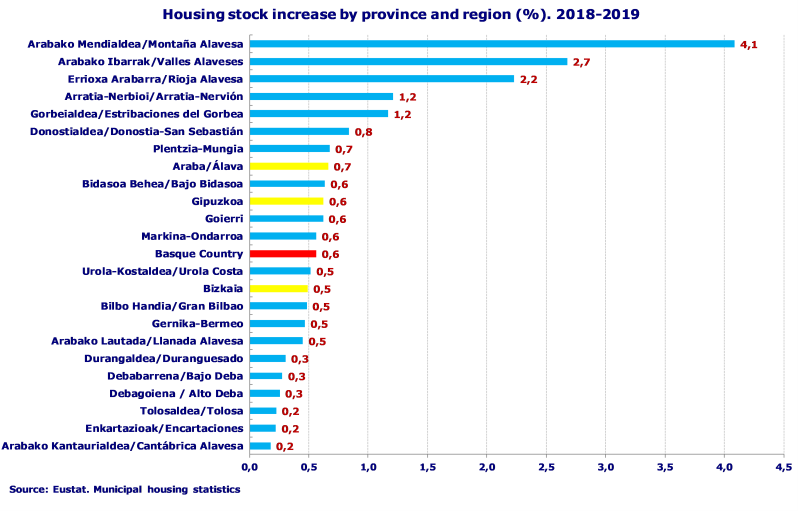
The 5,920 additional dwellings represented a relative increase of 0.6% in the housing stock, which comprises both family dwellings and collective establishments. There are some differences observed by province; thus, the highest increase corresponds to Álava with 0.7%, followed by Gipuzkoa with 0.6% and Bizkaia with 0.5%.
In the regional sphere, all the regions offered increased housing stock, and the following regions stood out for having growth above the Basque Country average (0.6%): Montaña Alavesa (4.1%), Valles Alaveses (2.7%), Rioja Alavesa (2.2%) and Estribaciones del Gorbea (1.2%), all in Álava, together with Arratia-Nervion (1.2%). At the opposite extreme, with growth below the average, were the regions of Tolosa, Encartaciones and Cantábrica Alavesa (0.2%) Duranguesado, Bajo Deba and Alto Deba (0.3%).
85% of family dwellings were used for habitual residence
From the point of view of use, 85.2% of the family housing stock was used for habitual residence (the primary family dwelling), 0.6 percentage points more than in 2018, whereas the number of second homes and empty dwellings increased by 0.2 points.
If the figures for primary homes are compared with those from the previous year, there are 5,560 more units, divided unequally between the provinces: the largest increase corresponded to Bizkaia, where the number of occupied dwellings increased by 3,076, compared to 1,671 more in Gipuzkoa and 813 in Álava.
At a more detailed provincial level, the municipalities where the stock of primary dwellings increased the most were Bilbao with 811 units; Vitoria-Gasteiz with 670; Donostia/San Sebastián with 415; and Barakaldo with 402 more dwellings. These municipalities correspond to those with the largest population size.
28.8% of primary dwellings in the Basque Country were inhabited by one person and 58.6% were inhabited by one or two people
In the Basque Country in 2019 the number of dwellings inhabited by one or two people were up 6,800 compared to the previous year, standing at 529,478 in January 2019. The highest growth corresponded to those with only one inhabitant, which increased by 5,214 dwellings, standing at 260,013, 28.8% of the total stock of primary dwellings. There was also an increase in dwellings with 5 to 9 inhabitants (974 units) and, to a lesser degree, in those with 10 or more inhabitants (76 dwellings more). By contrast, the number of dwellings inhabited by 3 or 4 people fell by 2,290.
This increase in dwellings with fewer inhabitants, 1 or 2, occurred across all regions and, in some cases, was even more pronounced. Of particular note were the regions of Valles Alaveses (+6%), Estribaciones del Gorbea (+5.8%) and Plentzia-Mungia (+5.5%), with increases well above the average (2.6%). In contrast, it should be emphasised that, out of the twenty regions in the Basque Country, only five saw a slight increase in the number of dwellings with 3 or 4 inhabitants. Gernika-Bermeo was the only region where the increase in this type of inhabitation (2.2%) was higher than the growth in the number of dwellings inhabited by 1 or 2 people (0.9%).
The average family dwelling had a usable floor space of 87.2 m2
The average usable floor space for the Basque Country as a whole was 87.2 m2. Álava had the largest family dwellings (92.3 m2), followed by Gipuzkoa with 86.9 m2 and Bizkaia with 85.8 m2.
The average age of the family housing stock in the Basque Country was 45.4. At provincial level, the most modern housing stock corresponded to Álava with 38.8 years, followed by Gipuzkoa with an average age of 45.9, whereas Bizkaia, with 47, is the province with the oldest housing stock.
In terms of the number of rooms, three quarters of Basque family dwellings had 4 or 5 rooms (including bedrooms, living room and kitchen) and, on average, 1.4 bathrooms.
More than 70% of buildings had a lift, almost six percentage points more than in 2010
With regards to housing equipment, in 2019, 81.8% of dwellings were in buildings with piped gas, 1.1 percentage points more than in 2018, a proportion that on a provincial level varied from 85.6% in Gipuzkoa to 83.4% in Álava and 79.1% in Bizkaia.
In turn, two out of three family dwellings were in a building that had a lift installed (70.1%), which represented 1.2 percentage points more than in 2010 and almost six points more (5.8) than in 2010.
On the other hand, 62.6% of dwellings were in buildings with more than ten dwellings, including 7.6% in buildings with more than forty. In contrast, one out of ten dwellings, 10.6%, was single-family or two-family; in Álava this latter percentage rose to 17.1%, whereas it was 9.4% in Gipuzkoa and 9.3% in Bizkaia.
As regards installations within the dwellings themselves, 55.1% had gas installed in the home, above all in Gipuzkoa (61%) and Álava (58.6%), while in Bizkaia this figure was 50.4%.
For further information:
Eustat - Euskal Estatistika Erakundea / Basque Statistics Institute
C/ Donostia-San Sebastián, 1 01010 Vitoria-Gasteiz
Press Service: servicioprensa@eustat.eus Tel: 945 01 75 62