Press Release 26/07/2018
DEATH STATISTICS. 2017
The average age of people who died was 80.4, years of age, almost four years more than ten years ago
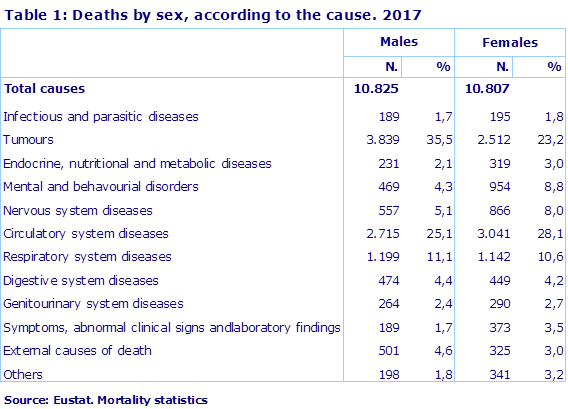
The number of deaths in the Basque Country was 21,632 in 2017, an increase of 1.9% compared to 2016, according to Eustat data. There were 10,825 male deaths and 10,807 female deaths. Broken down by month, January was the month with the highest number of deaths (2,706), whilst July registered the lowest number (1,515).
In 2017, 345 people over the age of 100 died, of which 87.2% were women. The number of deaths amongst centenarians has gradually increased in recent years, until reaching its maximum in 2017 (345 people), one more than the figure for 2015.
The average age of women who died was 83.6, whilst the average age of men was 77.2
The average age of people who died in 2017 was 80.4 years of age, whereas ten years before, in 2007, the figure stood at 76.8, meaning that the average age has risen by 3.6 years over the course of the last ten years.
The average age at death amongst men in 2017 was 77.2 years of age, whilst the average age amongst women stood at 83.6. In 2007, the average ages were 73.1 and 80.9, respectively. Thus, over the course of the last 10 years, the average age at death of men has increased by 4.1 years, and that of women by 2.7 years.
Population growth was negative, as there were 4,556 fewer births than deaths. By territory, negative balances were registered in Bizkaia and Gipuzkoa, where the population fell by 3,291 and 1,413, respectively. By contrast, in Álava, the number of deaths was lower than the number of births, thereby producing a positive balance by 148 people.
As regards child mortality, there were 41 deaths of children under one year of age in the Basque Country. Mortality amongst newborns, occurring within the first 28 days of life, registered 24 deaths, 5 of which were during the first 24 hours and another 15 in the first week. Within deaths amongst children below the age of 1, girls accounted for 39% of the total.
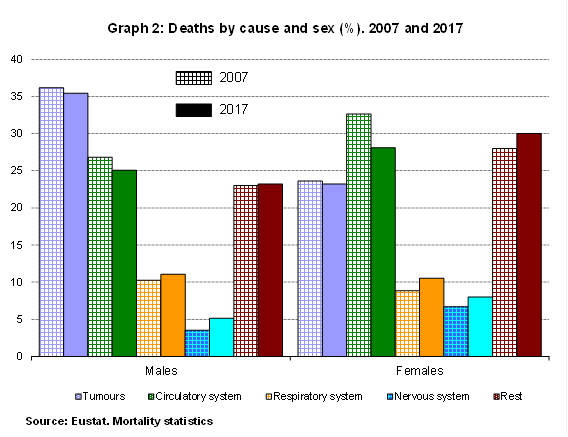
56% of deaths were the result of tumours and diseases of the circulatory system
29.4% of the deaths that occurred in 2017 (6,351 deaths) were the result of tumours, followed by deaths resulting from diseases of the circulatory system, which accounted for 26.6% of the total (5,756 deaths) and, in third place, some way behind, were deaths resulting from respiratory diseases, which accounted for 10.8% of the total (2,341 deaths), followed by those of the nervous system with 6.6% (1,423). The prevalence of these four groups of illnesses that were responsible for the highest number of deaths has varied over the course of the last decade: whilst deaths resulting from cardiovascular diseases have increased by only 0.8%, those resulting from tumours have risen by 9.3%, from respiratory diseases by 26.3%, and diseases of the nervous system by 45.8%, most notably Alzheimer´s which accounted for 571 deaths.
The cause of death continued to vary according to sex: amongst men, tumours caused more deaths than diseases of the circulatory system, whilst amongst women the main cause of death was cardiovascular disease, followed by tumours.
Furthermore, the cause of death varied in accordance with age. Amongst those aged under one, the most frequent causes of death were illnesses originating in the perinatal period and congenital malformations; amongst those aged from 1 to 39, the majority of deaths were attributable to tumours and external causes, including accidents and suicides; amongst those aged between 40 and 79, tumours were the highest cause of death, whilst amongst those aged 80 years or over, it was diseases of the circulatory system.
For further information:
Eustat - Euskal Estatistika Erakundea / Basque Statistics Institute
C/ Donostia-San Sebastián, 1 01010 Vitoria-Gasteiz
Press Service: servicioprensa@eustat.es Tel: 945 01 75 62