Press Release 18/04/2018
In 2016 Industrial Value Added grew 4.5% and employment 1.9% in the Basque Country
44.5% of sales in the manufacturing industry were made abroad
The Gross Value Added at factor costs of Industry in the Basque Country grew by 4.5% in 2016, whilst the number of people employed rose to 198,141, 1.9% more than the previous year, according to Eustat data. This increase in employment confirmed the change in the trend registered in 2015, being the second year with employment growth since 2008.
As a result of these two performances, the productivity of Basque industry, measured as value added per person in work, was €71,437 in 2016, 2.6% up on the previous year.
Another variable that performed positively was investment, which grew for the second consecutive year, specifically by 8.3% in 2016.
However, the net turnover figure, registered a nominal decrease of 2.4% in 2016, which was mitigated by a greater fall in expenditure on supplies (-4.4%) and external services (-3.8%), which boosted value added growth.
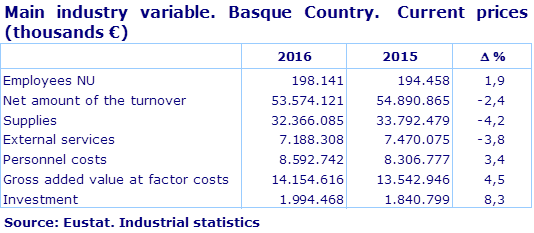
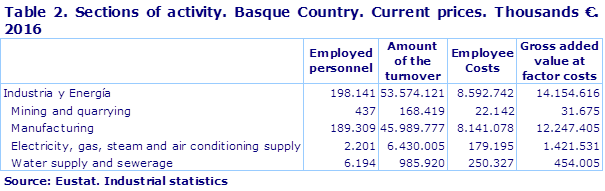
Within Industry, manufacturing, accounting for 95.5% of the number of people employed, 85.8% of turnover and 86.5% of the total value added, registered a positive performance in 2016, with growth of 1.9% in the number of people employed and 4.4% in value added, although turnover fell by 0.5%.
On a sectoral basis, due to its weight in the Basque industrial sector, the upward trend in the Transport Material branch, is particularly notable, with growth well above the average in employment (8.1%), sales (21.9%) and value added (9.4%). The branches of Machinery and Equipment and Metallurgy & Metal Products, also performed positively, with increases in the number of people employed of 3.1% and 1.3%, respectively, as well as in value added; up 3% for the branch of Machinery and Equipment and 5.9% for Metallurgy & Metal Products.
In relation to turnover, the branches that recorded the biggest decreases were Coke Plants & Oil Refining (-15.2%), Metallurgy & Metal Products (-4.1%) and Rubber & Plastics (-2.2%). The latter, however, registered an increase in value added (0.2%) and no change was observed in the number of people employed. Regarding the branch of Coke Plants & Oil Refining, value added was up by 11.8%, although the number of people employed fell by 2.7%.
Basque manufacturing industry companies maintained their strategy of openness towards foreign markets. Foreign exports accounted for 44.5% of manufacturing industry sales in 2016, 0.6 percentage points more than in 2015 and 11.5 points more than at the start of the crisis, in 2008. Out of the total sales, 28.7% was to the European Union while 15.8% was to the Rest of the World.
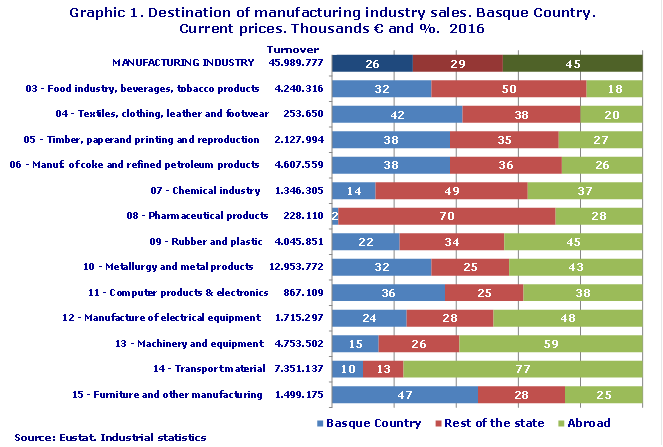
Sales to the Rest of Spain saw hardly any change, 0.1 percentage points more than in 2015, but its weight has dropped by 7.6 percentage points since 2008, accounting for 29.1% of total sales in 2016. Finally, the internal market (the Basque Country) took 26.4% of the total sold, 0.6 points less than in 2015.
On a sectoral basis, Transport Material increased the percentage of foreign sales even more, reaching 77.2% in 2016. The branch of Machinery and Equipment also stood out, with 58.8% destined to exports in 2016. Another branch with noteworthy performance is Electrical Material & Equipment, with a 2.7 percentage point increase in the percentage of foreign sales, reaching 48.3% in 2016.
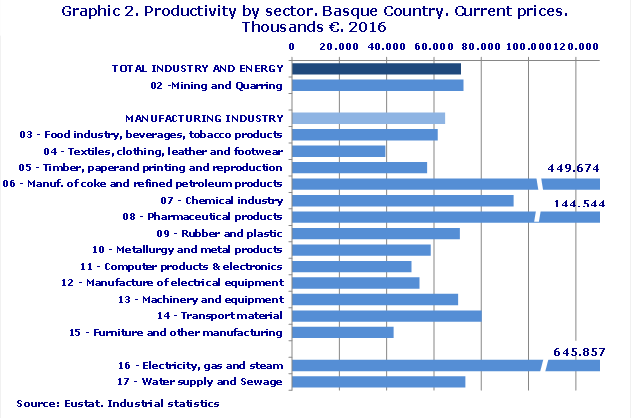
In terms of productivity, and excluding the Electricity, Gas & Steam (646 thousand euros per person) and Coke Plants & Oil Refining sectors (450 thousand euros per person), the branches with the most Productivity within Industry and Energy in 2016 were Pharmaceutical Products, with 145 thousand euros per person, and Chemical Industry, with 94 thousand euros per person. At the other end of the scale are the Textile, Garments, Leather & Footwear (39 thousand euros) and Furniture & Other Manufacturing Industries sectors (43 thousand euros). The average turnover for the Manufacturing Industry stood at 64,695 euros, 2.5% up on 2015, with the figure standing at 71,437 euros for Industry and Energy as a whole, 2.6% up on the previous year.
By province, turnover increases were heterogeneous, with Álava seeing growth of 5.5%, whereas Bizkaia and Gipuzkoa saw a drop of 5.6% and 3.4%, respectively. In terms of the performance in employment, all three provinces experienced upwards trends, with employment in Álava and Bizkaia rising by 2.9% and 2.3%, respectively, whereas in Gipuzkoa it was up by 1%. Value Added also showed a similar increase in all three territories: 4.9% in Bizkaia, 4.6% in Gipuzkoa, and 3.7% in Álava.
For further information:
Eustat - Euskal Estatistika Erakundea / Instituto Vasco de Estadística
C/ Donostia-San Sebastián, 1 01010 Vitoria-Gasteiz
Press Service: servicioprensa@eustat.es Tel: 945 01 75 62