Press Release 15/12/2017
The number of agricultural holdings in the Basque Country fell by 1.7 % between 2013 and 2016
The percentage of women owners and heads of holdings increased by 5.1%, standing at 35.5% of the total
The number of agricultural holdings dropped by 1.7% in the period between 2013 and 2016, according to data prepared by EUSTAT. The total area also fell by 4.1% and the utilised agricultural area (cultivated land and land used as permanent pastures) fell by 5.8%. Consequently, the ratio of utilised agricultural area to total area came to 70.8% in 2016, 1.8% less than in 2013.
The average area per holding decreased by 2.4% to reach 16.0 hectares per holding, a trend also seen in the average utilised agricultural area, or UAA per holding, which went from 11.8 to 11.4 hectares.
In Spain as a whole the number of holdings also fell (-2.1%), with a lower drop occurring in the total area and the utilised agricultural area (-0.1% and -0.3% respectively). The average size of the holdings is noticeably greater, and they are continuing to grow, going from 31.7 hectares (ha) in 2013 to 32.2 ha in 2016.
The fall in the utilised agricultural area (UAA) across the Basque Country overall is mainly due to the fall in permanent pastures (-8.3%) and to a lesser degree in cultivated land (-2.3%), particularly herbaceous and fallow land and orchards, down 2.3% and 5.4% respectively.
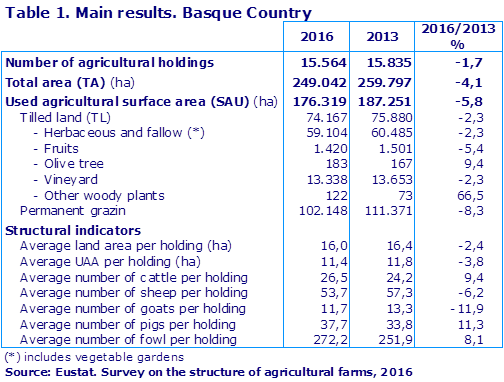
The average size of holdings increased in Gipuzkoa, whereas it fell in Bizkaia and Álava
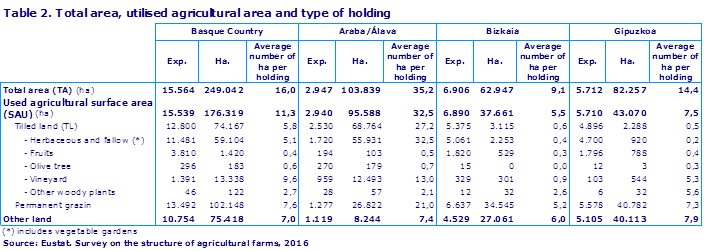
The evolution by province was not homogeneous. In Gipuzkoa there was a rise in the total area (3.7%), however, the number of holdings decreased by 2.1%, with the average size of holdings in 2016 being 14.4 ha, 6.0% higher than in 2013. In Bizkaia the opposite occurred, the total area shrank by 0.3% and the number of holdings grew by 2.6%. As a result agricultural holdings in Bizkaia reduced to 9.1 ha per holding, being the smallest in the Autonomous Region. In Álava there was a decrease in both the total area (-11.5%) and the number of holdings (-9.8%), with the result that the average number of hectares per holding stood at 35.2 ha, 2% less than in 2013.
The utilised agricultural area (UAA) fell in the three provinces, by 7.2% in Álava, 5.7% in Bizkaia and 2.9% in Gipuzkoa. This was mainly caused by the drops in permanent pastures.
Permanent pastures accounted for 57.9% of the total UAA in the Basque Country in 2016. Herbaceous and fallow crops made up 33.5% of the total and vines 7.6%. Orchards, olive groves and other woody crops accounted for the remaining 1%.
By province, two different models can be identified. On the one hand Álava, where herbaceous and fallow crops accounted for 58.5% of the UAA, followed by permanent pastures (28.1%) and vines (13.1%). However, in the other two provinces there was a prevalence of permanent pastures. In the case of Gipuzkoa, they accounted for 94.7% of the area, followed by herbaceous and fallow crops with 2.1% and orchards with 1.8% of its UAA. Permanent pastures accounted for 91.7% of the utilised agricultural area in Bizkaia, herbaceous and fallow crops 6% and orchards 1.4%.
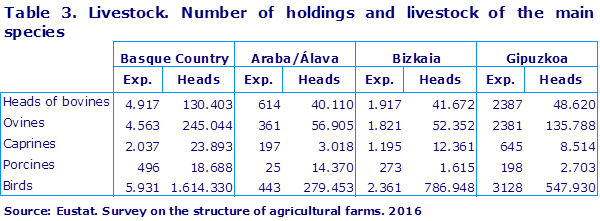
The number of cattle per holding increased by 9%
The number of livestock holdings in the Basque Country showed different trends according to the type of livestock. There was a decrease in pig (-11.5%), cattle (-6.9%) and poultry (-5.2%) holdings, whereas goat holdings increased by 15.8% and sheep holdings remained at 0.6%. The average size of pig (37.7 animals), cattle (26.5 animals) and poultry (272.2 birds) holdings increased by 11.3%, 9.4% and 8.1%, respectively. For their part, the average size of sheep (53.7 animals) and goat (11.7 animals) holdings has decreased by 6.2% in the case of sheep holdings and 11.9% for goat holdings
The highest number of animals in all species was in livestock holdings in Álava
If we analyse the different livestock species in 2016, we see an almost equal distribution of the more than 130 thousand head of cattle over the three provinces. Gipuzkoa with 37.2%, Bizkaia with 32.0% and Álava with the remaining 30.8%.
Of the 245 thousand head of sheep, Gipuzkoa accounted for 55.4%, with the rest divided between Álava (23.2%) and Bizkaia (21.4%). The distribution of goat herds was Biscay (51.7%), Gipuzkoa (35.6%) and Álava (12.6%). Álava, with 76.9%, had the highest number of pigs, followed by Gipuzkoa, with 14.5%, and Bizkaia, with 8.6%. Bizkaia stands out in terms of poultry numbers with 48.7%, followed by Gipuzkoa with 33.9% and Álava with 17.3%.
Regarding the size of the holdings, each province had a very different structure: holdings in Álava had the greatest number of animals of each species, whereas in Gipuzkoa and Bizkaia the holdings were smaller. The evolution in relation to 2013 was uneven. In the case of Álava, it is worth noting the increase in the size of livestock holdings of each species, except goats. In Gipuzkoa there was an increase in the number of animals per holding in cattle, goat and pig holdings, whereas Bizkaia only saw an increase in respect of cattle and poultry holdings.
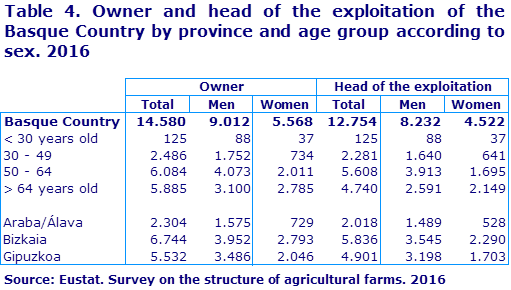
Women owners increased by 0.2%, whereas male owners fell by 3.0%
Women represented 38.2% of the owners of agricultural holdings in the Basque Country. Bizkaia stood out with 41.4% of women owners. 60% of those who owned holdings were over 60 years of age 35.5% of owners and heads of holdings were women, which represents a 5.1% rise compared to 2013, reaching 35.5% of the total. By contrast male heads of holdings fell by 3.6%.
Methodological note:
These data refer to the agricultural year from 1 October 2015 to 30 September 2016, with the exception of livestock data for which the reference date is 30 September 2016.
An agricultural holding is considered to be located in the municipality where the largest part of the land is found, or, in the event of doubt, where the sole or main building of the holding is situated.
The research units are the agricultural holdings that meet some of these conditions: have a Utilised Agricultural Area (UAA) of at least 1 ha; have at least 0.2 ha dedicated to vegetables and flowers, greenhouse crops, irrigated orchards or nurseries; have at least 0.1 ha dedicated to greenhouse vegetables, flowers or ornamental plants; have at least 0.5 ha dedicated to tobacco, hops or cotton; in the case of livestock holdings, have a certain economic significance.
This survey was performed in collaboration with the Spanish National Statistics Institute (INE) in the Basque Country.
For further information:
Eustat - Euskal Estatistika Erakundea / Basque Statistics Institute
C/ Donostia-San Sebastián, 1 01010 Vitoria-Gasteiz
Press Service: servicioprensa@eustat.es Tel: 945 01 75 62