Press release 16/11/2016
The population of the Basque Country fell by 1,324 in 2016
Population loss was concentrated in Bizkaia
The population of the Basque Country in 2016 totalled 2,171,886, with women making up 51.4% of the total population. The population of the Basque Country fell by 1.324 compared with 2015, and it had fallen by 9,704 people since 2012 - the year the population reached its historic high - according to Eustat data.
Bizkaia was the only province where the population fell between 2015 and 2016, with 2,590 fewer inhabitants, in addition to the decreases in 2012 and 2015 (12,692 people). The population in Álava rose by 558, putting its population higher than the figure for 2012, after the decreases in 2013 and 2014. Gipuzkoa has seen its population continue to grow since 2012, rising by 5,105 during these five years, with last year accounting for 708 people.
The only Basque capital that saw its population rise between 2015 and 2016 was Vitoria-Gasteiz, where it rose by 752, which is almost the population loss figure for Bilbao. Bilbao and Donostia/San Sebastián began to see their populations decrease in 2009, a historic high for both cities. Bilbao saw its population decrease more dramatically, though, having seen its population decrease by 12,575 over these last eight years, whilst Donostia/San Sebastián saw its population fall by 2,395. Excluding 2013 and 2014, the population of Vitoria-Gasteiz solely increased, reaching its highest ever population in 2016.
Barakaldo, Getxo, Portugalete, Basauri and Sestao – all part of Greater Bilbao – are the municipalities that underwent the greatest population decreases between 2015 and 2016, having recorded 1,844 fewer people. Between 2012 and 2016, the population losses in these municipalities came to 6,885 people. The municipalities with a higher population density in the Basque Country, above 6,000 inhabitants per km2, are concentrated in this region, with the highest density occurring in Portugalete, with 14,640 inhabitants per km2 in 2016.
On the other hand, municipalities such as Bernedo, Harana/Valle de Arana, Peñacerrada-Urizaharra and Valdegovía/Gaubea, belonging to Álava and with fewer than 7 inhabitants per km2, also saw their population fall last year.
In 24 municipalities in the Basque Country, people aged 65 or more accounted for over a quarter of the total population
At 21.4%, the Basque Country in 2016 has a greater proportion of the population over the age of 65 than Spain (18.6%). Castilla y León, Principado de Asturias and Galicia, where the figure is over 24%, are the Autonomous Communities that have higher proportions. If compared with Europe, only Italy exceeds the Basque figures. The proportion has gone up by 3 percentage points compared with 10 years ago.
88 municipalities exceed the average percentage of the Basque Country, whilst 163 presented the same or a lower percentage. Amongst those that exceed it are Bilbao, Donostia-San Sebastián and Barakaldo, which account for almost 29% of the population of the Basque Country. In 2006, 147 municipalities had a percentage higher than the average. Moreover, between the two dates the proportion of people over 65 years of age dropped in 89 municipalities, although they only make up 3.9% of the total population.
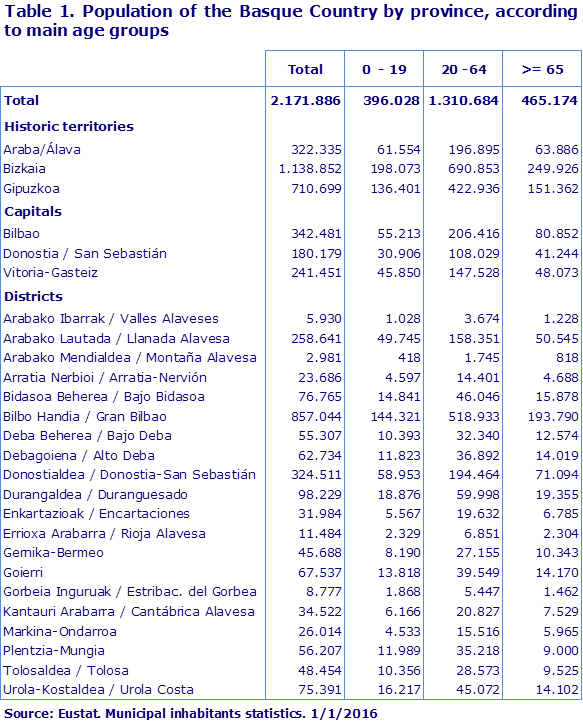
There is quite a lot of disparity between the municipalities regarding the percentage of people 65 and over, where it goes from 9.9% in Irura to 40.3% in Harana/Valle de Arana. There are three municipalities with a percentage equal to or lower than 10%. These are, along with the municipality mentioned, Alegría-Dulantzi and Larraul. The total population of these municipalities has increased to 4,985. On the other hand, four municipalities had a percentage over 30%: Harana/Valle de Arana, Lagrán, Elantxobe and Añana, which have a combined total of 960 residents.
The high proportion of elderly people in all of the municipalities in the region of Montaña Alavesa caused its figure to reach almost 27.4%, whilst the region with the next-highest percentage, Markina-Ondarroa, has 22.9% of people 65 and over, with Plentzia-Mungia falling to 16%.
If we look at older age groups, people aged 85 and above went from constituting 2% of the total population in 2006 to 3.4% of the total population in 2016, which is an increase of 1.4 percentage points over those 10 years. This increase has varied significantly across the regions. In Cantábrica Alavesa, the increase was 94%, whilst in Estribaciones del Gorbea, the increase was 24%. This process has been very dramatic for the centenarian population, with a rise in the number of centenarians from 308 in 2006 to 576 ten years later, which is an increase of 87%.
In the Autonomous Community of the Basque Country, there was a ratio of 1.4 people aged 65 or more to every person under 16, exceeding the ratio for Spain as a whole, which is 1.2, but still far from the ratio in Asturias, which is 2.1.
81 municipalities exceeded this ratio, with extreme cases such as that of Lagrán, with a ratio of nearly 9.7 to 1. Harana/Valle de Arana has a ratio of 6.1 to 1, and Moreda de Álava/Moreda Araba and Añana have over 5 elderly people for every person under 16. On the other hand, municipalities such as Irura, Alegría-Dulantzi, Larraul and Baliarrain had more than 2 young people up to the age of 15 for each person aged 65 and over.
Population distribution by age is most extreme in the municipalities of Álava where, due above all to its small size and the fact that any demographic phenomena, particularly migration, modifies this distribution.
For further information:
Eustat - Euskal Estatistika Erakundea / Instituto Vasco de Estadística
C/ Donostia-San Sebastián, 1 01010 Vitoria-Gasteiz
Press Service: servicioprensa@eustat.eus Tel: 945 01 75 62
Further press releases on municipal inhabitants statistics of the Basque Country
Municipal inhabitants statistics of the Basque Country databank