Press Release 16/06/2016
The housing stock of the Basque Country increased by 6,800 in 2015 compared to the previous year
Two out of three buildings had a lift installed and nearly 80% had a mains gas supply
The housing stock in the Basque Country was 1,040,592 on 1 January 2015, 6,791 dwellings more than one year before, according to data prepared by Eustat.
Over half of the dwellings were located in Bizkaia, 538,772, accounting for 51.8% of the total; Gipuzkoa, with 338,851 dwellings, represented 32.6%, whilst the remaining 15.7%, 162,969 dwellings, corresponded to Álava.
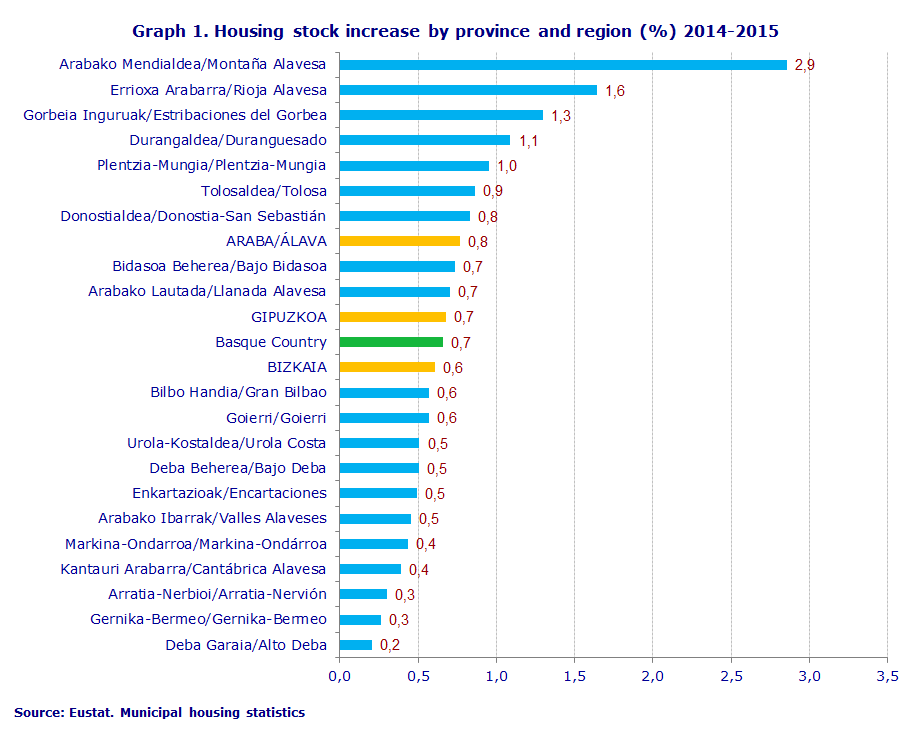
If these figures are compared to those of 2014, the nearly 6,800 additional dwellings signify an increase of 0.7%. Over the five-year period 2006-2011 the average annual increase was 7,817 dwellings, whilst over the previous five-year period 2001-2006 there were 20,486 extra dwellings per year.
The trends were of a similar intensity between the Provinces: Álava had the greatest growth, at 0.8%, followed by Gipuzkoa, at 0.7%, and Bizkaia, 0.6%.
On a regional level, the differences are more significant. Growth in the regions of Montaña Alavesa (2.9%), Rioja Alavesa (1.6%), Estribaciones del Gorbea (1.3%) and Duranguesado (1.1%) stand out for being above the Basque Country average. On the other extreme, with below-average growth, were the regions of Alto Deba (0.2%), and Gernika-Bermeo and Arratia-Nervión, both with 0.3%.
The housing stock of the three Basque provincial capitals saw growth below the Basque Country average
Vitoria-Gasteiz was the provincial capital whose housing stock grew the most, with 739 more dwellings, 0.6% up on the previous year. The increase in the number of dwellings in San Sebastián was also 0.6%, with 576 additional dwellings, and in Bilbao there was an increase of 0.3%, with 540 new dwellings.
On a municipal level, twenty-three municipalities experienced increases of 2% or more in their housing stock. There are 8 municipalities with growth of 5 percentage points or more, the most noteworthy of which were Baños de Ebro (32.5%), Barrundia (12%) and Gaintza (9.5%).
Eight out of ten dwellings are used for habitual residence
Regarding use, 84.9% of family dwellings were used for habitual residence, whilst 15.1% were used as second homes or were empty. Compared to the figure for the previous year, the percentage of main dwellings remained constant.
Bizkaia had the lowest proportion of second or empty homes: 14.5% of its total, compared to 15.0% in Gipuzkoa and 17.2% in Álava.
By region, three regions in Álava stood out for the high percentage of second or empty homes: Montaña Alavesa (48.2%), Valles Alaveses (46.4%) and Rioja Alavesa (45.8%).
In nearly half of Basque municipalities, one in four dwellings is not a habitual residence and in sixteen of them the proportion stands at or exceeds 50%, notably Sukarrieta and Bakio (63%), Añana (66.1%), Labastida/Bastida (66.8%) and Leza (67.4%).
In the capitals the proportion of non-primary dwellings is far lower. The lowest is in Bilbao (11.5%), followed by Vitoria-Gasteiz (12.2%) and the highest is in San Sebastián (15.8%).
The average Basque family home was 42 years old, had a useable floor space of 87 m2, 5 rooms and 1 bathroom
The average age of the family housing stock in the Basque Country was 42, standing at 34.9 in Álava, 42.6 in Gipuzkoa and 43.7 in Bizkaia.
Regarding useable floor space, Álava presented the largest family dwellings with an average of 91.9 m2 of space, followed by Gipuzkoa with 86.7 m2 and Bizkaia with 85.5 m2, resulting in an average useable floor space of 86.9 m2 for the Basque Country overall.
In terms of the number of rooms, three quarters of Basque family dwellings had 4 or 5 rooms (bedrooms, living room and kitchen) and, on average, 1.4 bathrooms. Less than one in a hundred dwellings, 0.8%, did not have a bathroom.
Two in three family dwellings had a lift in the building, which was an increase of 1.4 percentage points compared to the previous year.
Over half of family dwellings, 54.8%, were located in buildings of over ten units and 7.5% were in buildings of over forty units. On the other hand, one out of every ten dwellings, 10.5%, was single-family or belonged to a two-family building.
In 2015 there was an increase of 1.1 percentage points in gas supplied to the building by pipe, with respect to 2014
Eight out of ten primary dwellings (79.9%) in the Basque Country had a natural gas or propane mains supply.
By province, the greatest increase occurred in Gipuzkoa with 1.2 percentage points more than in 2014. In Álava and Bizkaia the variation was also positive, by one percentage point. In five regions, the increase in this provision exceeded 2 percentage points: Rioja Alavesa (4.2), Plentzia-Mungia (2.4), Estribaciones del Gorbea (2.3), Tolosa (2.2) and Urola Costa (2.1).
For further information:
Eustat - Euskal Estatistika Erakundea / Instituto Vasco de Estadística
C/ Donostia-San Sebastián, 1 01010 Vitoria-Gasteiz
Press Service: servicioprensa@eustat.eus Tel: 945 01 75 62
Further press releases on statistics on municipal dwellings in the Basque Country