Press release 21/09/2015
The Basque Country spent 45 million euros attending to the homeless in 2014, 8.6% more than in 2012
29% of the centres for homeless people in Spain are located in the Basque Country
Assistance to the homeless through the Basque Country social service network in 2014 was 45 million euros, 8.6% more than the two previous years, according to data prepared by Eustat. Assistance was given via 234 centres that offered 2,771 accommodation places and 2,104 meal places. These centres were attended by 2,091 workers.
29% of the centres for the homeless in Spain were located in Euskadi although only 16% of the total accommodation places were offered, seeing that the Basque centres are smaller on average. Two characteristics that stand out in the Basque assistance network for the homeless are: the higher percentage of public centres, 39% of the total compared to 30% nationally, and the fact that the majority of the staff in Basque centres is salaried, as opposed to being volunteers. In fact, in 2014, the salaried employees who worked at the Basque centres made up 19% of the national total, while volunteers only made up 9%.
Homeless people or those in residential exclusion are defined as individuals who are 18 years or over and do not have access to accommodation that complies with the criteria of liveability and who are consequently forced to live on the street temporarily or in temporary accommodation provided by the public sector or by non-government organisations. On 15 December 2014, 2,057 people were sleeping in such homeless centres. In comparison, the figure for all of Spain was 13,596; that is to say, the Basque Country accounts for 15%.
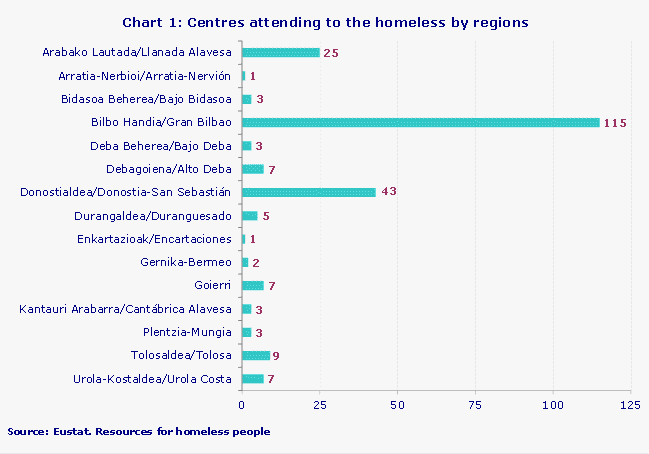
By province, half of the centres (54%) and places (47% for accommodation and 62% for meals) were located in Bizkaia, as well as a similar percentage for the human (58%) and financial resources (54%) used. Gipuzkoa held a third of the centres (34%) and the places (35% of accommodation and 22% of meals), while Álava accounted for the other 12% of the centres, with 19% of the accommodation places and 16% of the meal places.
By municipalities, the distribution of the centres was uneven: Bilbao offered 40% of the centres in the Basque Country and 75% of the centres of Bizkaia; Vitoria-Gasteiz had 89% of the centres in Álava; and finally, in Gipuzkoa, which has a more decentralised model, San Sebastian held 37% of the centres.
The Public Administrations funded 87% of the activity (39 million euros) while the rest was funded by in-house resources (8.3%) from private institutions (3.7%) and private donations (1.6%). Public funding was the only source of funding for the majority of the centres (59%), with local governments bearing the greatest financial effort with a contribution of 79% of the expenditure.
Three out of every four centres dependent on private institutions, all of which are not for profit, were mainly or totally funded by the Public Administration, which, overall, funded 91% of its activity. This public contribution included subsidies and compensation for the 692 accommodation places provided by these institutions, almost half (47%) of the private offering.
Volunteer personnel on a part-time basis represented 44% of the employment at centres for homeless people
In 2014, 2,091 people worked to attend to homeless people in social service centres in the Basque Country, of which 1,030 (49%) were salaried personnel, most of them on a full-time basis (59%) and women (70%). In addition, the collaboration of 927 people (44%) who worked as volunteers in these centres, almost all part-time (84%) and also mostly women (59%), should be highlighted. The figures on the personnel who worked at State centres were 17,572 people, of which 5,417 (30.8%) were salaried and 10,710 (60.9%) volunteers.
A total of 498 homeless people stayed overnight at hostels and low-demand centres
Following European typology ETHOS, which is used to classify homelessness and residential exclusion, the people in the most serious residential exclusion or homelessness are those who live on the street and sleep in centres or on the street. Taking 15 December 2014 as a reference date, on which the centres that increase the number of winter places to protect against the cold were open, there were 549 accommodation places for homeless people and 498 people spent the night in them, so the occupancy of the centres was 91%. 905 meal services were provided in the 428 catering places available and breakfast was provided to 72% of the people who stayed overnight in these centres.
1,559 homeless people temporarily resided at the social services network of centres
Services for homeless people or those who live in centres temporarily were provided by institutions from 174 centres which offered 2,222 places and, on 15 December 2014, provided temporary housing to 1,559 people.
These centres included 23 residences and shelters and 151 flats (98 individuals and 53 organised by networks). One of every two people (841) resided temporarily in one of the 251 flats provided by the 53 "networks of flats" mentioned above. In Spain there were 239 residences and shelters and 264 flats.
The majority of these centres were orientated towards homeless people with a specific social background such as immigration, drug and/or alcohol addiction, mental illness, domestic violence, and others.
The shelters for women were grouped into 40 centres, mostly public, that offered 64 residences and 384 places, and provided temporary accommodation to 192 people. The majority of these were orientated towards victims of gender violence, specifically, 321 places where 151 women and their families lived at the end of 2014.
The transition resources directed towards young people in shelters or in need of guardianship until they became adults were concentrated in 18 centres, through which 31 flats with 188 places were offered, where 172 young people were residing temporarily at the end of 2014. This group of centres, mostly privately owned but with public financing, was attended by 110 workers, almost all salaried employees (66%). "Foreign unaccompanied minors" who arrive in the Basque Country are included in this group, and so the percentage of immigrants was 100% in 11 of these centres.
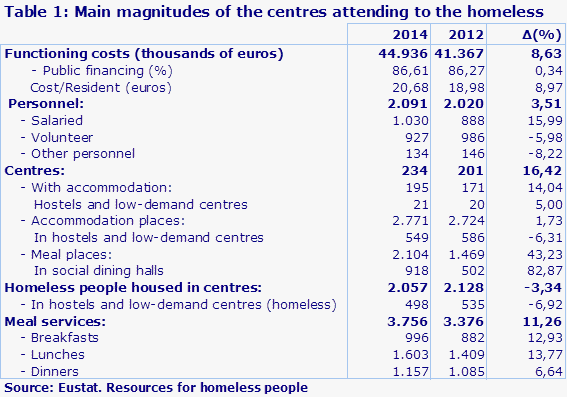
Note: The data from 2012 has been revised due to methodological changes. This statistical operation was performed by Eustat in collaboration with the Spanish National Statistics Institute (INE) in the Basque Country.
For further information:
Eustat - Euskal Estatistika Erakundea / Instituto Vasco de Estadística
C/ Donostia-San Sebastián, 1 01010 Vitoria-Gasteiz
Press Service: servicioprensa@eustat.eus Tlf: 945 01 75 62
Further press releases for Resources for homeless people