Press Release 08/06/2015
The fall in sales in industry affected fourteen of the twenty Basque regions in 2013
All of the regions displayed negative trends in staff employed
The variation of net sales in the extraction and manufacturing industry in 2013 was negative for fourteen of the twenty regions in the Basque Country, according to Eustat data. The decreases varied between 1.3% in Rioja Alavesa and 12.9% in Urola Costa. Five regions saw positive growth, with Estribaciones del Gorbea showing the highest growth rate, at 10.1%.
Basque extractive and manufacturing industries as a whole registered a 1.9% decline in sales. By province, Gipuzkoa showed the worst trend, with a decrease of 4.8%, whilst Álava saw a 2.6% drop. Bizkaia, however, bucked the trend with a 0.4% increase in sales.
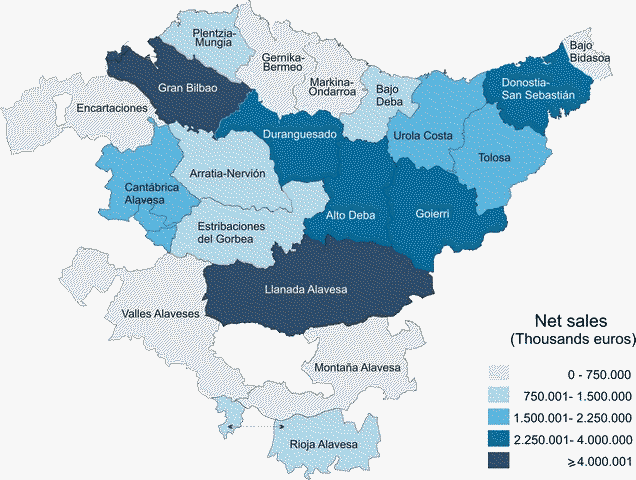
Distribution of net sales in the extraction and manufacturing industry by regions. 2013. Thousands of euros
Source: EUSTAT. Industrial statistics
Six regions accounted for 74.4% of total sales, which include the three provincial capitals, and the variation was uneven. The two located in Bizkaia, together with Donostialdea/Donostia-San Sebastián saw positive variations. Gran Bilbao registered an increase of 1.1% in sales, Duranguesado a rise of 0.7% and Donostialdea 0.3%. Alto Deba (-7.6%) and Goierri (-6.8%) stood out in the negative sense and Llanada Alavesa also registered a 2.2% drop, two tenths of a percentage point on the Basque Country average.
By province, in Gipuzkoa the average fall was 4.8%. Urola Costa was the region with the greatest fall in sales, of 12.9%, while Donostialdea-San Sebastián was the only region where values were up on the previous year (0.3%). Bajo Deba, in turn, saw the practically identical net figure to the year before.
In Álava, only Estribaciones del Gorbea showed a positive rate of growth, at 10.1%. Conversely, the decreases in sales in Cantábrica Alavesa, by 9.3%, and Valles Alaveses, 4.1%, stand out. The region of Llanada Alavesa, whose sales accounted for 64% of the those of the province in 2013, saw a fall just under the average for the province as a whole.
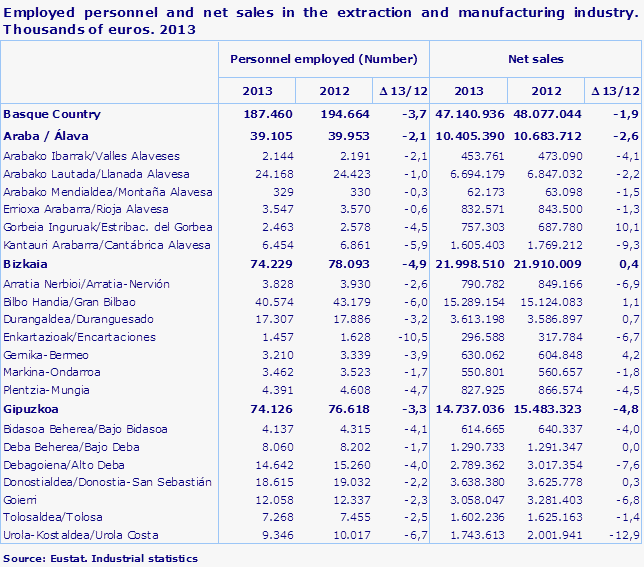
The province of Bizkaia is the only one that saw a positive variation in sales, by 0.4%. Three of its regions showed positive results, in addition to 1.1% in Gran Bilbao, 70% of the total sales in the province, and Duranguesado (0.7%), the region of Gernika-Bermeo, with 4.2% growth, the highest in the province. Of the other regions, the negative rates of Arratia-Nervión, -6.9%, and Encartaciones, -6.7%, stand out.
The number of people employed was less positive, as nineteen of the twenty regions posted negative rates. The Autonomous Region saw an average drop of 3.7%, with a relatively homogenous provincial performance, but with a slightly steeper downturn in Bizkaia (-4.9%) than in Gipuzkoa (-3.3%) and in Álava (-2.1%).
In Álava, the falls in employment in Cantábrica Alavesa and Estribaciones del Gorbea were noteworthy (-5.9% and -4.5%, respectively). In Llanada Alavesa, the region in which 62% of the staff employed in these sectors are concentrated, the fall was 1%.
In Bizkaia, the most negative trends for employment was seen in Encartaciones, with a fall of 10.5%, and Gran Bilbao, with a decrease of 6%, where 55% of employment in the province is located.
The situation in Gipuzkoa was the same, with a negative trend in employment in all regions. The region of Urola Costa lost the most employment, with a fall of 6.7%, while Bajo Deba lost the least, at 1.7%.
Methodological note:
The sectorisation used is the National Classification of Economic Activities (CNAE-2009), with the B (extractive industries) and C (manufacturing industries) being the only sections included in this disaggregation by regions.
For further information:
Eustat - Euskal Estatistika Erakundea / Instituto Vasco de Estadística
C/ Donostia-San Sebastián, 1 01010 Vitoria-Gasteiz
Press Service: servicioprensa@eustat.es Tel: 945 01 75 62
Further press releases on industrial statistics of the Basque Country
Industrial statistics of he Basque Country databank