Press Release 26/11/2014
One in four people had been educated at university level in the Basque Country in 2013
Two in three vocational training qualifications corresponded to higher level studies
Nearly one in four people over the age of ten, 24%, had intermediate-higher or higher university studies in 2013, a total of 472,000 people, according to Eustat data.
318,000 people had a higher university level of training, representing 16.2%. This figure was up 0.4 percentage points on 2011, when 312,000 people had the same level of training (15.8%). This proportion rose to 16.4% for women whereas it stayed at just 15.9% for men, widening the differences that existed in 2011.
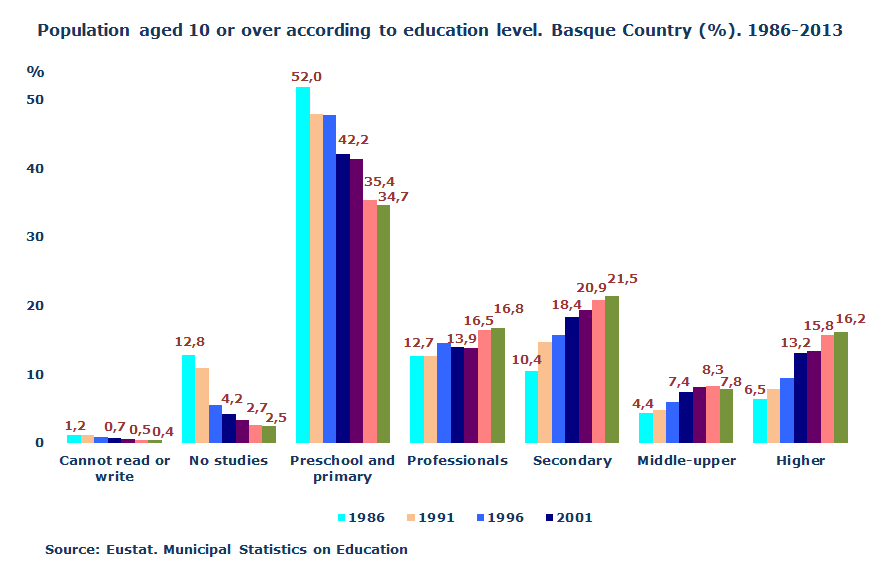
Conversely, the illiteracy rate among the over 10s was 0.4% in 2013: 0.3% in the case of men and 0.6% in the case of women. This rate was particularly high among the elderly and, therefore, while the rate stood at 0.2% for the under 65s, it jumped to 1.2% for the over 65s, although it had dropped by 0.2 percent with respect to 2011.
The differences in the level of education by province were small. Comparatively, a higher proportion of individuals were educated to secondary school level in Álava, 22.6% compared to 21.5% for the Basque Country as a whole. Bizkaia, for its part, topped the autonomous region by 0.8% with its level of university studies, reaching 24.8%; Gipuzkoa, with 17.9%, was up 1.1 percent on the Basque Country as a whole in terms of the proportion of people that had obtained vocational training qualifications.
The distribution of the level of education by region presented bigger differences. Regions whose university level of education stood out included Plentzia-Mungia, 33%, Estribaciones del Gorbea, 26.4%, and Donostia-San Sebastián, 26.3%. The following regions stood out in terms of their level of vocational training qualifications: Valles Alaveses, 21.3%; Alto Deba, 20.6%, and Encartaciones, 20.5%. And the most prominent regions in terms of the secondary education level were Bajo Bidasoa, 23.6%, Llanada Alavesa, 23.4%, and Plentzia-Mungia, 23.1%.
Population aged 10 and above with a university level of education by region. Basque Country (%). 2013
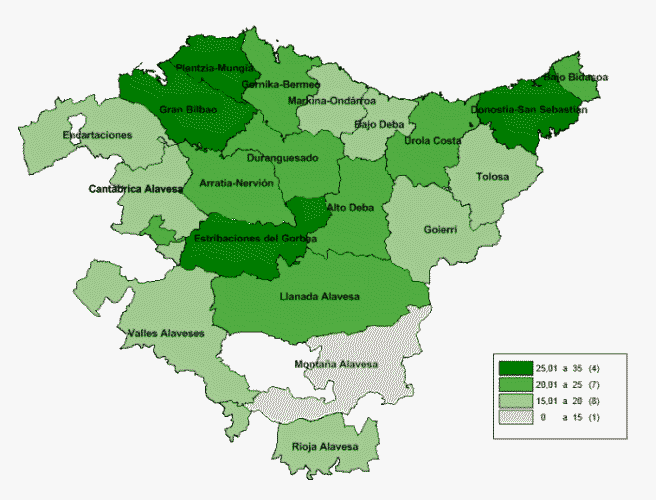
Source: Eustat. Municipal Statistics on Education 2013
There was a rise in the number of qualifications in secondary education as well as in vocational training and university compared to 2011
Based on the level of qualifications, in 2013 19.4% of the population over 10 years old held a secondary education qualification. This proportion rose to 20.1% in the case of women and fell to 18.8% in the case of men. Compared to 2011, the number of people qualified at this level of education increased by 0.5 percentage points.
In the case of university qualifications, 18.7% of the population over 10 years old held an intermediate-higher or higher qualification. This proportion rose to 20.5% in the case of women and fell to 16.9% in the case of men. Compared to 2011, the number of intermediate-higher and higher qualifications increased by 0.2 percentage points.
The population holding vocational training qualifications also grew from 15.6% in 2011 to 15.9% in 2013. More men held qualifications, 19%, than women, 13.1%. The detail of vocational training qualifications shows that two in three qualifications issued corresponded to higher level, i.e. qualifications relating to higher-level training cycles.
As with the level of education, in the case of the level of qualifications, Bizkaia recorded the highest proportion of its population with university degrees, 19.8%, followed by Gipuzkoa with 17.8% and, lastly, Álava with 17.1%. For its part, Álava had the highest proportion of people qualified in secondary education, 20.3%; followed by Gipuzkoa, with 19.5%; and Bizkaia, with 19.1%. Finally, Gipuzkoa had the highest proportion of individuals with vocational qualifications, 17.1%, compared to 16.1% in Álava and 15.2% in Bizkaia.
For further information:
Eustat - Euskal Estatistika Erakundea / Instituto Vasco de Estadística
C/ Donostia-San Sebastián, 1 01010 Vitoria-Gasteiz
Press Service: servicioprensa@eustat.eus Tel: 945 01 75 62
Further press releases on Municipal statistics on education of the Basque Country