Press Release 04/03/2014
The number of non-university students grew by 1.9% in the Basque Country in the academic year 2012/13
Enrolments in Vocational Training increased by 25% during the last four academic years
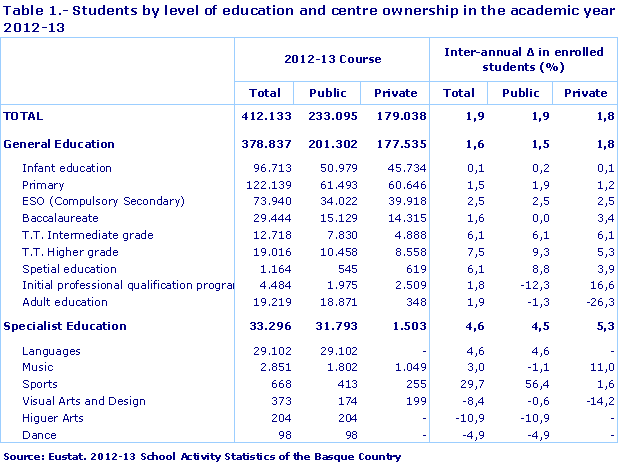
In the 2012-13 academic year the non-university student population in the Basque Country stood at 412,000, 1.9% up on the previous year, according to data prepared by Eustat. Of these, 379,000 students, or 92%, were enrolled in General Education, with a positive balance of 6,100 new students registered with respect to the previous academic year, an increase of 1.6%.
In Specialised Education, there were a total of 33,000 enrolments, which was almost 4.6% more than the previous year. Language teaching particularly stood out, given that nine of every ten enrolments were in the Official Language Schools, with a total of 29,000 students. Music was in second place in terms of the number of enrolments with 2,800 students. The other subjects were, in decreasing order, as follows: Sports, Art & Design, Higher Arts and Dance.
Enrolments in Vocational Training increased by 7% last academic year
With a total of 32,000 students and an increase of 2,000, this was the fourth consecutive year in which enrolments in Vocational Training increased. There was an increase of 25% since the academic year 2009-10.
In this academic year there was no increase in Infant Education and a moderate increase (+1.5%) in Primary. In Compulsory Secondary Education, there were 1,800 additional enrolments with an increase of 2.5%. As regards Upper Secondary, there was a 1.6% increase, with 500 extra enrolments. Finally, the number of Language students was up by 4.6% with a positive balance of 1,300 enrolments.
57% of the student population studied in public centres
It could be said that, within General Education, the distribution of students was balanced in relation to the choice of public or private centres at all levels, except for intermediate level Vocational Training, with 62% of enrolments in public centres, and in Adult Primary Education, with 98%.
On the other hand, in Specialised Education there was a greater diversity, due in large part to there being fewer centres in this area, and the choice between public or private centres is often dependent on the subjects offered. Therefore, whilst Languages, Dance and Higher Arts were subjects studied in public centres, because they are the only centres offering them, in Music, Sports and Art, the student population in public centres stood at 63%, 62% and 47%, respectively.
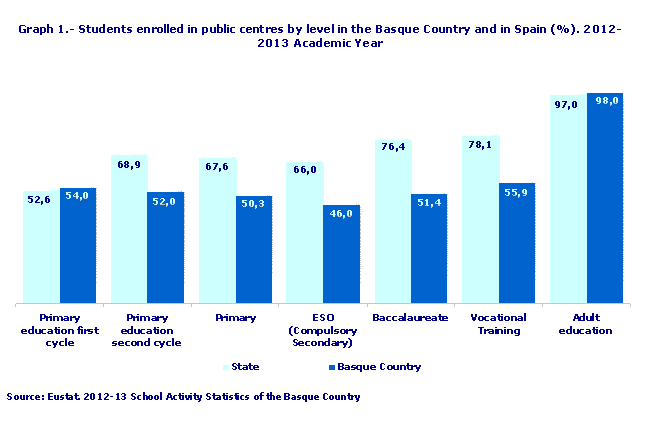
We can see that at most levels the weight of public centres was greater in the State than in the Basque Country, except in first-cycle Infant Education where the Basque Country was one percentage point higher.
At other levels the differences were very significant: in 2nd cycle Infant Education and Primary it stood at 17 percentage points, and in Secondary the gap was even greater, reaching 25 points in Upper Secondary, 22 in Vocational Training and 20 in Compulsory Secondary Education.
�
Three quarters of students in Gipuzkoa studied in model D
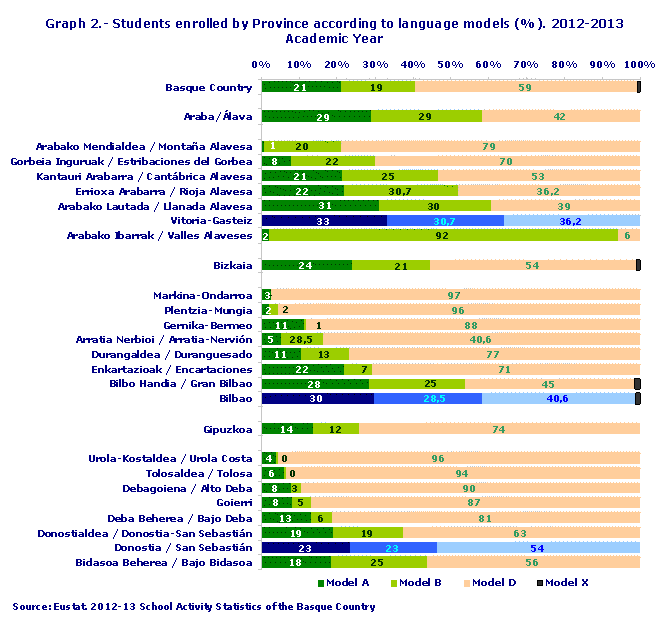
Gipuzkoa was the Province with the highest proportion of students in Basque, with 74%, followed by Bizkaia, with 54%, and Álava, with 42%. However, there was diversity in all three provinces at a regional level.
Donostialdea was the region of Gipuzkoa with the greatest number of students, but only 54% of them studied in Basque, 20 points below the average for the province. However, in a number of regions the proportion was over 90%: Urola Costa (96%), Tolosa (94%) and Alto Deba (90%).
In Bizkaia, the region of Gran Bilbao represented 38% of all enrolments, but only 45% studied in Basque, 9 percentage points below the average for the province. The lowest proportion, however, was in Arratia-Nervión (41%). The highest percentages were seen in the regions Markina-Ondarroa (97%), Plentzia-Mungia (96%) and Gernika-Bermeo (88%).
Finally, the only regions in Álava with a clear predominance of model D were Montaña Alavesa (79%) and Estribaciones del Gorbea (70%), although their demographic weight is minimal, while in the region with the most students, Llanada Alavesa, barely a third studied in Basque, 6 points below the average for Álava.
For further information:
Eustat - Euskal Estatistika Erakundea / Instituto Vasco de Estadística
C/ Donostia-San Sebastián, 1 01010 Vitoria-Gasteiz
Press Service: servicioprensa@eustat.eus Tlf: 945 01 75 62
Further press releases on Public Outpatient Statistics
Databank on Public Outpatient Statistics