Press Release 12/21/2012
SURVEY ON THE HOMELESS (EPSH) 2012
In 2012, 60% of the homeless in the Basque Country were foreigners
The number of "homeless" has increased 14% since 2005 and stood at 2,090 people
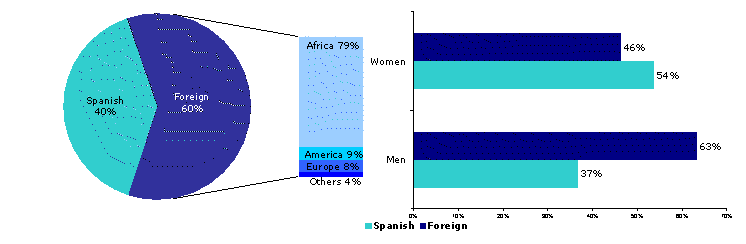
The homeless population attended in accommodation centres and dining halls in 2012 was estimated to be 2,090 people, which is a 14% increase on 2005, according to the Survey on the Homeless carried out by Eustat in collaboration with the National Statistics Institute (INE). 60% of the 2,090 homeless attended in said centres were foreign (in Spain this figure stood at 45.8%). By continents, they were mainly from Africa (79%), followed by America (9%) and Europe (8%). Specifically, most originated from Morocco (44%) and Algeria (12%).
Bizkaia attended to 54%, Gipuzkoa to 30% and Álava to 16% of the homeless
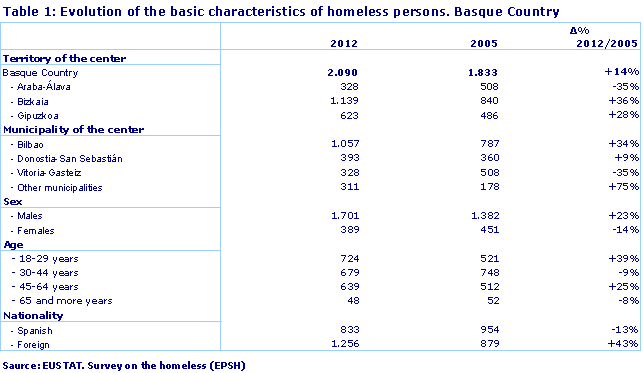
By province, more than half of the homeless population in the Basque Country was attended in centres in Bizkaia (1,139). Bilbao, the capital, had the highest number of homeless (1,057). In Gipuzkoa, 623 of the homeless (63%) were in Donostia-San Sebastián. However, in Álava the 328 people attended were in the capital.
Homeless according to nationality and sex in 2012. Basque Country (%)
Source: Eustat. Survey on the Homeless (EPSH)
Gender was the differentiating factor in the homeless
By gender, 81% of the homeless were men, compared to 19% of women. This percentage is similar to the state level. By nationality, 63% of the homeless men were foreigners, whereas slightly less than half are women (46%). By ages, the group of young people aged 18 to 29 stands out, representing 35% of the total (whereas the figure for the State is 19.3%). They are followed by the 30 to 44 age group (32%), the 45 to 64 group (31%) and over 65s, the smallest group (2%).
46% had been homeless for more than 3 years
40% were lodged in collective accommodation; 49% in flats and lodgings provided by a public body or NGO, and the remaining 11% in places that are not destined to be lived in. 46% had been homeless for more than 3 years. 5% stated that they had not eaten on the day of the interview; 27% had no income, and of those that did, 37% came from a social benefit (including the AES) and 15% from donations by an NGO. They spent 66% of the money they obtain on food.
�
74% of the homeless did not consume alcohol
With regards to health, 24% were affected by severe or chronic illness, 15% had a disability and 22% had been hospitalised in the last year. 74% claimed that they did not consume alcohol and 65% that they did not consume drugs. Hashish and marijuana were the drugs most commonly consumed.
Insecurity must be added to the health problems, as 20% of the homeless had been the victims of aggression and 28% of theft. On the other hand, 36% had been arrested on at least one occasion. 88% of the homeless attended had been in contact with social service employees. Their evaluation of the assistance received was favourable in 58% of cases.
Homeless trend in the Basque Country: more men, young people and foreigners
In 2005-2012, the number of homeless increased among men (+23%), young people (+39%) and foreigners (+43%). On the contrary, the number dropped among women (-14%), the 30 to 44 age group (-9%) and those of Spanish nationality (-13%). The difference in the trend by provinces is also noteworthy, with a sharp fall in the number of people attended in Álava (-35%), compared to a rise in Bizkaia (36%) and Gipuzkoa (28%).
For further information:
Basque Statistics Institute
C/ Donostia-San Sebastián, 1 01010 Vitoria-Gasteiz
Tel: +34-945-01 75 00 Fax: +34-945-01 75 01 E-mail: eustat@eustat.eus
Contact: MªJosé Santamaría Gallardo
Tel:+34-945-017 548 Fax:+34-945-017 501
Further press releases on the Survey on the Homeless (EPSH)