Press release 27.03.12
One in ten active individuals was unemployed
According to the Municipal Statistics on Active Population there were 1,035,574 active individuals in 2010, 468,423 women and 567,151 men. Consequently, the activity rate of the Basque Country for this year stood at 47.7% of the population, 42.2% in the case of women and 53.5% in the case of men.
Of the three provinces, Álava showed the highest rate of activity, 49.9%, whilst in Gipuzkoa and Bizkaia the rates were comparable, 47.9% and 47%, respectively.
The activity rates by regions of the Basque Country varied between 45.9% for la Rioja Alavesa and 51.6% for Estribaciones del Gorbea, both in Álava. In Bizkaia those at the extremes were Plentzia-Mungia, with an activity rate of 50.4%, and Gernika-Bermeo, which had the lowest rate (46%). For its part, Gipuzkoa was the most homogenous province, given that the rates in its regions varied between Alto Deba with 48.4% and Bajo Deba with 46.8%.
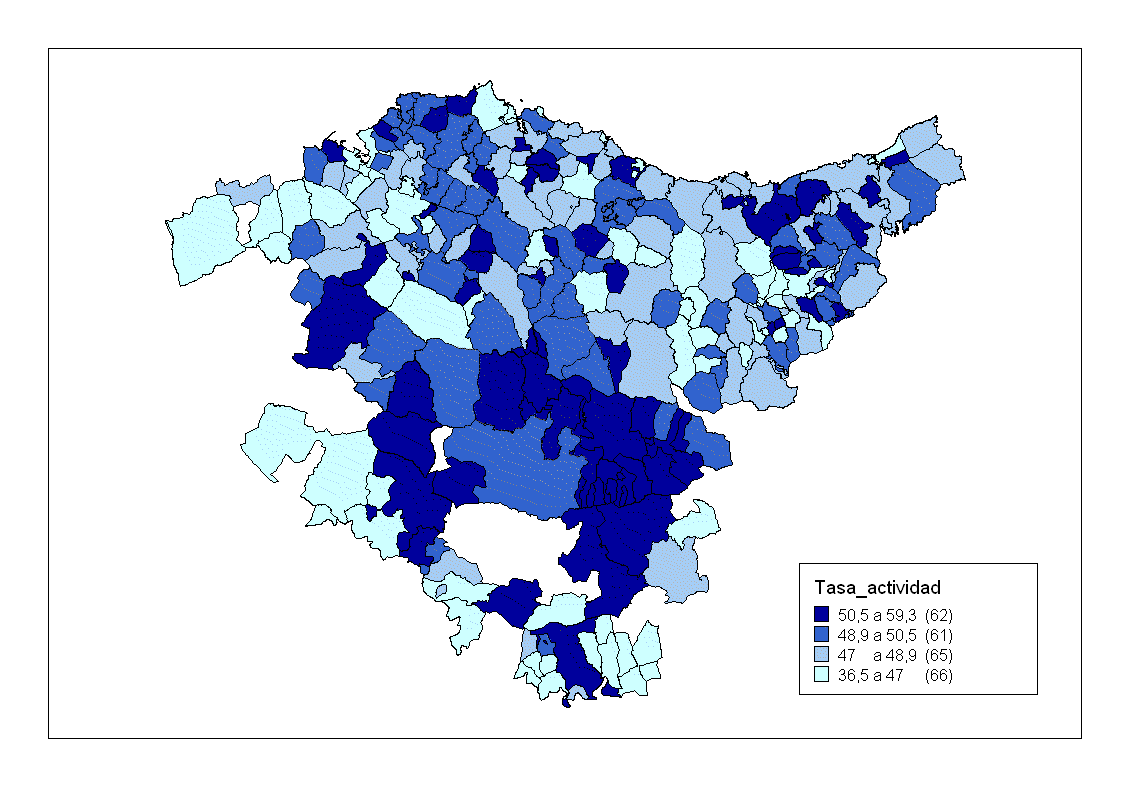
Map 1. Activity rate by municipality (%). 1-I-2010
Source: EUSTAT. Municipal Statistics on Active Population
At municipal level, the greatest activity corresponded to the smallest municipalities (those of less than ten thousand inhabitants), with an activity rate of 48.9%. This rate decreased as the population size increased: 47.8% for municipalities of between ten and forty thousand inhabitants and 46.6% for the stratum of forty to one-hundred thousand inhabitants. In the case of provincial capitals, the three with more than one-hundred thousand inhabitants, the activity rate stood at 47.6%.
It is precisely in the capitals where the differences in activity between men and women were more reduced, 53% active in the case of men and 42.6% in that of women, whilst the greatest differences were registered in the forty to one-hundred thousand inhabitants stratum (52.9% against 40.8% active).
Amongst the capitals, the highest activity rate, 50.1%, was seen in Vitoria-Gasteiz, whilst the lowest, 45.8%, corresponded to Bilbao. For its part, Donostia-San Sebastián had an activity rate of 47.7%.
Of the 251 municipalities in the Basque Country, sixty-nine showed an activity rate equal or above 50% of the population, with Elburgo/Burgelu and Irura standing out with rates close to 60%. In the opposite extreme, in two municipalities, Kripan and Lanestosa, the activity rate did not reach 40% of the population.
One in ten active individuals was unemployed
At the beginning of 2010, unemployment affected 9.7% of the active population, more in the case of men (10.3%) than in that of women (9.1%).
The highest unemployment rate, 10.3%, corresponded to Bizkaia, both for men (10.9%) and women (9.5%). In Álava the unemployment rate stood at 9.8% (10.4% for men and 9.1% for women), whilst in Gipuzkoa it affected 8.8% of the active population (10.4% men, 8.4% women).
The situation for regions was very uneven. Both the region with both the highest rate of unemployment (Estribaciones del Gorbea – 6.5%) and the lowest (Rioja Alavesa – 13.3%) were situated in Álava. Other regions with unemployment rates above 10% were Marquina-Ondarroa, Bajo Bidasoa, Gran Bilbao and Valles Alaveses. With the exception of the already mentioned Bajo Bidasoa, the rates of unemployment for the rest of the regions of Gipuzkoa remained below the Basque Country average.
As far as the population size of the municipalities was concerned, the lowest unemployment rates were in those with a higher number of the population in work. For municipalities of less than ten thousand inhabitants the unemployment rate was 8.7%, against 9.3% and 10.6%, respectively, for the strata of greater size.
In the capitals the unemployment rate stood at 10.3% of their population. In Bilbao, which had the highest unemployment rate, this indicator stood at 11.2%, against the 10% of Vitoria-Gasteiz and the 8.9% of Donostia-San Sebastián.
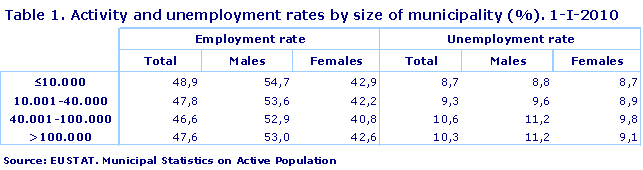
On the other hand, the differences in the unemployment rates between men and women were greater as the size of the municipality increased: One decimal point more for men in the smallest municipalities against the nearly two points more in the capitals.
In 51 of the 251 municipalities of the Basque Country the unemployment rate stood at 10% or more of the active population. This rate was especially high for the municipalities of Álava: Oyón-Oion (20.8%), Moreda de Álava/Moreda Araba (18.0%), Ribera Baja/Erribera Beitia (14.6%) and Lapuebla de Labarca (13.9%).
On the other hand, in 15 municipalities of the Basque Country the unemployment rate was below 5%, with Samaniego (2.6%), Altzaga (2.4%), Navaridas (2.2% and Gizaburuaga (1.9%) particularly standing out.
�
In Gipuzkoa the municipalities with the highest employment rates were in industry, in Álava in agriculture and in Bizkaia in Services
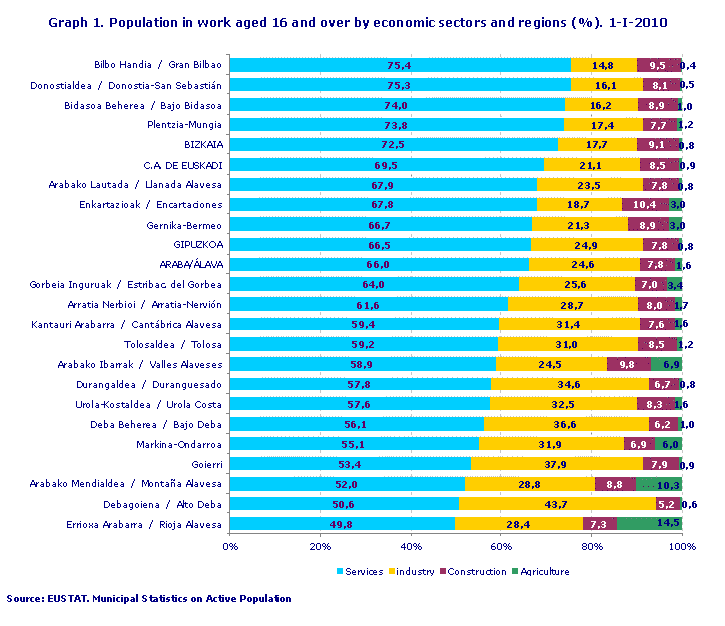
In any case, the most acute differences between the various municipalities of our autonomous community took place in employment according to activity sectors.
Whilst the average of the proportion of the population in work in the Basque Country in the services sector stood at 69,5%, in some municipalities such as Getxo, Plentzia, Bilbao, Berango, Barrika, Gorliz, Sukarrieta, Sopelana, Loiu de Bizkaia and Donostia-San Sebastián in Gipuzkoa it accounted for between eight and ten individuals in work.
The majority of the municipalities with the highest proportion of individuals in work in the industrial sector were in Gipuzkoa. Against a proportion of 21.1% for the Autonomous Community as a whole, municipalities such as Eskoriatza, Oñate, Ormaiztegi, Aretxabaleta, Aizarnazabal, Antzuola, Idiazabal, Lazkao, Mendaro, Amezketa, and Baliarrain in Gipuzkoa, Zaldibar, Ermua y Etxebarria in Bizkaia and Kripan y Aramaio in Álava exceeded 40% of individuals in work.
By contrast, the great majority of municipalities with high proportions in the agriculture sector belonged to Álava. In fact, the ten municipalities with the greatest proportion of individuals in work in agriculture were in this province, all of them with proportions equal to or greater than 20%. In some cases, such as Baños de Ebro/Mañueta and Elvillar/Bilar, agriculture accounted for almost one in every two individuals in work, 47.1% and 40.8%, respectively.
For its part, construction employed 8.5% of the working population, but in some municipalities in Vizkaia and Guipuzkaia, such as Artzentales, Trucios-Turtzioz, Gaztelu, Amezketa, Muskiz, Abanto and Ciérvana-Abanto Zierbena, Belauntza, Hernialde and Berastegi, this proportion varied between 14.1% for the last example and 19.2% for the first.
For further information:
Basque Statistics Office
C/ Donostia-San Sebastián, 1 01010 Vitoria-Gasteiz
Tel:+34-945-01 75 00 Fax:+34-945-01 75 01 E-mail: eustat@eustat.es
Contact: Amaia San Miguel
Tel:+34-945-01 64 91 Fax:+34-945-01 75 01