Press release 14/12/2011
30.1% of Basque companies with 10 or more employees implemented technological innovation in 2010
This percentage rises to 38.9% if non-technological innovation is also taken into account
The percentage of companies implementing technological innovation in 2010 was 13.8%, rising to 30.1% in those with 10 or more employees, according to Eustat data. Spending implemented by Basque companies on technological innovation activities stood at 2581.9 million euros, following a drop of 6.2% with regards to the previous year. This spending represented 3.95% of GDP.
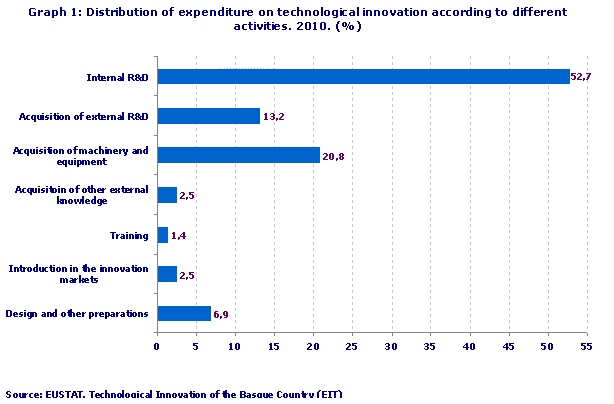
Amongst the main activities necessary for technological innovation, particular mention should be made of spending on internal R&D, which accounted for 52.7% of the total, the acquisition of machinery and equipment, 20.8%, and the acquisition of external R&D, 13.2%, with the remaining activities accounting for 13.3% of spending.
The number of companies with technological innovation in the 2008-2010 period represented 13.8% of the total in the Basque Country, which was a drop of seven tenths in relation to the previous period, corresponding to 25,747 companies. Innovation is considered technological when it is implemented by those companies that are able to introduce a new or appreciably improved product, either good or service, into the market (5.6% of the total in 2010), or those which implement, within their own establishment, a new or appreciably improved process (11.6% of the total in 2010).
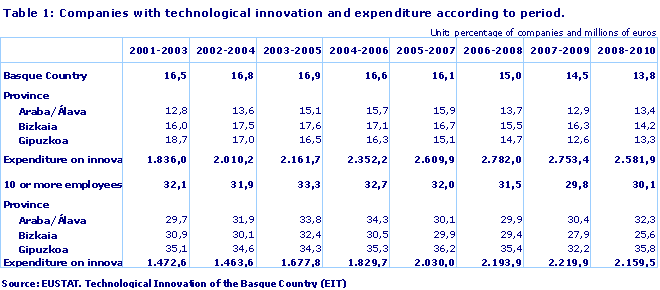
These percentages, however, rise to 30.1% if we only take into account companies with 10 or more employees, which is an improvement of three tenths on the data from the previous year. As regards this size of company, 19.9% were product innovators and 22.2% process innovators.
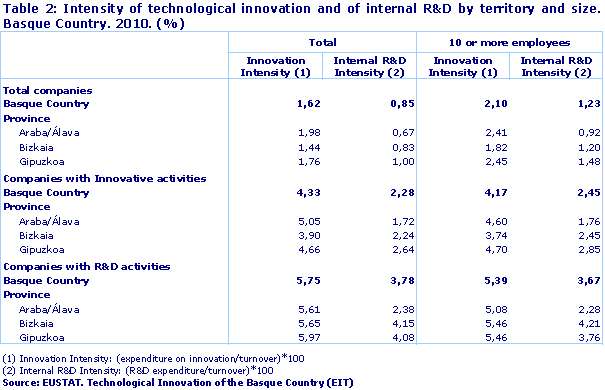
Innovation intensity, defined as spending on innovation activities as a percentage of turnover, stood at 1.62%, whilst internal R&D intensity, spending on internal R&D as a percentage of turnover, stood at 0.85%. If we take into account companies of 10 or more employees, these percentages rise to 2.10% and 1.23%, respectively.
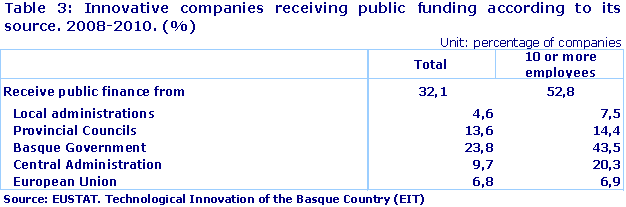
32.1% of companies with technological innovation received public funding
32.1% of companies with technological innovation received some sort of public financial support. If we look at its origins, it stands out that support coming from the Basque Government accounted for 23.8% of the total for these companies. In the case of companies of 10 or more employees, 52.8% received support, with the Basque Government being the provider of funds to the greatest number of companies, specifically 43.5% of companies of this size that spent on innovation.
Regarding cooperation on R&D and innovation activities, 10.0% of innovating establishments signed some kind of agreement with other companies or institutions in the 2008-2010 period. This percentage rises to 25.2% in establishments of 10 or more employees.
In this size of company, amongst those that signed an agreement, attention should be drawn to cooperation with technology centres (53.5%), other establishments of the same company (52.8%), with suppliers of equipment, materials, etc. (37.2%), with Universities and other higher education institutes (36.7%) and with experts and consultant firms (32.9%).
77.4% of innovating companies felt that innovation had positive effects
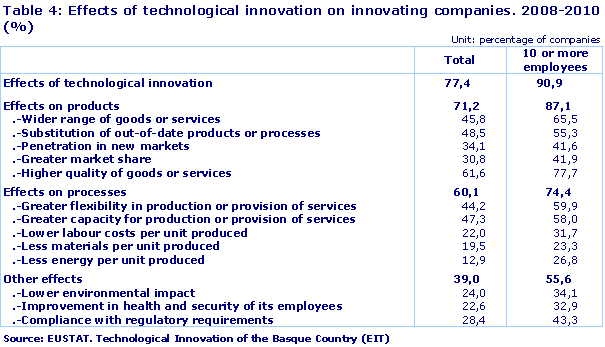
77.4% of innovating companies felt that innovation had positive effects 71.2% felt that innovation had positive effects on their products, be they goods or services, 60.1% on their internal processes and 39.0% felt that other positive effects existed, on the environment or the health of their employees.
In innovating companies of 10 or more employees, 90.9% felt that innovation had positive effects, whilst the rest of the previously mentioned percentages regarding this size of company accounted for 87.1%, 74.4% and 55.6%, respectively.
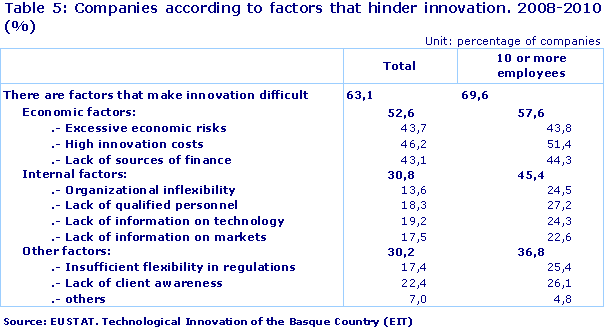
Just over half of companies felt that there were factors that hindered technological innovation
Just over half of companies felt that there were certain factors that hindered technological innovation (58.7%). Amongst these factors, the economic ones stand out. Companies pointed to the high costs involved in implementing innovation (46.2%), along with the economic risks, which they considered to be excessive (43.7%) and the lack of funding sources (43.1%). Amongst companies with 10 or more employees, this percentage rose to 69.6%, with the same hindrances highlighted.
30.8% of innovating companies with 10 or more employees had used some kind of patent or other methods of protection for their inventions or innovations
It is worth mentioning that during the 2008-2010 period, 30.8% of innovating companies with 10 or more employees used some kind of patent or other method of protection. In these companies in this period, 11% requested some kind of patent to protect inventions or innovations developed in their establishment and 13.8% had one in force by the end of 2010. As for other methods of protection, 24.8% of innovating companies with 10 or more employees had used one in the aforementioned period. Amongst these the registering of trademarks (22.6%) and of designs or models (13.9%) stood out.
38.9% of companies of 10 or more employees implemented innovation (technological or non-technological) in the Basque Country in the 2008-2010 period
On the other hand, if we also take into account non-technological innovation in the Basque Country, 19.8% of companies were innovators (technological or non-technological innovation) in the 2008-2010 period. This percentage was obtained by taking into account non-technological innovation (11.8% of companies) as well as technological innovation (13.8% of companies). Taking into account only companies of 10 or more employees, the percentage of innovating companies (technological or non-technological) stood at 38.9%.
Non-technological innovation is composed of organisational innovation or innovation related to marketing.
Organisational innovation consists of the implementation of new organisational methods in the internal functioning of the company, and was carried out by 8.3% of Basque companies, whilst marketing innovation is the execution of new commercial strategies or concepts that are significantly different to previous ones and that have not been used before, which was the case in 6.5% of all companies in the Basque Country.
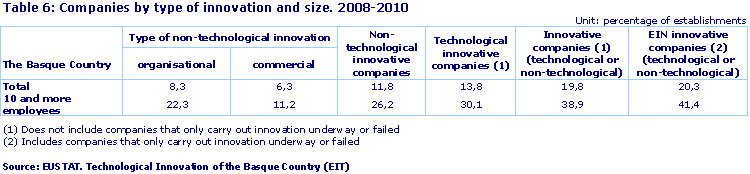
As regards companies with 10 or more employees, those that implement innovation of any kind represented 38.9% in this period.
This figure was reached taking into account that 30.1% of these companies implemented technological innovation and 26.2% non-technological innovation.
The figure for non-technological innovation, for its part, and for this size of company, was obtained from 22.3% implementing organisational innovation and 11.2% marketing innovation.
�It can also be added that, if we also take into account companies that solely had innovation in progress or innovation that was unsuccessful, the so-called EIN companies, the percentage of those with 10 or more employees that implemented innovation accounted for 41.4%.
Methodological note: The Survey on Technological Innovation EIT 2009 includes the National Classification of Economic Activities 2009 (CNAE-2009).
CNAE-93 and CNAE-2009 classification of activities
For further information:
Basque Statistics Office
C/ Donostia-San Sebastián, 1 01010 Vitoria-Gasteiz
Tlf:+34-945-01 75 00 Fax:+34-945-01 75 01 E-mail: eustat@eustat.eus
Contact: José Miguel Escalada
Tlf:+34-945-01 75 96 Fax:+34-945-01 75 01
Further press releases on the Technological Innovation of the Basque Country (EIT) Survey
Databank on the Technological Innovation of the Basque Country (EIT)Survey