Press release 29/07/2011
Spending on Social Services per inhabitant in the Basque Country was up by 14% in 2009
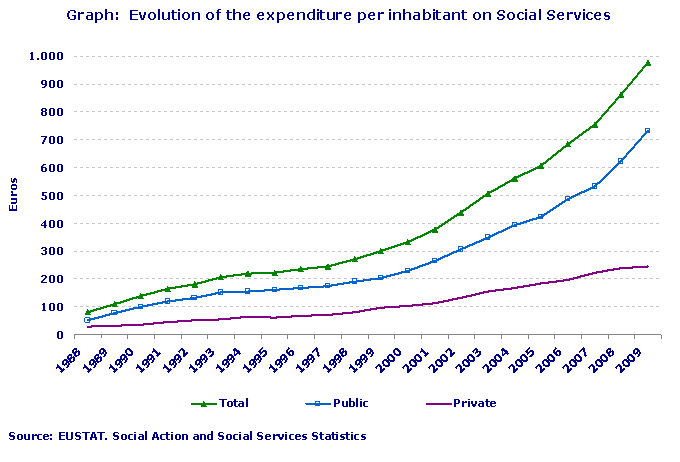
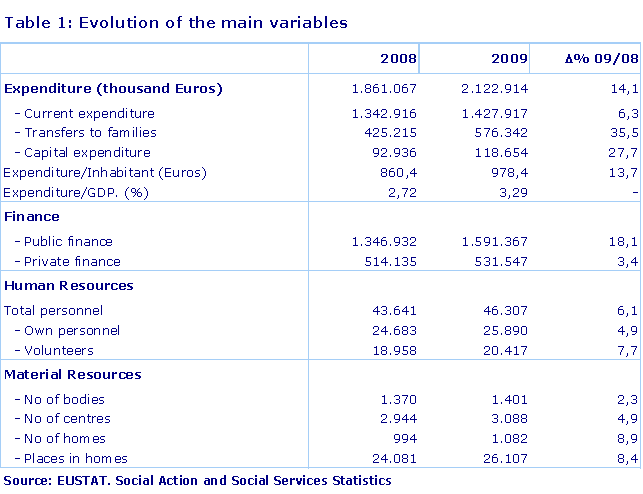
Spending on social services in the Basque Country stood at 2,123 million euros, 14.1% up on the previous year, according to Eustat data. This expenditure represented 3.3% of Basque GDP and average spending per inhabitant was 979 euros, 13.7% up on the previous year, 734 euros of which came from public funds.
By province, spending rose by 6.5% in Álava, by 16.2% in Bizkaia and by 14% in Gipuzkoa. In per-capita terms, Álava, with an average of 1049 euros per inhabitant, remained ahead of the 984 euros of Bizkaia and 939 of Gipuzkoa.
The contribution from the different public authorities came to 1,347 million euros, which represented 75% of expenditure, whilst the remaining 25% came from the private sector. One out of every five euros spent was financed by user contributions and other sales. The elderly in residential homes contributed 213.5 million euros of this total, which accounted for 50% of the current expenditure of these centres.
�
The sector directly employed 4.1% of working women
In 2009, social services overall generated 1207 new jobs and directly employed 25,890 people (2.76% of people in employment), of which 70% were women (4.5% of women in employment). This figure does not include subcontracted workers, home helpers or direct carers, whose total hours worked were the equivalent of over 6,000 full-time jobs. Furthermore, in 2009 there were 20,417 volunteers, who work free of charge for the social services, and this represented an equivalent of 1840 full-time jobs.
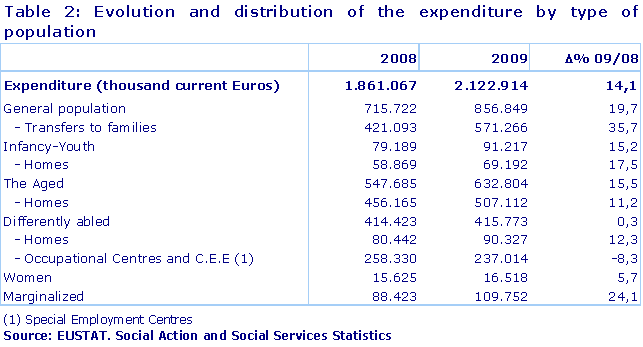
Amongst the diversity of the social services, the services for the population as a whole and for the elderly stand out as the areas to which the greatest amount of resources were dedicated, as between the two they represented 70% of the expenditure.
Amongst the resources for the population as a whole, transfers to families, particularly Guaranteed Basic Income (RGI, which includes the supplementary PAGAMI payment) were the programmes that were particularly noteworthy, due to their size and evolution, with 265 million euros (+31%) and Social Emergency Aid (AES), with 62 million (+37%).
�
These two benefit payments, related to the fight against poverty, are financed almost completely by the autonomous Administration and managed in collaboration with regional and municipal administrations. Combined, in 2009 they represented an expenditure of 151 euros per inhabitant of the Basque Country, with their incidence noteworthy in Bizkaia, where they stood at 202 euros per inhabitant, a figure greatly superior to the 135 euros in Álava and the 74 euros in Gipuzkoa.
With regards to care for the elderly, in 2009 there were 19,533 residential places, which meant a coverage of 4.7 places per 100 elderly persons aged 65 and over. The public administration offered 35% of these places through publicly-funded centres and agreed a similar percentage (30%) with private institutions.
With respect to day-care centres, the number of places offered came to 3884, with 5% more than in 2008. The public administration offered 83% of these places directly or by means of agreements with the private sector.
For further information:
Basque Statistics Office
C/ Donostia-San Sebastián, 1 01010 Vitoria-Gasteiz
Tel: +34-945-01 75 00 Fax:+34-945-01 75 01 E-mail: eustat@eustat.eus
Contact: Matxalen Plagaro
Tel+34-945-01 75 99 Fax:+34-945-01 75 01
More press releases about Social Action and Social Services Statistics in the Basque Country
Social Action and Social Services Statistics in the Basque Country Databank