Press Release 27/05/2009
INDUSTRIAL DISTRICT STATISTICS 2007
The Goierri, Markina-Ondarroa and Cantábrica Alavesa districts headed industrial growth in the Basque Country in 2007
Half the industrial wealth and 46.7% of jobs were concentrated in the districts that are home to the three provincial capitals
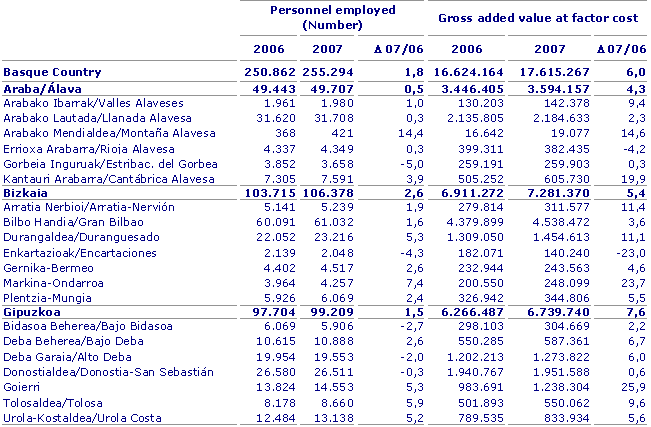
Three districts, one in each province, headed industrial growth in the Basque Country in 2007: Goierri (25.9%), Markina-Ondarroa (23.7%) and Cantábrica-Alavesa (19.9%), according to Eustat data. Furthermore, the three accounted for 25% of the contribution to increasing industrial added value. Encartaciones (-23%) and Rioja Alavesa (-4.2%) were at the other end of the scale and werethe only two to register negative growth of their added value.
The provincial capitals and their catchment areas continue to generate practically half the industrial wealth, even though it was slightly down on 2006. Specifically, the Gran Bilbao district, the Llanada Alavesa (which includes Vitoria-Gasteiz) and Donostialdea together generated 49.2% of the 2007 industrial added value. 25.7% was generated in the Gran Bilbao district, 12.4% in the Llanada Alavesa and 11.1% in Donostialdea. Overall, the industrial employment rate stood at 119,251 people, i.e., 46.7% of the workforce employed in the industrial sector of the three provinces.
By provinces, Gipuzkoa posted the greatest growth (7.6%) and was also the only province where all the districts recorded positive growth. In addition to the Goierrri, Tolosa (9.6%), Bajo Deba (6.7%) and Alto Deba (6%) posted growth over the average for the Basque Country and accounted for 54% of the province’s added value and 20.7% for the Autonomous Community as a whole. Donostialdea registered the lowest growth in the province (0.6%), even though its contribution to the total (29%) is less than that of the other districts that include the capitals.
Bizkaia was the second province in terms of growth, 5.4%, and generated 41.6% of the industrial added value of the Basque Country and provided jobs in this sector for 103,715 people (41.3%). In this province, Markina-Ondarroa was the district with greatest growth (23.7%), followed by Arratia-Nervión (11.4%) and Duranguesado (11.1%). The Gran Bilbao district, which accounted for 62% of the industrial wealth of the province, grew under the average (3.6%). The only district to posted negative added value growth was Encartaciones (-23%), which was also the district with the worst results in the Autonomous Community.
Álava, up 4.3% on 2006, accounted for 20.4% of the wealth generated by the industry of the Basque Country. By districts, the greatest growth was registered in Cantábrica Alavesa (19.9%) and Montaña Alavesa (14.6%). At the other end of the scale, the Rioja Alavesa district posted negative growth of -4.2% and Estribaciones del Gorbea with 0.3%. The Llanada Alavesa, where the Basque capital is located and which contributed 61% of the industrial added value of the province, was up by 2.3%.
�
Industrial employment in the Basque Country rose to 255,294 people in 2007. 46.7% of this industrial employment was concentrated in the Llanada Alavesa, Gran Bilbao and Donostialdea districts, even though the district where there was the greatest increase in the number of workers was the Duranguesado (Bizkaia) with 1,164 jobs more than in 2006.
The districts posting the greatest percentage increases in employment were Montaña Alavesa (14.4%), Markina Ondarroa (7.4%) and Tolosa (5.9%), yet again one from each territory. At the opposite end of the scale, five districts posted negative growth with losses of industrial jobs compared to 2006. These five districts were: Alto Deba, Estribaciones del Gorbea, Bajo Bidasoa, Encartaciones and Donostialdea.
Personnel employed and Added Value at industrial factor cost by regions. 2007. Thousands of euros.
Source: EUSTAT
For further information:
Basque Statistics Office
C/ Donostia-San Sebastián, 1 01010 Vitoria-Gasteiz
Tlf:+34-945-01 75 00 Fax:+34-945-01 75 01 E-mail: eustat@eustat.es
Contact: Iosune Azula Lazkano
Tel:+34-945-01 75 06 Fax:+34-945-01 75 01
Online press releases: www.eustat.es
Databank: www.eustat.eus/bancopx/spanish/english.aspx