Hotel clustering
Introducción 
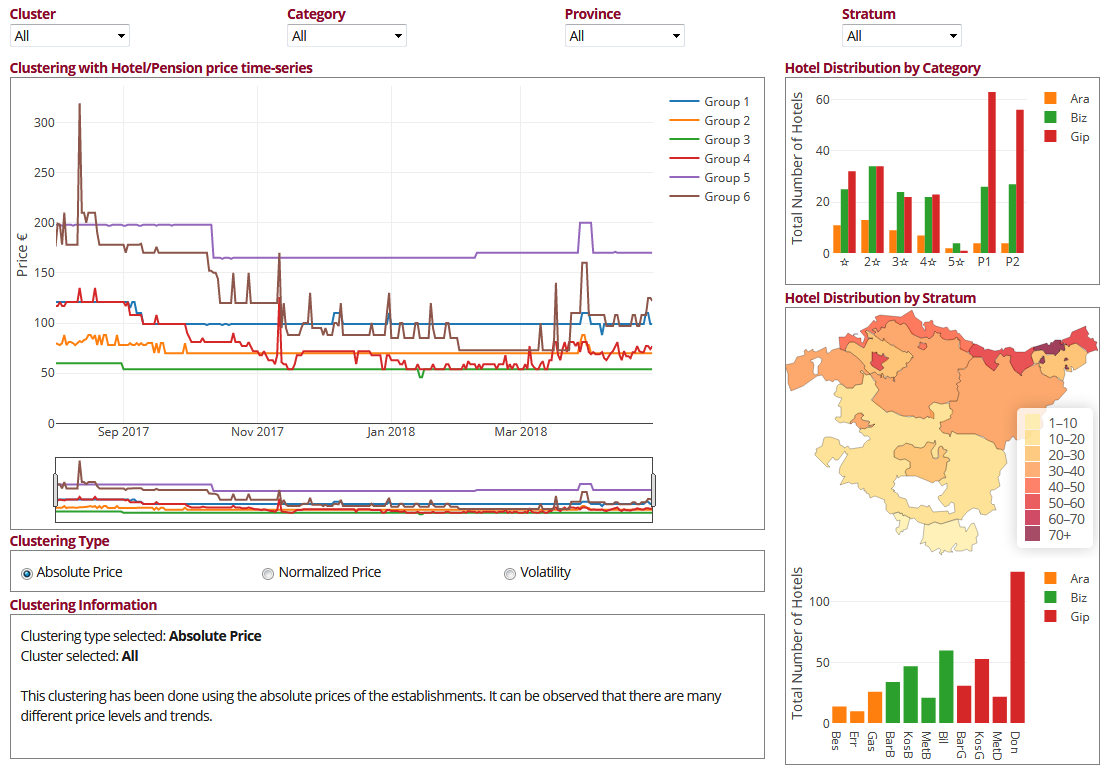
The Clustering application is a tool that groups establishments in the Basque Country using daily prices. These prices were collected via web-scraping methods on platforms offering room reservations at hotel establishments
To obtain the daily prices, 120 consultations per establishment were conducted every day, that is, the prices for the following 120 days were requested for every day and hotel/guesthouse. After obtaining the prices, the average of all of these 120 possible daily prices was selected for analysis.
Selection of cluster and filters
The 4 selectors on the top of the application are mainly divided into 2 parts:

- Cluster: via this selector you can choose to show one cluster in particular or all at once. Selecting the option All will show all of the groups in the first graph; the other graphs will show the absolute data of the establishments disaggregated by category and stratum. Also, selecting one cluster in particular will depict that cluster and the percentage of hotels corresponding to that group, again disaggregated by category and stratum.
- Category, Historical Territory and Stratum: these 3 selectors are simply filters which can be applied to the establishments.
Type of Clustering
The graph offers the option to select the type of clustering conducted for this application:

- Absolute Prices: the establishments have been grouped using the original prices. The objective is to group the hotels and guesthouses by different price ranges and different trends.
- Normalised Prices: for this clustering the hotel prices have been normalised from 0-100 in order to capture different seasonal price trends. On the one hand are those with constant or nearly constant prices, assigned a value of 100, and on the other are those who change their prices depending on the time of year or public holidays.
- Volatility: in this case the daily change in price has been studied. This was done using the close-to-close estimator, based on the manual from the TTR library on R.
In the first 2 cases, the clustering of the seasonal price series was conducted using the Euclidean distance, after trying different distances in libraries such as
TSdist, TSclust
y dtw
Distribution of Hotels by Category
The bar graph appearing with this heading disaggregates the hotels by category. Depending on the option selected in the Cluster selector, its meaning will change slightly.
-
All is selected in the Cluster selector, the graph will show all of the establishments that were found via web-scraping, disaggregated by category. That is, the absolute data are portrayed.
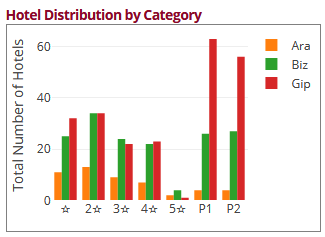
- On the other hand, if a specific cluster is selected in the Cluster selector, the diagram shows the percentage data. What appears in this case is the percentage of hotels and guesthouses belonging to the selected cluster.
Distribution of Hotels by Stratum
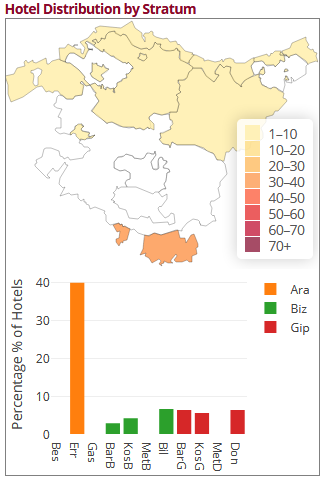
The map and bar graph appearing with this heading disaggregate the hotels into 11 different strata. Depending on the option selected in the Cluster selector, its meaning will change slightly.
- If the option All is selected in the Cluster selector, the graph and map will show all of the establishments that were found via web-scraping, disaggregated by geographical stratum. That is, the absolute data are portrayed.
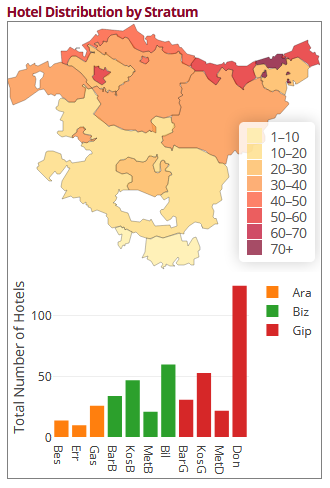
- On the other hand, if a specific cluster is selected in the Cluster selector, the diagram and map show the percentage data. What appears in this case is the percentage of hotels and guesthouses belonging to the selected cluster.
Technique
This tool uses the libraries Leaflet (to create the map) and Plotly (for the seasonal series and bar graphs). The use of JavaScript enables it to be interactive, and you must therefore have the JavaScript option active in your browser.