Press release 22/12/2025
SOCIAL PROTECTION ACCOUNT. 2024 Preview
Expenditure on social protection in the Basque Country totalled 25,910 million euros in 2024, an increase of 6.3% on the previous year
Expenditure per inhabitant stood at 11,707 euros, representing 26.4% in terms of GDP
Total expenditure on social protection in the Basque Country in 2024 amounted to 25,910 million euros, representing an increase of 6.3% compared to 2023, equivalent to an additional 1,531 million euros, according to Eustat data. In terms of GDP, this expenditure rose from 26.1% in 2023 to 26.4% in 2024, an increase of three tenths of a percentage point. Meanwhile, per capita spending increased by 5.8%, from 11,070 to 11,707 euros in 2024.
The Social Protection Account is prepared using the methodology of the European System of Integrated Social Protection Statistics (ESSPROS) and calculates the income and expenditure of the social protection systems in the Basque Country for any public or private body. Expenditure on social protection includes administrative expenses and spending on social benefits; the latter include both cash payments and benefits in kind that households receive from the social protection systems.
Main data and indicators of social protection in the Basque Country. 2022-2024


| |
2022 |
2023 (p) |
2024 (a) |
2023(p)/2022 (%) |
2024(a)/2023 (%) |
| Total expenditure on social protection |
|
|
|
|
|
| Millions Euros |
22,617 |
24,379 |
25,910 |
7.8 |
6.3 |
| In % of GDP p.m |
26.1 |
26.1 |
26.4 |
0,0* |
0,3* |
| In Euros per inhabitant |
10,320 |
11,070 |
11,707 |
7.3 |
5.8 |
| PPP per inhabitant |
11,045 |
12,153 |
12,908 |
10.0 |
6.2 |
| Expenditure on social benefits by functions (thousand euros) |
|
|
|
|
|
| TOTAL |
22,351 |
24,096 |
25,617 |
7.8 |
6.3 |
| Illness/Health care |
6,163 |
6,356 |
6,811 |
3.1 |
7.2 |
| Invalidity |
1,394 |
1,511 |
1,527 |
8.4 |
1.1 |
| Old age |
9,781 |
10,756 |
11,546 |
10.0 |
7.3 |
| Survivors |
2,062 |
2,236 |
2,343 |
8.4 |
4.8 |
| Family/ Children |
803 |
926 |
953 |
15.3 |
2.9 |
| Unemployment |
1,158 |
1,205 |
1,248 |
4.1 |
3.6 |
| Housing |
199 |
231 |
232 |
16.1 |
0.4 |
| Social exclusion |
791 |
875 |
957 |
10.6 |
9.4 |
| INDICATORS (euros) |
|
|
|
|
|
| Expenditure on social benefits per inhabitant |
10,198 |
10,941 |
11,575 |
7.3 |
5.8 |
| Expenditure on social benefits per inhabitant In PPC(1) |
10,915 |
12,012 |
12,762 |
10.1 |
6.2 |
| Expenditure on the function "Illness / health care" per inhabitant |
2,812 |
2,886 |
3,078 |
2.6 |
6.6 |
| Expenditure on the function "Old Age" per person aged 65 and over |
19,054 |
20,506 |
21,607 |
7.6 |
5.4 |
| |
| GDPm.p. ESA2010. Base2022 (in million of euros) |
86,714 |
93,243 |
98,290 |
7.5 |
5.4 |
| Average population |
2,191,631 |
2,202,376 |
2,213,109 |
0.5 |
0.5 |
(1)purchasing power parity
(*)difference in percentage points
(p)provisional
(a)advanced data
Date December 22, 2025
Source: Eustat. Social Welfare Account
Out of the total expenditure on social protection, 25,617 million corresponded to expenditure on social benefits, and 293 million to administrative expenses. Expenditure on social benefits rose by 6.3% in 2024, that is, an increase of 1,521 million on 2023.
Analysis of expenditure on social benefits by function
The breakdown of social benefits shows the functions on which expenditure was incurred, all with increases in 2024.
-The "Social Exclusion" function registered the highest percentage growth, 9.4%, that is, up 82 million on the previous year, standing at 957 million in 2024.
-The "Old Age" function includes spending on pensions, financial benefits related to dependence and other benefits in kind, such as residential services and home care. It rose by 7.3%, comprising the expenditure with the greatest increase in absolute values - up 790 million on 2023 - and stood at 11,546 million in 2024. However, this growth was lower than the 10.0% recorded the previous year. As in previous years, the most significant increase was seen in the amount of cash retirement benefits, up 666 million on 2023.
-The "Illness/Healthcare" function, which includes expenditure on healthcare services and cash benefits for short-term incapacity, rose by 7.2%, an increase of 455 million compared to 2023, standing at 6,811 million.
-The "Survivors" function, including primarily pensions for widows/widowers and orphans, rose by 4.8%, up 107 million, amounting to 2,343 million in 2024.
-Spending on "Unemployment" stood at 1,248 million, representing an increase of 3.6%, 43 million higher than the previous year. The "Family/Children" function increased by 2.9%, standing at 953 million euros.
-Expenditure on "Disability" was up 1.1%, amounting to 1,527 million euros.
-The "Housing" function registered the lowest growth, with an increase of 0.4% and a total outlay of 232 million euros in 2024
An analysis of the percentage weight of each function in the total spending on social benefits shows that the "Old Age" function continued to top the social expenditure list, representing 45.1% of the total in 2024 (up 0.5 percentage points on 2023).
The next highest ranking expenditure corresponded to the "Illness/Healthcare" function, with 26.6% of spending on social benefits, also with greater weight than in 2023 (0.2 percentage points).
For its part, "Social exclusion" increased its weight to 3.7%, compared to 3.6% in 2023.
The percentage weight of the other functions decreased: "Survivors" (9.1%), "Disability" (6.0%), "Unemployment" (4.9%), "Family/Children" (3.7%) and "Housing" (0.9%).
Period availables
Participation of institutional units in expenditure
In relation to the institutional units that incurred expenditure on social protection, the spending undertaken on the Social Security System and State Administration in 2024 represented 61.7% of the total, an increase of 7.0% on 2023, amounting to 15,981 million. It is worth highlighting the expenditure corresponding to cash benefits for: Old age, 9,652 million, Survivors (2,202 million) and Short-term incapacity (1,207 million).
Expenditure by group of institutional units and year (million euros). 2021-2024
| |
2021 |
2022 |
2023 (p) |
2024 (a) |
Annual variation rate (%) |
| |
|
|
|
|
2022/21 |
2023(p)/22 |
2024 (a)/23 |
| Social Security System and State Administration |
13,487 |
13,784 |
14,938 |
15,981 |
2.2 |
8.4 |
7.0 |
| Basque Administration |
7,064 |
7,316 |
7,869 |
8,312 |
3.6 |
7.6 |
5.6 |
| Private Institutions |
1,460 |
1,517 |
1,572 |
1,617 |
3.9 |
3.6 |
2.9 |
| Total expenditure on social protection |
22,011 |
22,617 |
24,379 |
25,910 |
2.8 |
7.8 |
6.3 |
(p)provisional
(a)advanced data
Date December 22, 2025
Source: Eustat. Social Welfare Account
The expenditure incurred by the Basque Administrations amounted to 8,312 million, representing 32.1% of the total, up 5.6%. This increase was due, on the one hand, to a 5% increase in the "Illness/Healthcare" function, amounting to 4,991 million euros; and, on the other, to spending on the public social services system as a whole, including the institutions of the Basque Government, Provincial Councils and Local Administration, which increased by 6.6% to 3,321 million euros. Of particular note was the expenditure on "Social Exclusion", 860 million, "Old Age", 811 million and "Family/Children", 620 million.
Lastly, Private institutions contributed 1,617 million, 6.2% of the total, up 2.9%.
European comparison of spending on social protection
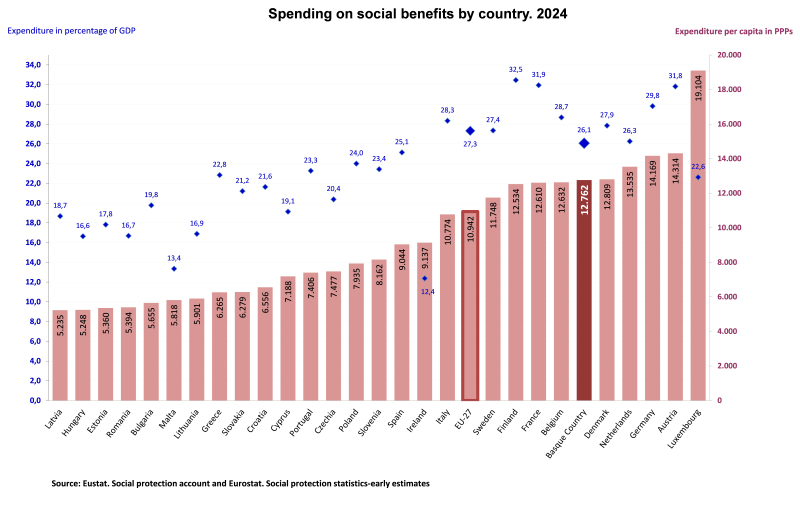
In comparison with Europe, the trend in expenditure as a share of GDP is similar to that registered by neighbouring countries in Europe. The level in relation to GDP peaked in 2020 and decreased over the following years, rising slightly in 2024.
In the Basque Country in particular, spending on social benefits as a percentage of GDP rose by 0.2 percentage points in 2024 and stood at 26.1%, placing it above Spain (25.1%) and below the EU-27 score of 27.3%, which was up 0.6 percentage points on the previous year, according to Eurostat estimates for 2024.
Lastly, total expenditure on social benefits per inhabitant measured in Purchasing Power Parity (PPP) in the Basque Country was 12,762, higher than the averages for the EU-27 (10,942), Spain (9,044) and France (12,610), among others. The table was topped by Luxembourg (19,104) and Austria (14,314).
For further information:
Eustat - Euskal Estatistika Erakundea/Basque Statistics Institute
C/ Donostia-San Sebastián, 1 01010 Vitoria-Gasteiz
Press Service: servicioprensa@eustat.es Tel.: 945 01 75 62