Press Release 31/07/2025
UNIVERSITY STATISTICS 2024
The number of enrolments at universities in the Basque country increased by 2.5% in the 2023/24 academic year
Dual degrees were up 18% at public universities
In the 2023/24 academic year, there were 72,915 enrolments at universities with centres located in the Basque Country, 2.5% more than in the previous year, according to Eustat data. The rise in enrolments was seen at all university levels.
Enrollments registered in the universities of the Basque Country by level of studies. 2023/24
| | Total | Men | Women | Public | Private | Variation with respect to the previous course (%) |
| | | | | | | |
| Total | 72.915 | 33.324 | 39.591 | 49.662 | 23.253 | 2,5 |
| | | | | | | |
| Degrees | 61.379 | 27.596 | 33.783 | 41.455 | 19.924 | 2,4 |
| Post-graduate | 11.536 | 5.728 | 5.808 | 8.207 | 3.329 | 3,1 |
| Official Masters | 6.752 | 3.323 | 3.429 | 4.107 | 2.645 | 3,3 |
| Doctorate | 4.784 | 2.405 | 2.379 | 4.100 | 684 | 2,7 |
Date July 31, 2025
Source: Eustat. University statistics
Growth was uneven between the public and private systems. While public universities accepted 606 students more than in the 2022/23 academic year, the number of enrolments at privately owned universities increased by 1,167. In relative terms, these figures translated into rises of 1.2% and 5%, respectively. Despite this, public universities continued to educate the majority of students (68.1%), especially when it came to doctorates (85.7%).
Dual degrees maintained the upward trend of recent years and registered more than 3,700 enrolments, 11.9% more than in the previous academic year. Once again, growth was uneven between public and private centres. However, in this regard, there was higher growth in the public system, which recorded a 17.7% increase in the number of enrolments in dual degrees, compared to a rise of 6.6% at private universities.
The most popular joint degree was the one combining Business Management and Administration and Law, with 796 students, followed by the dual degree in Primary Education and Physical Activity and Sport Sciences, with 416 enrolments.
Business Management and Administration, Primary Education and Law topped the list of most popular degrees
Three degrees accounted for 22% of undergraduate students. They were Business Management and Administration, Primary Education and Law degrees, which held the top positions in the ranking of degrees with the highest number of enrolments among both men and women. However, the remaining top ten degrees in terms of enrolment numbers were very different for men and women. While the men’s ranking included several engineering degrees, the women’s ranking was dominated by health and social degrees.
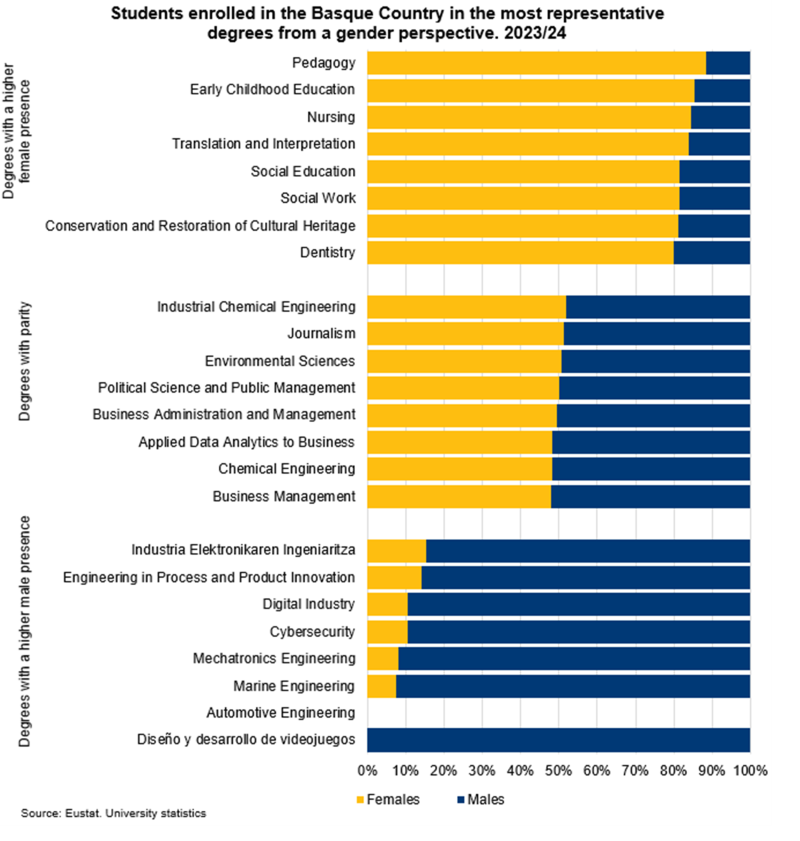
Looking at the data from the perspective of gender distribution within each degree, the results were the same as in recent years. Pedagogy and Early Childhood Education were the most female-dominated degrees, as 88.4% and 85.3% of their students were women, respectively.
At the opposite end of the scale were Automotive Engineering, Marine Engineering and Mechatronic Engineering degrees, where only one in ten students were women. Of particular note was the case of the Video Game Design and Development degree, which was offered for the first time in the 2023/24 academic year and debuted with a small group composed entirely of men.
Among the degrees with the greatest balance between men and women were several from the field of organisation management, such as Business Management and Administration, Business Management, Political Science and Public Management, and Applied Business Data Analytics.
Public universities taught more in Basque and private universities taught more in English
With regard to the language in which students at Basque universities received their education, it is worth noting that more than half of credits were taught in Spanish (54.6%), while the use of Basque and English stood at 37.7% and 7.3%, respectively. The presence of other languages, such as French or German, was residual. However, whether the academic centre was publicly or privately owned, as well as the level of education (undergraduate or master’s), influenced the distribution of the languages of instruction.
In this regard, Basque was more present in public universities than private universities. Specifically, the proportion of credits taught in Basque in the public sphere was 16 percentage points higher than in the private sphere. In contrast, private universities overtook public universities in terms of teaching in English.
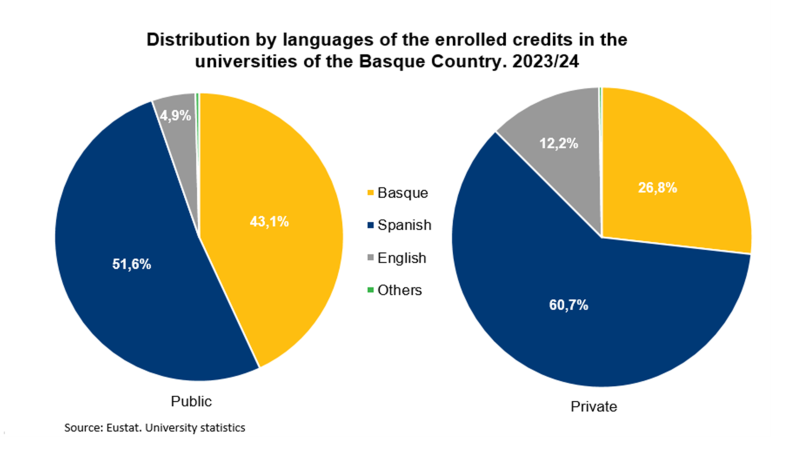
As regards the distribution by level of education, it is important to note that, in comparison with undergraduate studies, where the distribution was similar to that mentioned above, Spanish gained prominence in master’s degrees to the detriment of Basque. Thus, seven out of ten credits in master’s programmes were taught in Spanish. The remaining credits were distributed equally between Basque and English.
The number of doctoral theses that were successfully completed increased by 8.1%
The number of graduates from Basque universities rose to 14,608 in the 2023/24 academic year, 2.4% higher than in the previous year. Growth was seen at all academic levels, but especially at doctoral level, where 669 doctoral theses were successfully completed, 50 more than in 2022/23, representing an increase of 8.1%.
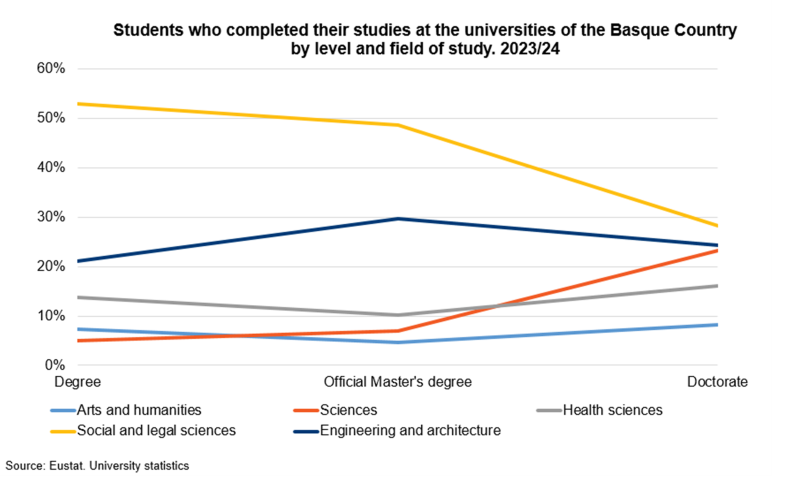
The distribution of degree holders by branch of study varied across the levels of education. Although more than half of graduates obtained a degree in the Social and Legal Sciences branch, only one in four new doctors presented a doctoral thesis in this field. The opposite was true in the Sciences branch. Only 5% of people who completed undergraduate studies obtained a scientific degree in subjects such as Biology, Chemistry or Mathematics, among others. However, this proportion rose to 23.2% for doctoral degrees.
There was parity among university teaching staff
There were nearly 10,400 staff members at Basque universities. Six out of ten were teachers and one in ten worked exclusively on research. The rest carried out technical, management, administrative and service tasks.
There was an even gender distribution among both teaching and research staff. However, management and administration teams were made up of twice as many women as men.
For further information:
Euskal Estatistika-Erakundea / Basque Statistics Institute
C/ Donostia-San Sebastián, 1 01010 Vitoria-Gasteiz
Press Service: servicioprensa@eustat.eus Tel.: 945 01 75 62