Press release 21/03/2025
ENVIRONMENTAL ACCOUNTS: ENVIRONMENTAL TAXES ACCOUNT. ADVANCE. 2023
Environmental taxes in the Basque Country stood at 1,398 million euros in 2023, up 11.4% on the previous year
Environmental taxes accounted for 7% of all taxes in the Basque Country in 2023
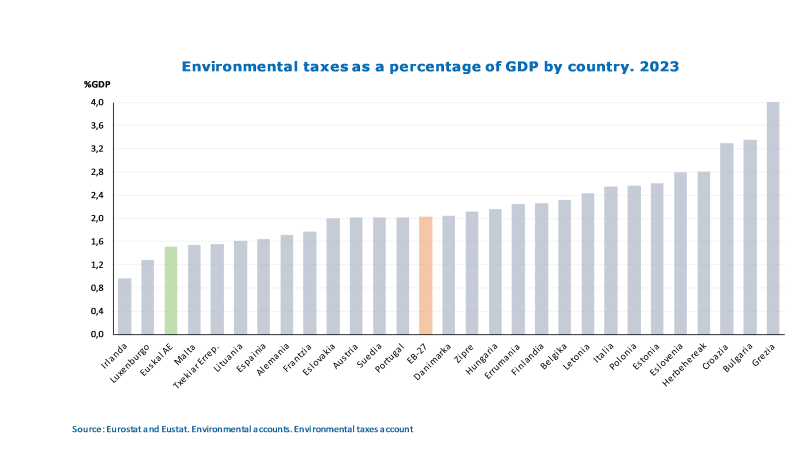
Environmental taxes in the Basque Country constituted 1,398 million euros in 2023, 143 million more than the previous year (+11.4%), corresponding to 1.5% of GDP, according to the Environmental Taxes Account prepared by Eustat.
This account is part of the Environmental Accounts System and is prepared following Eurostat methodology. Its framework comprises all taxes whose tax base is a physical unit (or a proxy of it) of something that has a proven, specific negative impact on the environment and which is defined in the European System of Accounts (SEC2010) as a tax.
With regard to total taxes in the Basque Country, environmental taxes represented 7% in 2023, four tenths more than in 2022.
Based on criteria of an environmental nature, environmental taxes are grouped into three categories: Energy taxes, Transport taxes and Taxes on pollution and resources.
Environmental Taxes in the Basque Country by environmental nature (thousand euros). 2019-2023
| | 2019 | 2020 | 2021 | 2022 | 2023(a) | Annual variation rate (%) |
| | | | | | | 2020 /2019 | 2021 /2020 | 2022(p) /2021 | 2023(a) /2022(p) |
| TOTAL ENVIRONMENTAL TAXES | 1.387.462 | 1.170.753 | 1.388.771 | 1.255.353 | 1.398.090 | -15,6 | 18,6 | -9,6 | 11,4 |
| TAXES ON ENERGY | 1.211.335 | 1.005.469 | 1.220.078 | 1.078.976 | 1.185.763 | -17,0 | 21,3 | -11,6 | 9,9 |
| TAXES ON TRANSPORT | 165.048 | 154.150 | 157.681 | 162.574 | 163.957 | -6,6 | 2,3 | 3,1 | 0,9 |
| TAXES ON CONTAMINATION AND RESOURCES | 11.079 | 11.134 | 11.012 | 13.803 | 48.370 | 0,5 | -1,1 | 25,3 | 250,4 |
(a)Advanced data
(p)Provisional data
Date March 21, 2025
Source:Eustat. Environmental accounts. Environmental taxes account
Of particular note was the sharp rise in revenue generated by Taxes on Pollution and Resources, primarily due to the inclusion of two new taxes
As regards the types of environmental taxes, energy taxes registered the highest amount, reaching 1,186 million in 2023, accounting for 84.8% of total environmental taxes, following an increase of 9.9% compared to 2022. This was a direct consequence of the evolution of the Special Hydrocarbon Tax, which, with 964 million, represented 81.3% of energy taxes and posted an increase of 7.2%, i.e. 65 million more than in 2022.
Within this group, the Special Hydrocarbon Tax was followed by Greenhouse Gas Emission Rights, which saw notable growth over the last two years. Specifically, they rose by 57% in 2022 and 22% in 2023, amounting to 171 million, 31 million more than in 2022.
The Energy Savings and Efficiency Plan Surcharge and the CORES Resource posted more modest positive performances. The former, with 24 million, doubled its figures in comparison with 2022 (105.4%), and the latter saw an increase of 14.3%, reaching 16 million.
In the same group, the Tax on the Value of Electricity Production and the Special Tax on Electricity together accounted for a total of 9 million, 5 million less than the previous year, representing a decrease of 37.2% compared to 2022. This performance was caused by the emergency measures taken at the time to mitigate the impact of escalating prices on retail electricity markets.
Secondly, transport taxes contributed 164 million euros in 2023, 0.9% more than the previous year, representing 11.7% of all taxes of an environmental nature. Of particular note in this category was the Tax on Mechanical Traction Vehicles, which, at 137 million euros in 2023, accounted for 83.4% of this group of taxes.
Lastly, taxes on pollution and resources contributed 3.5% of all environmental taxes, at 48 million euros, up 35 million on 2022. The sharp rise in this group was caused by the inclusion of two new taxes within taxes on pollution, which aim to encourage waste prevention, preparation for reuse and recycling. The first of these was the Tax on Single-Use Plastic Packaging, and the second was the Tax on Waste Disposal in Landfills; the former accounted for 26 million and the latter 11 million.
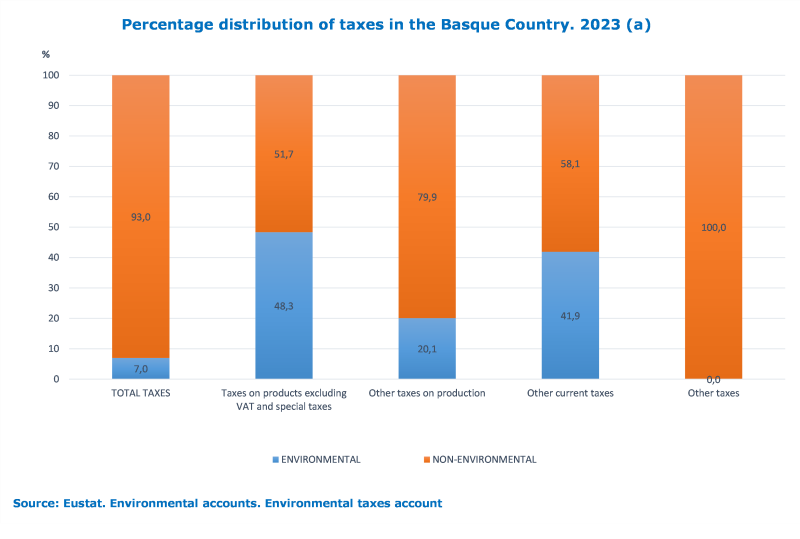
As regards classification by type of tax, the largest proportion of taxes of an environmental nature, 48.3%, were concentrated in Taxes on Products, Excluding VAT and Taxes on Imports; in 2023, the figure stood at 1,075 million, representing 76.9% of all environmental taxes, 3.1 points more than in 2022.
For their part, Other current taxes with an environmental purpose accounted for 41.9%, 1.1 points lower than 2022, amounting to 137 million euros.
Lastly, in Other taxes on production, 20.1%, 2.2 points lower than 2022, corresponded to environmental taxes, with 186 million euros, an increase of 28.7% compared to 2022.
European comparative analysis of the environmental tax burden
Green taxation, measured as the percentage of environmental taxes in GDP, was estimated at 1.5% in the Basque Country in 2023, below countries such as Denmark (2.1%), France (1.8%) and Germany (1.7%), but higher than Ireland (1.0%) and Luxembourg (1.3%). The average for the EU27 stood at 2.0% and for Spain it was 1.6%. At the top of the table were countries such as Greece, Bulgaria and Croatia, with rates above 3%.
Provincial analysis of Environmental Taxes
The distribution of environmental taxes by province for 2023 reveals that Bizkaia accumulated 57% of the total, Gipuzkoa 29.2% and Álava the remaining 13.8%.
Furthermore, although the increase in environmental taxes in 2023 for the Basque Country stood at 11.4%, Bizkaia was notably above average, with a rise of 13.5% compared to 2022, followed by Gipuzkoa, up 9.3%, and Álava with an increase of 7.3%.
Environmental Taxes in the Basque Country by province (thousand euros). 2019-2023
| | 2019 | 2020 | 2021 | 2022(p) | 2023(a) | Annual variation rate (%) |
| | | | | | | 2020 /2019 | 2021 /2020 | 2022 (p) /2021 | 2023(a) /2022(p) |
| BASQUE COUNTRY | 1.387.462 | 1.170.753 | 1.388.771 | 1.255.353 | 1.398.090 | -15,6 | 18,6 | -9,6 | 11,4 |
| ARABA/ALAVA | 218.228 | 175.729 | 216.575 | 180.295 | 193.459 | -19,5 | 23,2 | -16,8 | 7,3 |
| BIZKAIA | 718.442 | 614.017 | 720.087 | 701.699 | 796.555 | -14,5 | 17,3 | -2,6 | 13,5 |
| GIPUZKOA | 450.792 | 381.007 | 452.109 | 373.359 | 408.076 | -15,5 | 18,7 | -17,4 | 9,3 |
(a)Advanced data
(p)provisional data
Date March 21, 2025
Source:Eustat. Environmental accounts. Environmental taxes account
As regards environmental taxes in relation to the respective GDP, in Bizkaia they represented 1.7% in 2023, while in both Gipuzkoa and Álava, they accounted for a more moderate and similar proportion of around 1.3% in 2023.
Note:
The data published today incorporate an update of the data following the European extraordinary revision policy established by Eurostat, which involves regularly revising and updating the statistical sources and estimation methods used to prepare national accounts, by making systematic and coordinated improvements every five years, which means that all European countries carried out a revision of their respective accounts in 2024.
Changes were implemented when revising the Public Administration Accounts 2022, including changes regarding the accounting of taxes and subsidies in accordance with the availability of new sources of information. This revision has had an impact on the data published to date, as the data series for previous years has been recalculated.
For further information:
Eustat - Euskal Estatistika Erakundea/Basque Statistics Institute
C/ Donostia-San Sebastián, 1 01010 Vitoria-Gasteiz
Press Service: servicioprensa@eustat.eus Tel.: 945 01 75 62