Press Release 22/07/2024
POPULATION AND HOUSING CENSUS. HOUSING. 2023
The housing stock in the Basque Country underwent continuous growth between 2013 and 2023, adding a total of 53,896 more units
Dwellings used as primary residences increased by 6,889 compared to 2022
In the last decade, the housing stock in the Basque Country has undergone continuous growth, with a total of 53,896 more units representing an increase of 5.2%, according to Eustat data. By province, there was a similar relative increase in the number of units compared to 2013. It is worth highlighting Álava, with the largest relative rise, 5.6% higher compared to 2013, amounting to 8,997 additional homes. In Gipuzkoa, there was an increase of 17,441 dwellings, up 5.2%, while in Bizkaia the housing stock grew by 27,458 units, representing a relative rise of 5.1%.
As such, as of 1 January 2023, the housing stock in the Basque Country totalled 1,081,647 units. Over half of these dwellings, a total of 560,845, were located in Bizkaia, accounting for 51.9% of the housing stock. In Gipuzkoa there were 351,859 homes, 32.5% of the total, while the remaining 168,943 homes were located in Álava, comprising 15.6% of the total stock.
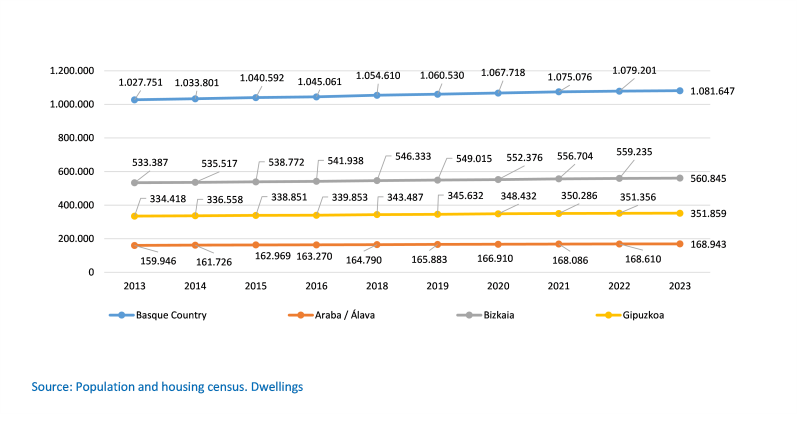
In the Basque Country, dwellings used as primary residences increased by 6,889 units compared to 2022
There were 1,080,582 family dwellings in the Basque Country. 85.6% of them were used as primary residences (925,373 dwellings), while the remaining 14.4% (155,209 dwellings) corresponded to second or unoccupied homes. The proportion has remained at similar levels over the years.
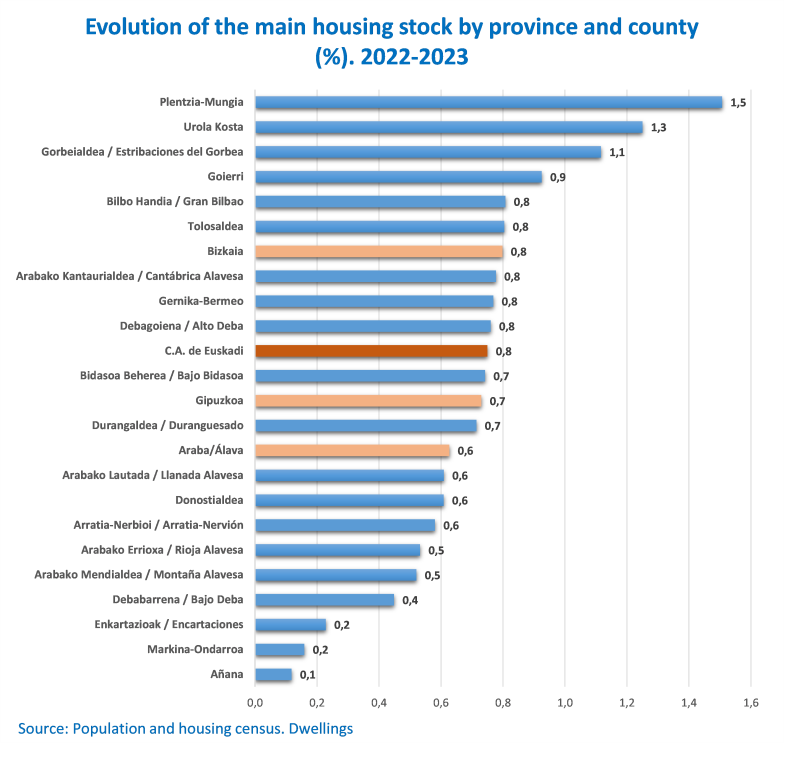
Compared to 2022, the number of primary family homes rose by 6,889 (0.8%), at the expense of the use of second or empty homes, which fell by 4,419 units (-2.8%). Bizkaia registered the highest growth, with 3,831 additional dwellings, representing a rise of 0.8%. In Gipuzkoa, there were 2,180 extra occupied dwellings, an increase of 0.7%. Álava saw growth of 0.6%, amounting to 878 more units than a year ago.
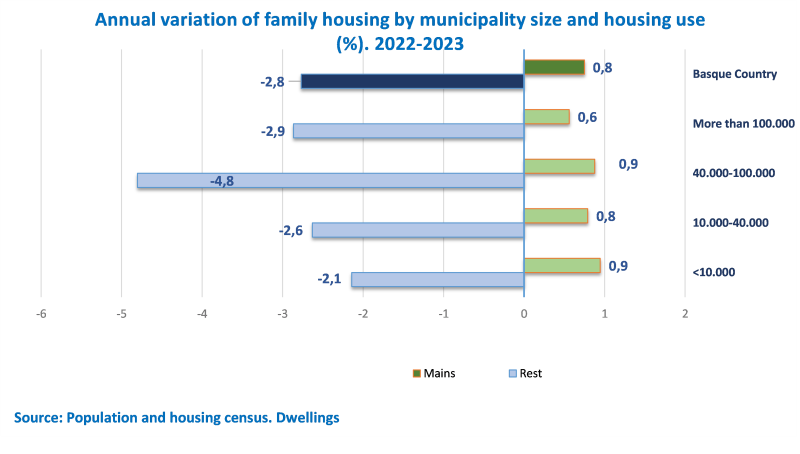
An analysis of the annual variation in the use of housing by size of municipality reveals the same pattern as by province: a drop in the number of non-primary dwellings and an increase in the number of primary dwellings. In particular, in the group of municipalities with a population of between 40,000 and 100,000 residents, including Barakaldo, Basauri, Getxo, Irún, Portugalete and Santurtzi, the percentage of primary residences increased by 0.9% compared to 2022 (0.1 percentage points above the average), while second or empty homes decreased by 4.8% (2 percentage points below the average).
Moreover, the stratum of municipalities with fewer than 10,000 residents was the group where the percentage of non-primary dwellings fell the least, with a drop of 2.1%, below the Basque average of -2.8%, while primary dwellings grew by 0.9%. In the stratum comprising the Basque capitals, the percentage of primary family dwellings increased by more than the Basque Country average compared to the previous year (0.6% compared to an average of 0.8%).
In every region, there was an increase in primary dwellings compared to 2022
At the local level, there were increases in the number of primary residences in every region, with variations ranging from 1.5% in the Plentzia-Mungia region to 0.1% in the region of Añana.
Dwellings under lease increased by 5.1% between 2022 and 2023
In the Basque Country, the most common form of tenancy among the 925,373 primary family homes in 2023 was ownership, representing 83.3% of the total (770.558 dwellings). The province of Bizkaia had a higher level of home ownership than the Basque Country average (84.1%). By contrast, in Gipuzkoa 82.1% of homes were owned and Álava was in the middle position (83%), also below the average.
As regards homes under lease, 137,123 dwellings under lease were recorded, representing 14.8% of the total, while the remaining 1.9%, 17,692 homes, correspond to other types of tenancy, with granting of use rights being the most common. By province, Gipuzkoa and Álava are above the average for leases with 16% and 15.4%, respectively, while 13.9% of homes in Bizkaia are under lease.
In 2023, 6,604 more dwellings under lease were recorded, an increase of 5.1% on the previous period. This growth was registered in both Álava (+3.6%) and Gipuzkoa (+3.5%), but above all in Bizkaia (+6.7%). As regards the provincial capitals: Bilbao registered the greatest rise in dwellings under lease (1,709, 7.3% in relative terms), followed by San Sebastián (582 dwellings, +3.7%) and Vitoria-Gasteiz (663 homes, +3.9%).
Home tenancy classification varied significantly, depending on the size of the municipalities. In the stratum of below 10,000 inhabitants, there was a higher proportion of owned homes, 87.4%, representing a difference of 4.1 percentage points compared to the Basque Country average. This same stratum is noteworthy for having the lowest percentage of dwellings under lease, 10%, 4.8 percentage points lower than the Basque average.
Conversely, in municipalities with over 100,000 inhabitants, the proportion of dwellings under ownership fell to 80.6%. The municipality of Vitoria-Gasteiz is notable as the city with the highest percentage of housing units under ownership, 82.1%. By contrast, it is worth highlighting San Sebastián, where 20.6% of primary residences were under lease, 3 percentage points above the average for its stratum, 4.6 percentage points higher than the average in its province and 5.8 points higher than the Basque Country average.
There was a rise in the number of dwellings with one or two residents and a fall in homes with three or more cohabitees between 2022 and 2023
In 2023 the average number of people occupying a family home in the Basque Country was 2.4. Single-member households comprised 30.5% of the total number of primary family homes, up 0.5 percentage points compared to the previous year, representing an increase of 6,189 units. 56.5% of the total number of new single-member households, more than half, were in Bizkaia, with 3,497 additional units in that province.
In addition, 30.2% of dwellings were occupied by two people, one tenth of a percentage point higher than the previous year. By contrast, family units with three or more residents accounted for 39.3%, five tenths of a percentage point lower than in 2022.
On average, Basque family homes were 48.7 years old with an area of 87.5 m2, between 4 and 5 rooms and 1.4 bathrooms
The average age of the family housing stock in the Basque Country was 48.7. At the provincial level, the most modern housing stock corresponded to Álava at 42.7 years old, followed by Gipuzkoa with an average age of 49.1, whereas Bizkaia, with 50.3, was the province with the oldest housing stock.
The average usable floor area of dwellings in the Basque Country as a whole was 87.5 m2. Álava had the largest family homes with an average of 92.8 m 2, followed by Gipuzkoa with 87 m2 and Bizkaia with 86.1 m2.
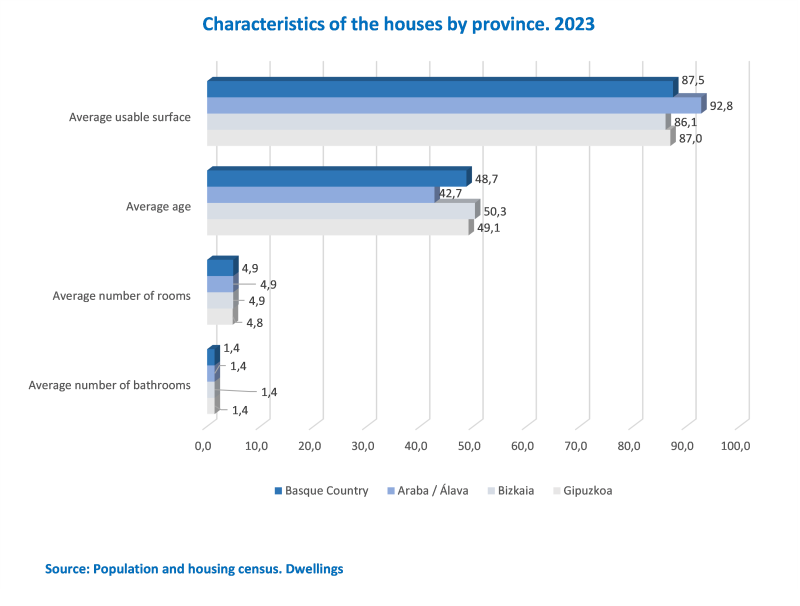
As regards the number of rooms, three quarters of Basque family homes had 4 or 5 rooms (including bedrooms, living room and kitchen) and an average of 1.4 bathrooms. Virtually all the dwellings had at least one bathroom (99.7%).
Lastly, in 2023, 83.1% of primary dwellings in the Basque Country had piped gas in the building. In addition, 74.1% of all primary homes had a lift. These results represent an increase of two and three tenths of a percentage point, respectively, in relation to the presence of these facilities in 2022.
For further information:
Eustat - Euskal Estatistika Erakundea / Basque Statistics Institute
C/ Donostia-San Sebastián, 1 01010 Vitoria-Gasteiz
Press Service: servicioprensa@eustat.eus Tel.: 945 01 75 62