Press Release 30/09/2025
POPULATION AND HOUSING CENSUS. EDUCATION. 01/01/2024
Almost 44% of the population of the Basque Country aged over 15 had completed higher education in 2024
The levels of primary education and lower account for 11.1% of the population aged 15 and over, 7 tenths lower than the previous year
In 2024, 43.9% of the population aged 16 and over residing in the Basque Country had completed higher education, whether university studies or vocational training, according to Eustat data. This group amounts to 836,632 people, an increase of 6 tenths of a percentage point compared with 2023. Meanwhile, the proportion of the population who had completed compulsory education or some lower level is 35.5% (677,007 people), 7 tenths of a percentage point lower than in 2023.
Population aged 16 and over in the Basque Country by level of education attained. 2022-2024


| |
2024 |
2023 |
2022 |
2024 (%) |
2023 (%) |
2022 (%) |
| |
| Level of training achieved |
1,906,571 |
1,895,243 |
1,879,375 |
100 |
100 |
100 |
| |
| A.First stage of secondary and lower education (level 0-2) |
677,007 |
685,830 |
686,009 |
100 |
100 |
100 |
| 0.Less than primary |
28,713 |
30,724 |
31,983 |
4.2 |
1.6 |
1.7 |
| 1. Primary education |
183,951 |
192,741 |
200,395 |
27.2 |
10.2 |
10.7 |
| 2.Low secondary education: up to ESO and equivalent |
464,343 |
462,365 |
453,631 |
68.6 |
24.4 |
24.1 |
| |
| B.Second stage of secondary education and non-tertiary post-secondary education (level 3-4) |
392,932 |
387,896 |
382,308 |
58.0 |
56.6 |
55.7 |
| 3.Upper secondary education: Baccalaureate, intermediate vocational training and equivalent |
381,116 |
376,000 |
370,307 |
56.3 |
19.8 |
19.7 |
| 4.Non-tertiary post-secondary education: level 3 professional certificates and equivalent |
11,816 |
11,896 |
12,001 |
1.7 |
0.6 |
0.6 |
| |
| C.Higher education (including doctorate)(level 5-8) |
836,632 |
821,517 |
811,058 |
123.6 |
119.8 |
118.2 |
| 5.Higher vocational education and equivalents |
298,424 |
291,217 |
291,103 |
44.1 |
15.4 |
15.5 |
| 6.University degrees, diplomas and equivalents |
196,521 |
193,565 |
186,876 |
29.0 |
10.2 |
9.9 |
| 7.Bachelor's degrees, double degrees and master's degrees |
319,821 |
314,962 |
311,523 |
47.2 |
16.6 |
16.6 |
| 8.PhD level or equivalent |
21,866 |
21,773 |
21,556 |
3.2 |
1.1 |
1.2 |
Date September 30, 2025
Source: Eustat. Population and housing census. Education
According to the National Classification of Education (CNED-A), the first education group corresponds to the first stage of secondary education or lower, ranging from basic and compulsory education to lower levels. 35.5% of the population aged 16 and over belonged to this group, a drop of 0.7 points compared to the previous year. This includes 1.5% of people with incomplete primary education, 9.6% with primary education, and 24.4% with the first stage of secondary education completed, including qualifications equivalent to Compulsory Secondary Education, General Basic Education or Elementary Baccalaureate, among others, as well as some vocational training courses.
The second group corresponds to secondary education and post-secondary non-higher education, which comprised 20.6% of the population aged 16 and over, an increase of 0.1 percentage points compared to 2023. This level of education includes upper secondary education and basic and intermediate level vocational training. The third group, higher education, accounted for 43.9% of the population, with another increase of 0.6 points in respect of the previous year. Within this group, 15.7% corresponded to advanced level vocational training, with 298,424 people.
Plentzia-Mungia and Estribaciones del Gorbea reveal the highest proportion with higher education, along with Urola-Costa
An analysis of the level of education attained by the population aged 16 and over, taking into account the disaggregation by province, revealed small percentage differences. Álava registered the highest proportion of people with a level of education belonging to group A, which corresponds to the first stage of secondary education or lower, with 36.7% of the population aged 16 and over. This figure was slightly higher than the 35.6% recorded in Bizkaia and the 34.8% in Gipuzkoa.
Population aged 16 and over in the Basque Country by the level of education achieved according to historical territory (%). 2023-2024
| |
Basque Country |
Araba / Álava |
Bizkaia |
Gipuzkoa |
| |
2024 |
2023 |
2024 |
2023 |
2024 |
2023 |
2024 |
2023 |
| |
| Level of training achieved |
1,906,571 |
1,895,243 |
285,199 |
283,294 |
1,000,326 |
994,166 |
621,046 |
617,783 |
| A.First stage of secondary and lower education (level 0-2) |
35.5 |
36.2 |
36.7 |
37.3 |
35.6 |
36.4 |
34.8 |
35.3 |
| B.Second stage of secondary education and non-tertiary post-secondary education (level 3-4) |
20.6 |
20.5 |
21.9 |
21.6 |
20.2 |
20.0 |
20.7 |
20.8 |
| C.Higher education (including doctorate)(level 5-8) |
43.9 |
43.3 |
41.4 |
41.1 |
44.2 |
43.6 |
44.4 |
43.9 |
Date September 30, 2025
Source: Eustat. Population and housing census. Education
As for group B, which includes the second stage of secondary education and post-secondary non-higher education, Álava once again had the highest percentage of 21.9%, compared to 20.7% in Gipuzkoa and 20.2% in Bizkaia. However, in the case of group C, which represents higher education, Gipuzkoa recorded the highest proportion with 44.4%, followed by Bizkaia with 44.2%, while Álava was slightly below this, with 41.4%.
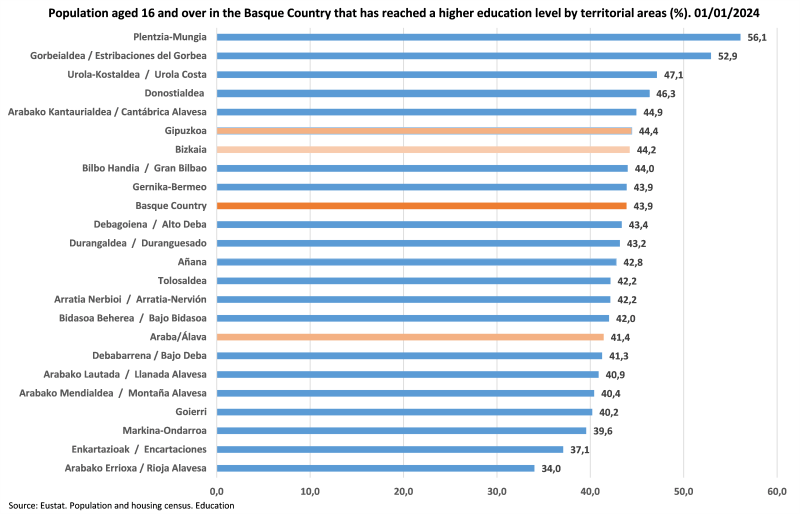
Differences in the level of higher education were more pronounced at the regional level. Plentzia-Mungia and Estribaciones del Gorbea stood out as the regions where more than half of the population had completed higher education, with 56.1% and 52.9%, respectively. These figures are 12.2 and 9 percentage points higher than the average for the Basque Country. At the other end of the scale, the districts of Rioja Alavesa, at 34%, and Encartaciones, at 37.1%, reveal the lowest percentages, with around a third of the population having received higher education.
Among the Basque capitals, San Sebastián recorded the largest proportion of people with higher education (51.3%), followed by Bilbao with 48.1% and Vitoria-Gasteiz with 40.8%. This ordering matches the trend observed in terms of the provinces, with the population of Gipuzkoa likewise having the largest proportion with higher education.
44.4% of men and 43.4% of women resident in the Basque Country and aged 16 or over have higher education
Among men and women aged 16 and over, those with higher education represent the largest group: 44.4% of men and 43.4% of women. Next comes the initial stage of secondary education and lower, accounting for more women (37.6%) than men (33.2%); and lastly the second stage of education and non-higher, post-secondary education, more common among men (22.3%) than women (19%) By province and in terms of higher education, women residing in Álava stood out for having a higher relative value than men, 41% compared to 41.8%.
Population aged 16 and over in the Basque Country by level of education attained according to historical territory and sex (%). 2024
| |
Basque Country |
Araba / Álava |
Bizkaia |
Gipuzkoa |
| |
Total |
Men |
Women |
Total |
Men |
Women |
Total |
Men |
Women |
Total |
Men |
Women |
| |
| Level of training achieved |
1,906,571 |
916,288 |
990,283 |
285,199 |
138,653 |
146,546 |
1,000,326 |
476,995 |
523,331 |
621,046 |
300,640 |
320,406 |
| GROUP A |
677,007 |
33.2 |
37.6 |
104,642 |
35.4 |
37.9 |
356,201 |
33.0 |
37.9 |
216,164 |
32.6 |
36.9 |
| GROUP B |
392,932 |
22.3 |
19.0 |
62,375 |
23.6 |
20.2 |
201,700 |
21.9 |
18.6 |
128,857 |
22.5 |
19.1 |
| GROUP C |
836,632 |
44.4 |
43.4 |
118,182 |
41.0 |
41.8 |
442,425 |
45.1 |
43.4 |
276,025 |
44.9 |
44.0 |
Date September 30, 2025
Source: Eustat. Population and housing census. Education
One in ten people aged 16 and over were still in education and, of these, almost half were pursuing higher education
In 2024, 11.2% of the population aged 16 and over in the Basque Country, equivalent to 213,854 people, were enrolled in some level of education. Almost half of this group of students, 49.4% (a total of 105,559 people), were pursuing higher education. 40.2%, 86,063 people, were at the level of secondary education and post-secondary non-higher education. 7.5%, i.e. 16,012 people, were at the level of first stage of secondary education or lower. Lastly, 2.9%, equivalent to 6,220 people, were enrolled in non-formal education for adults.
If we look at the student population aged 16 and over as a whole and disaggregated by gender, we can see that there was a higher proportion of women, representing 52.7%, in comparison to men, accounting for 47.3%. This difference was seen at all levels of ongoing education. At the higher level, women account for 53%, indicating a difference of 6 percentage points compared with men.
If we analyse men and women as separate groups, the distributions are similar. Among women, a higher proportion of students belong to the higher education group (+0.7 percentage points), and in particular informal education (+1.2 percentage points). Meanwhile, among men we find a greater proportion of students in the second stage of secondary education and non-higher, post-secondary education group (+1.6 percentage points) and in the first stage of secondary education and lower group (-0.3 percentage points).
The Basque population that pursued higher education primarily moved to another municipality in the same province
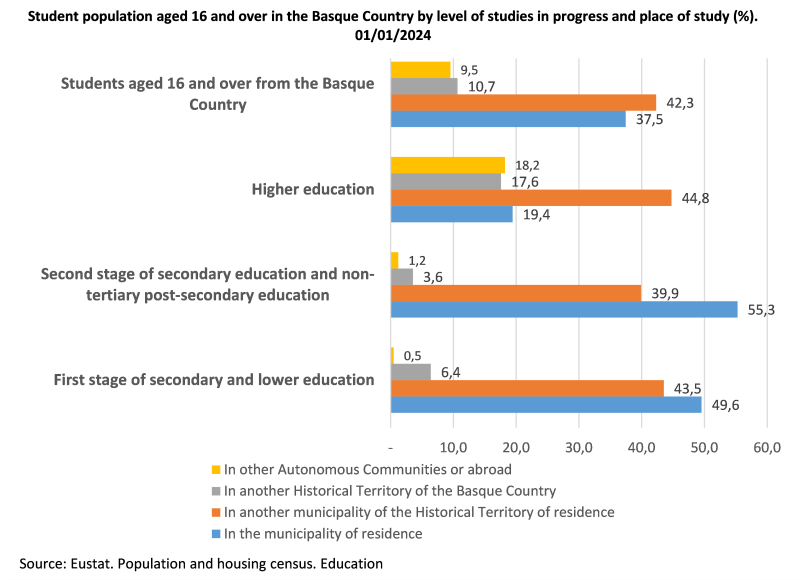
In 2024, more than half secondary and non-higher, post-secondary education students were studying in their own municipality (55.3%), followed by the group of students in the first stage of secondary education or lower (49.6%). As for the population aged 16 and over in the Basque Country that pursued university studies or advanced level vocational training, 44.8% (47,263 people) moved to a municipality within their home province. At this level of education, it is worth highlighting that 18.2% of students attended centres outside the Basque Country or abroad, a trend not seen at other education levels.
For further information:
Eustat - Euskal Estatistika Erakundea/Basque Statistics Institute
C/ Donostia-San Sebastián, 1 01010 Vitoria-Gasteiz
Press Service: servicioprensa@eustat.es Tel.: 945 01 75 62