Press Release 05/12/2025
POPULATION AND HOUSING CENSUS – POPULATION STRUCTURE. 01/01/2025
In 2025 the Basque Country resident population rose to 2,218,210 people, 10,203 more than a year ago
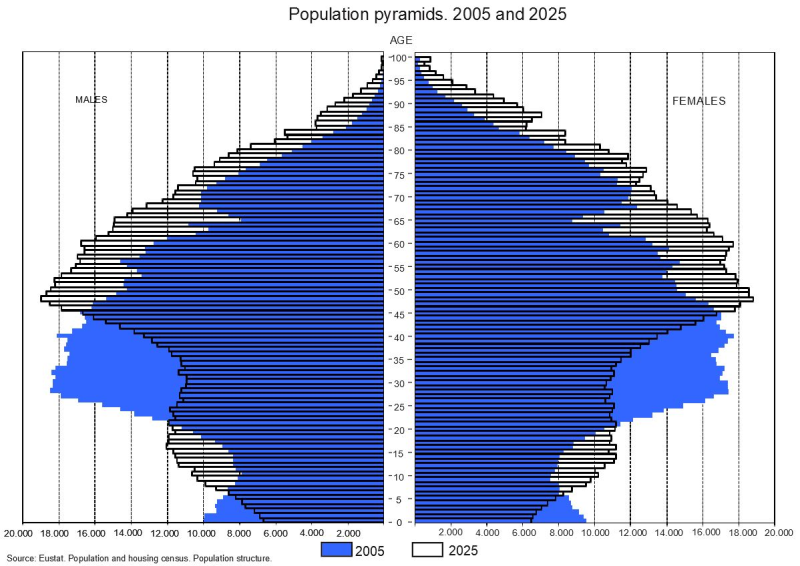
The average age of the population is 46.1 years, 4 years more than in 2005
On 1 January 2025, the population of the Basque Country stood at 2,218,210 people, an increase of 10,203 compared with 2024, representing a rise of 0.5% in relative terms, according to Eustat data. This growth was exclusively due to the migratory balance (between immigrations and emigrations), which represented 20,870 more people, while population growth (the difference between the number of births and deaths) was negative by 9,455 people.
In absolute terms, the greatest population increase was in Bizkaia, with 5,696 more residents than in 2024 (+0.5%), reaching 1,155,733 inhabitants; followed by Álava, with a resident population of 337,680, 2,534 more people than the previous year (+0.8%); and lastly, Gipuzkoa, where the increase was 1,973 inhabitants(+0.3%), rising to 724,797.
An analysis of a longer time period yields different results. Between 2005 and 2025, Álava's population increased by 13.3%, that is, there were 39,514 more residents. Gipuzkoa registered a greater increase in the number of people, 40,977, representing 6% in relative terms. As for Bizkaia, it added 33,323 inhabitants during this period, 3% of its population.
The population increased in 150 municipalities, including the 3 capitals
The population increased in all three Basque capitals between 2024 and 2025. Bilbao saw the greatest rise, with 2,525 more inhabitants, followed by Vitoria-Gasteiz with 1,982, and lastly San Sebastián, with 496 more people. Looking back to 2005, we can see that the population of Bilbao has increased by just 763 people over the last 20 years (+0.2%) and that of San Sebastián has risen by 1,670 people (+0.9%). Meanwhile, the population of Vitoria-Gasteiz has increased by 13.4% over those two decades, from 223,953 to 253,956 inhabitants in (30,003 more inhabitants).
As regards the remaining municipalities in the Basque Country, it should be noted that over the last year 150 of them increased their population, while 93 reduced it. The municipalities that registered the greatest increase in population were, in order, Barakaldo (649 residents), Berango (638 inhabitants) and Urduliz (410 inhabitants). Meanwhile, the municipality with the greatest decline in absolute terms was Getxo, with a loss of 291 inhabitants, followed by Hondarribia, which lost 145 residents. Villabuena de Álava, Armiñon and Elantxobe are the municipalities with the greatest percentage decline, over 4% in all three cases.
Between 2005 and 2025, Getxo, Galdakao, Portugalete, Basauri and Sestao, in the Gran Bilbao region, were the municipalities that registered the greatest fall in population, with an overall loss of 18,213 people. Ondarroa, in Bizkaia, also registered a drop of over 1,000 inhabitants. By contrast, Barakaldo, Leioa and Etxebarri grew by more than 4,000 residents in this period.
Focusing on regions, it was specifically Gran Bilbao that registered the greatest population growth over the past year, adding 4,299 inhabitants, followed by Llanada Alavesa, with 2,148, and Donostialdea, some distance behind with an extra 889. In the rest, it is worth noting that 3 of the 20 regions lost population, two of them with just 10 and 13 fewer people.
Looking back to 2005, we find that Llanada Alavesa registered by far the greatest increase, more than 34,187 people, followed by Donostialdea, with an additional 15,482 inhabitants, and Plentzia-Mungia, gaining 12,646. Only one region has lost population over the last 20 years: Markina-Ondarroa with 516 people less.
The average age of the population is 46.1 years, 4 years more than in 2005
The average age of the population of the Basque Country stood at 46.1 in 2025, 2 years older than in Spain as a whole. Compared to 2005, the average age increased by 4 years. The difference between the genders stands at 3 years, as men have an average age of 44.6 and women 47.6, because of the greater volume of female population of more advanced ages. The average age in the provinces reflected their age structure: In Álava the average age was almost one year lower than the average for the Basque Country (45.3); in Gipuzkoa it was close to, but just below, the Basque average (45.7); and it was higher in Bizkaia, standing at 46.6.
In 2025, the proportion of people aged 65 and over in the Basque Country was 24.3%, 0.3 points higher than the previous year and 3.6 points above Spain (20.7%). Only 4 autonomous regions had higher percentages: Asturias (28.4%), Castile and Leon (27.3%), Galicia(26.9%) and Cantabria (24.5%). If we take gender into account, the proportion of women aged 65 or over was 26.9% compared to 21.6% of men.
86 municipalities exceeded the average percentage of the Basque Country, whilst 166 presented the same or a lower percentage; among the former were Bilbao, San Sebastián, Barakaldo and Getxo, which were home to 31.8% of the total population of the Basque Country.
In 2005, the percentage of the population aged 65 and over was 18.3% and 148 municipalities had a percentage higher than the average. Furthermore, between 2005 and 2025, there were 59 municipalities in which the proportion of those aged over 65 decreased, although they are home to just 2.2% of the total population.
Population of the Basque Country by province, according to large age groups . 01/01/2025


| |
Total |
0 - 19 |
20 -64 |
≥ 65 |
| |
|
Number |
% |
Number |
% |
Number |
% |
| Total |
2,218,210 |
383,111 |
17.3 |
1,295,330 |
58.4 |
539,769 |
24.3 |
| Historic Territories |
|
|
|
|
|
|
|
| Araba/Álava |
337,680 |
61,996 |
18.4 |
197,915 |
58.6 |
77,769 |
23.0 |
| Bizkaia |
1,155,733 |
191,199 |
16.5 |
677,986 |
58.7 |
286,548 |
24.8 |
| Gipuzkoa |
724,797 |
129,916 |
17.9 |
419,429 |
57.9 |
175,452 |
24.2 |
| Capitals |
|
|
|
|
|
|
|
| Bilbao |
346,933 |
52,676 |
15.2 |
206,157 |
59.4 |
88,100 |
25.4 |
| Donostia / San Sebastian |
183,388 |
29,172 |
15.9 |
105,384 |
57.5 |
48,832 |
26.6 |
| Vitoria-Gasteiz |
253,956 |
46,589 |
18.3 |
148,523 |
58.5 |
58,844 |
23.2 |
| Districts |
|
|
|
|
|
|
|
| Añana |
6,468 |
998 |
15.4 |
3,963 |
61.3 |
1,507 |
23.3 |
| Arabako Errioxa / Rioja Alavesa |
11,935 |
2,311 |
19.4 |
7,043 |
59.0 |
2,581 |
21.6 |
| Arabako Kantaurialdea / Cantábrica Alavesa |
34,610 |
6,246 |
18.0 |
19,684 |
56.9 |
8,680 |
25.1 |
| Arabako Lautada / Llanada Alavesa |
272,119 |
50,274 |
18.5 |
159,682 |
58.7 |
62,163 |
22.8 |
| Arabako Mendialdea / Montaña Alavesa |
3,258 |
487 |
14.9 |
1,924 |
59.1 |
847 |
26.0 |
| Arratia-Nerbioi / Arratia-Nervión |
24,402 |
4,594 |
18.8 |
14,271 |
58.5 |
5,537 |
22.7 |
| Bidasoa Behea / Bajo Bidasoa |
77,625 |
13,364 |
17.2 |
45,175 |
58.2 |
19,086 |
24.6 |
| Bilbo Handia / Gran Bilbao |
865,092 |
138,502 |
16.0 |
507,183 |
58.6 |
219,407 |
25.4 |
| Debagoiena / Alto Deba |
55,238 |
10,227 |
18.5 |
31,053 |
56.2 |
13,958 |
25.3 |
| Debarrena / Bajo Deba |
63,287 |
11,593 |
18.3 |
35,815 |
56.6 |
15,879 |
25.1 |
| Donostialdea |
332,007 |
55,653 |
16.8 |
193,780 |
58.4 |
82,574 |
24.9 |
| Durangaldea / Duranguesado |
99,913 |
18,286 |
18.3 |
58,669 |
58.7 |
22,958 |
23.0 |
| Enkartazioak / Encartaciones |
32,422 |
5,569 |
17.2 |
19,030 |
58.7 |
7,823 |
24.1 |
| Gernika-Bermeo |
46,668 |
8,153 |
17.5 |
26,710 |
57.2 |
11,805 |
25.3 |
| Goierri |
68,887 |
13,732 |
19.9 |
39,256 |
57.0 |
15,899 |
23.1 |
| Gorbeialdea / Estribaciones. del Gorbea |
9,290 |
1,680 |
18.1 |
5,619 |
60.5 |
1,991 |
21.4 |
| Markina-Ondarroa |
25,608 |
4,287 |
16.7 |
14,648 |
57.2 |
6,673 |
26.1 |
| Plentzia-Mungia |
61,628 |
11,808 |
19.2 |
37,475 |
60.8 |
12,345 |
20.0 |
| Tolosaldea |
50,099 |
9,897 |
19.8 |
29,033 |
58.0 |
11,169 |
22.3 |
| Urola Kosta |
77,654 |
15,450 |
19.9 |
45,317 |
58.4 |
16,887 |
21.7 |
Date December 5, 2025
Source: Eustat. Population and housing census. Population structure
There is disparity in terms of the age of the resident population and, more specifically, with regard to the percentage of those aged 65 and over, which ranges from 10.1% in Baliarrain to 37.4% in Lagrán.
Aside from the former, there were another 5 municipalities with percentages below 14%: Irura, Armiñon, Arakaldo, Alegría-Dulantzi and Astigarraga. The combined population of the 6 municipalities stood at 13,239 inhabitants. Meanwhile, aside from Lagrán, there were 9 municipalities with a percentage above 30%: Morga, Añana, Mundaka, Ea, Valdegovía, Sukarrieta, Elantxobe, Ereño, and Valle de Arana. These ten places had a total of 5,838 residents.
Focusing on the regional level, there were seven regions where the population aged over 65 exceeded 25% of the total: Markina-Ondarroa (26.1%), Montaña Alavesa (26%), Gran Bilbao (25.4%), Gernika-Bermeo and Bajo Deba (25.3% in both cases), Alto Deba and Cantábrica Alavesa (25.1% in both cases). Meanwhile, the region in which this percentage was lower than a year ago was Plentzia-Mungia, with a percentage of 20%.
If we look at older age groups, people aged 85 and above went from constituting 1.9% of the total population in 2005 to 4% of the total population in 2025, although this percentage was very unevenly distributed between men and women: 2.6% of the male population in the Basque Country were aged 85 or over, while this proportion rose to 5.2% among women. This process has been very dramatic for the centenarian population, with a rise in the number of centenarians from 299 in 2005 to 960 twenty years later, 86.4% of whom were women.
In the Basque Country, there were 1.85 people aged 65 and over for every minor aged under 16, exceeding the ratio for Spain as a whole, which was 1.5, but still far from that for Asturias, which was 2.7.
By regions, Montaña Alavesa, Gran Bilbao, Añana and Markina-Ondarroa revealed the highest proportion, with two or more adults over 65 for each child under 16, while in Plentzia-Mungia the ratio was 1.3.
At municipal level, 91 municipalities had a score equal to or higher than the average, with extreme cases such as Lagrán and Valle de Arana, with a ratio of more than 5 to 1. Conversely, it is worth highlighting Baliarrain, with over 2.6 children aged 0 to 15 for every person aged 65 or over, followed by Orendain with 1.6, Irura and Astigarraga, with 1.5, however it should be noted that these are municipalities with small populations. In total, only 22 municipalities had at least one child under 16 for each person over 65.
For further information:
Eustat - Euskal Estatistika Erakundea/Basque Statistics Institute
C/ Donostia-San Sebastián, 1 01010 Vitoria-Gasteiz
Press Service: servicioprensa@eustat.es Tel.: 945 01 75 62