Press Release 27/01/2026
HEALTH OVERVIEW. 2025
Health Overview of the Basque Country 2025
Increase in life expectancy and drop in perception of good health in the Basque Country in the last 5 years
Eustat has published the fourth edition of the Health Overview, corresponding to 2025, a summary of key statistical information in the field of health. The contents are organised into six thematic areas: state of health, health-related conduct, prevention practices, healthcare resources, care for health problems, and healthcare expenditure.
Greater increase in life expectancy among men helps reduce the gender gap
Life expectancy at birth stood at 81.7 years for men and 87 for women in the Basque Country in 2024. These figures are above the European Union (EU-27) average, with a difference of 2.5 years in the case of men, and 2.6 years for women. They are also slightly higher than the average for Spain, one of the countries with the greatest life expectancy in Europe, with differences of 0.3 and 0.5 years, respectively. The difference in favour of women in the Basque Country has shifted from 5.8 years in 2019 to 5.3 years in 2024, thus reducing the gender gap by half a year.
Life expectancy at the age of 65 stood at 19.9 additional years for men and 24 years for women in 2024. This means that a woman reaching the age of 65 can expect to live on average until she is 89, while a man of the same age will live to 84.9 years. The difference between the two is 4.1 years in favour of women.
Disability-free life expectancy is also greater for women (81.9 years) than for men (77.3 years), with a slightly smaller gender difference (4.6 years) than in the case of life expectancy at birth.
Men take a more positive view of their health. 82% of men saw their health as good or very good, compared with 78.1% of women, according to the 2023 Health Survey. However, this perception has dropped by 4.2 percentage points among men and 4.4 for women over the last 5 years.
Mental health problems were more prevalent in 2023 in women (26.5%) than in men (17.7%). Both groups registered an increase in comparison with 2018, of 10.1 and 8.1 percentage points, respectively. Symptoms of anxiety and depression are more frequent among the population aged 75 years and over.
68.4% of deaths by suicide and self-inflicted injuries in 2024 corresponded to men, and 31.6% to women, according to the Death Statistics.
As for chronic disease, prevalence has declined, and is slightly higher among women (42.3%) than men (41.4%). Hypertension was the most frequent cause, followed by high cholesterol and back pain.
Women reveal a slight increase in smoking, high-risk alcohol consumption and obesity, but have also improved in physical activity
In 2023, smoking dropped among men and rose slightly among women, compared with 2018. Nonetheless, the habit remains more common in men (17.2%) than in women (13.8%), the gender gap thus shrinking to 3.4 percentage points. In contrast with 2018, more women were smoking than men in the age groups 15 to 24 and 65 to 74.
Long-term high-risk alcohol consumption, linked to a greater risk of developing health problems, is more common among men (16.6%) than women (11.1%). Among the younger population, however, aged between 15 and 24, such consumption among women amounts to 14.8%, compared with 10.7% of men.
Obesity rose in 2023 compared with 2018 by more among women (2 percentage points) than men (0.3 points), while remaining more prevalent in men (14.2%) than in women (13.2%).
In general, women reveal greater adherence to a Mediterranean diet (45.7%) than men (41.5%). By age, those between 65 and 74 years old show the greatest adherence (59.8% of women and 54.7% of men), while the younger population aged 15 to 24 have the lowest levels (33.7% and 23.6%, respectively).
In 2023, 84.3% of men and 80% of women engaged in physical activity or healthy exercise, representing a greater increase among women (6.1 percentage points) than men (4.6 points) over the past 5 years. This positive progress has reduced the gender gap to 4.3 percentage points (having stood at 5.8 in 2018).
Widespread coverage of prevention practice in 2024
With regard to prevention practice, flu vaccine coverage in those aged over 24 amounted to 82.2% in 2024, higher than the recommended level of 75%. Participation in screening for breast cancer (79.4%) and colorectal cancer (71%) was likewise above the recommended values.
Adhesion to neonatal health prevention programmes (heel prick and deafness) stood at levels above 99%. Lastly, the Infant Dental Care Programme (PADI) revealed an improvement in participation in 2024 (65.2%) compared with the previous year (61% in 2023), but has still not reached the levels seen prior to the pandemic (68.2% in 2019).
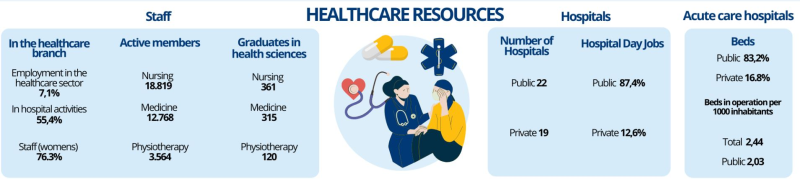
Healthcare activities accounted for 7.1% of all employment in the Basque Country in 2024
The workforce employed in healthcare activities amounted to 67,315 in 2024, 7.1% of all jobs. This level of employment has risen by 8.4% compared with 2020, with the majority engaged in hospital activities (55.4%). With regard to human resources in healthcare, women account for the majority of those working in health sector professions (76.3%).
This female domination likewise extends to university studies in Health Sciences, with women making up 79% of graduates, and the majority for all qualifications (medicine, nursing, physiotherapy, pharmacy, human nutrition and dietetics, dentistry and psychology). The same pattern may be seen in specialist healthcare training, with women accounting for 71% of Internal Resident Physicians (MIR) and 94.7% of Internal Resident Nurses (EIR).
In comparative terms, the Basque Country has the second-highest rate of registered practising physicians of any Spanish region (5.7 per 1,000 population), as well as in nursing (8.1 per 1,000).
Women attend primary care appointments more frequently, while men are more often admitted to hospital
Women make more frequent use of primary care, with 5.7 medical appointments per year compared with 4.4 for men, and 3.1 nursing appointments compared with 2.9. Among older people (aged 85 and over), meanwhile, this trend is reversed, with men becoming the majority users. The most common reasons for appointments are locomotor system problems and skin and skin appendage complaints.
51.3% of acute hospital admissions corresponded to men in 2024 (48.7% women). 52.3% of those admitted to hospital were aged 65 or over. The three main causes of hospitalisation are diseases of the digestive, circulatory and respiratory systems, which together account for 38.5% of all hospital admissions.
These three factors are, in that order, the most common causes for hospital admission among men. For women, meanwhile, respiratory causes lie in first place, followed by digestive conditions, which furthermore stand at the same level as pregnancy, childbirth and postnatal care.
69.5% of health expenditure is financed by the public sector
Current health expenditure in the Basque Country rose by 6% in 2023 compared with 2022, according to the Health Account, amounting to 8,554 million euros. 69.5% of this expenditure was funded by the public sector, and the remaining 30.5% by the private sector. This expense accounted for 9.2% of GDP in 2023, and a cost per capita in PPP (purchasing power parity) terms of 4,262 per person, higher than the EU-27 average (3,835 PPP). The majority of expenditure corresponds to curative healthcare (hospital and outpatients), which in 2023 accounted for 56.9% of current expenditure (6.5% higher than in 2022).
To view the Health Overview on the website: [click here]