Press release, 18 December 2025
2025 INFORMATION SOCIETY OVERVIEW
In 2025, TV access via the internet in homes and cloud computing services for companies are the highest-growing categories in the Basque Country
56.3% of internet users and 30.5% of establishments engaged in e-commerce in the Basque Country
In 2025, more than half (60.9%) of households in the Basque Country are able to access TV channels via the internet. For their part, 32.4% of companies pay for cloud computing services, according to data prepared by Eustat.
In both cases, the level of growth has been remarkable: while a decade ago just 9% of households were able to watch TV via the internet, this figure has risen by 51.9 percentage points in 2025. With specific regard to companies, in 2019 (the first year with data available) the proportion of firms using cloud computing services stood at 20.3%. This figure has grown by more than 12 points in six years.
These figures are explained to a great extent by the fact that information and communication technology (ICT) equipment in the Basque Country has registered continuous year-on-year growth, although not all equipment has increased in the same manner and with the same intensity. An uneven distribution of ICT is observed in the sphere of households and those who comprise them, depending on variables such as age and relationship to the activity. In the case of companies, the disparities mainly depend on the number of people employed.
Sphere of households and those who comprise them
Centring the analysis on households and those who comprise them, connectivity-related technological equipment can be found in the majority of homes in the Basque Country. Moreover, the trend is increasing. Some 92.1% of Basque households have an internet connection (broadband in almost all cases), which represents a rise of 21.9 percentage points since 2015. Among those families with at least one person aged 16-74, internet connection availability rises to 98.4%.
Computers are found in 76.1% of households, representing an increase of 5.5 percentage points over 2015; while laptop computers are present in 60% of households, reflecting an increase of 5.1 percentage points during the last 10 years. Furthermore, almost all households (98.8%) have at least one mobile phone; an increase of 5.4 percentage points compared to 10 years ago.
With regard to those aged 15 and over residing in these households, the percentages are slightly higher: 95.3% have access to the internet at home (17.3 percentage points more than in 2015), 82.8% have access to a computer (up 4.4 points) and 99.4% have access to a mobile phone (an increase of 3.5 percentage points).
Some 89.7% of Basque Country residents aged 15 and over have used the internet in the last three months; a proportion that has increased by 18 percentage points in the space of 10 years (71.7% in 2015).
Among those aged 6-14 living in households in the Basque Country, 99.7% have access to the internet at home (1.1 percentage points more than in 2015), 95.7% have access to a computer (down by 2.3 percentage points) and 84.4% use it frequently (at least once per week). All of them (100%) have access to a mobile phone at home (unchanged since 2015) and while 43.8% use it to access the internet, 8.4% use it for purposes other than internet access and 47.7% of those in this age group do not use it at all.
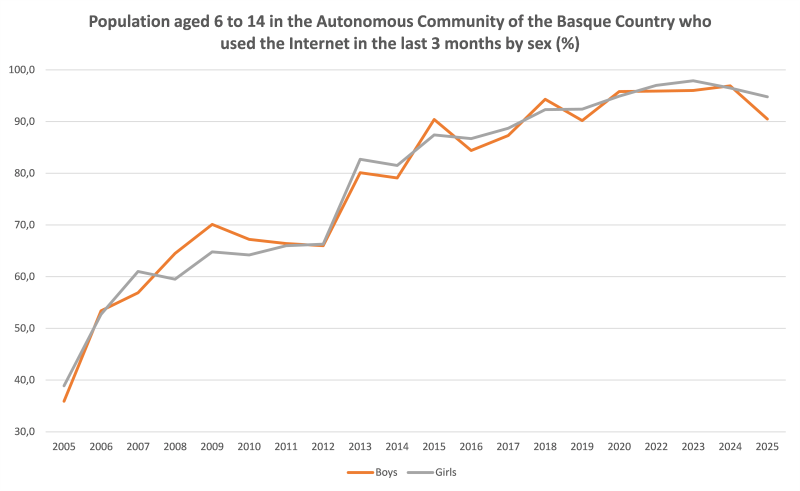
Some 92.6% of Basque Country residents aged 6-14 have used the internet in the last three months; a proportion that has increased by 3.7 percentage points in the space of 10 years (88.9% in 2015). Some 57.6% of internet users in this age group go online at least five days per week.
There are numerous activities that can be carried out online. Among users aged 15 and over, and with specific regard to personal internet use, activities geared towards communication and searching for information are the most common. Practically all of the Basque Country’s internet users who form part of this age group have communicated via WhatsApp or other instant messaging applications (97.5%), while a smaller proportion have searched for information on goods or services (84.9%), used email (83.8%) or read news stories, newspapers or magazines (80%). Participation in social networks stands at 57.9% among the internet user population aged 15 and over, rising to 89.3% among people aged 15-24.
Likewise, activities directed towards consumption and household economy are responsible for a large number of operations carried out over the internet. 75% of people online used the internet for banking activities in 2025. With regard to activities related to leisure and culture that take place outside the home, 54.9% of the internet user population have booked accommodation or trips related to tourism; an increase of 1.8 percentage points over the previous year (2024).
E-government makes it possible to carry out official procedures with the public administration via the internet. In this sphere, 57.3% of internet users have completed and submitted forms to the public administration online, while 57.9% have obtained information and 51.2% have downloaded official forms via the internet.
With regard to those aged 6-14 living in households in the Basque Country, the online activities engaged in most frequently are those related to entertainment and creativity. Some 78.8% of Basque internet users aged 6-14 have viewed content on video sharing sites, while a smaller proportion have played or downloaded games via the internet (74.2%), listened to music via the internet (66.7%), watched films or videos on demand (63.4%) or communicated via WhatsApp and other instant messaging applications (48.8%). Participation in social networks among internet users aged 6-14 stands at 26.9%.
Lastly, with regard to e-commerce, the proportion of internet users aged 15 and over who have acquired goods or services of any kind online in the last three months is 56.3%, which equates to a total of 976,400 people. This figure represents 50.5% of the overall Basque population for this age group, and is 1.5 times higher than the number of people who made purchases online 10 years ago. The purchases made by this group mainly consist of clothes, footwear, accessories, accommodation, household goods, tickets to cultural events, personal care and hygiene products, transport and sports equipment.
Business sphere
Between 2015 and 2025, companies in the Basque Country have made significant progress with regard to the adoption of technology. Currently, 96.1% of firms have access to the internet and 57.1% have a website: figures which put the Basque Country in a favourable light within the context of the EU-27.
Of particular note is the gradual technological convergence between large and small companies. While large companies possess the largest amounts of equipment, smaller companies are constantly increasing their technological capacities.
Additionally, the use of technological equipment on the part of employees has also increased: the proportion of employees who use a computer has grown from 69.5% in 2015 to 77.6% in 2025 (a little over 8 percentage points), while access to the internet among employees has increased from 61.8% to 74.5% over the last decade.
However, unlike in the case of equipment, the proportion of employees who use these technologies barely changes at all according to the size of the company.
With regard to information and communication technologies (ICT), they are virtually ubiquitous in the public sector: 100% of establishments have a computer and internet connection, and 99.6% have a website.
The digital relationship between companies and the public administration is now an established reality. This is reflected in the fact that 98.3% of Basque companies with internet access carried out official procedures with the public administration electronically in 2025. There has been unquestionable progress in this area, given that in 2015 the equivalent figure was 67.7% of establishments – a change of more than 30 percentage points in just 10 years. This difference narrows if we only consider companies with 10 or more employees, for which the equivalent figure in 2025 is 98.7% of establishments; a rise of 5.6 percentage points compared to the figure for 2015 (93.1%).
The use of ICT in the primary sector is not as common, chiefly due to the fragmentation and inherent nature of the activity. As well as the specific nature of the activity itself, it should also be noted that 97.2% of establishments in this sector employ nine people or fewer. In this group, only establishments engaging in fishing activity achieve significantly higher percentages for ICT equipment. However, this detail barely affects the total for the sector, as agricultural companies comprise the vast majority (95.9%) of all primary sector establishments.
With regard to e-commerce on the part of companies in the Basque Country, the most relevant detail is the unequal balance between purchases and sales. As of 31 December 2024, the proportion of establishments that have engaged in e-commerce stands at 30.5%, with 27.8% corresponding to purchases and 8.7% to sales. These proportions are higher than those for a decade ago (2014), when 24.8% of establishments engaged in e-commerce, with 23.1% corresponding to purchases and 6.0% to sales. If we take size into account, among companies with 10 or more employees e-commerce grew from 28.8% to 40.4% during the 2014-2024 period.
Lastly, in the area of business digitalisation (Industry 4.0), the following indicators stand out:
- Use of social networks for business purposes: 53.8% of establishments.
- Cloud computing: 32.4% of establishments pay for these services.
- Cyber-security activities: these are carried out at 24.8% of establishments.
- Between 12% and 16% of establishments use mobile applications for clients, the Internet of Things (IoT) and big data analysis.
- However, less than 9% use artificial intelligence, 3D printers and robotics.
Note: The structure of the Information Society Overview comprises six major areas: ICT equipment, computer use, internet use, electronic administration (e-government), e-commerce and digitalisation (Industry 4.0). These areas are analysed from the point of view of families, the general population, companies, the administration and the rural environment. In addition, an analysis is conducted of the differences between provinces and age groups, and the differences related to personal activity or size according to the number of employees. The figures for the Basque Country are also placed into an international context.
https://es.eustat.eus/panoramadelasociedaddelainformacion/2025/inicio.html
For further information:
Eustat - Euskal Estatistika Erakundea/Basque Statistics Institute
C/ Donostia-San Sebastián, 1 01010 Vitoria-Gasteiz
Press Service: servicioprensa@eustat.eus Tel.: 945 01 75 62