Press Release 22/09/2023
SURVEY ON SOCIAL CAPITAL. 2022
Trust in institutions and professions among the Basque population increased in 2022 compared to 2017
The indicators of trust in networks of family and friends, electoral participation and safety remained at high levels, despite decreasing with respect to previous editions
Trust in people among the population aged 15 and over in the Basque Country had a score of 5.8 out of 10 and reached the highest level when referring to trust in people within their family network and circle of friends (7.0). At the other end of the scale, with a score of 5.0, trust in institutions increased and achieved a satisfactory rating for the first time in 2022, according to Eustat data.
If we look at trust in the different professions (5.6), we can see a continued rise in relation to previous editions. The medical profession remained the highest rated (7.6), followed by the scientific profession (7.3) and teaching (7.0), while the following achieved a satisfactory score: police (6.3), traders (6.0), civil servants (5.6), judges (5.5) and businesspeople (5.1). Meanwhile, political professionals, despite an improvement of 6 tenths of a point, continued to have the worst score (3.0), together with priests (4.3) and the military (4.7), with media professionals just falling short of a satisfactory rating (4.9).
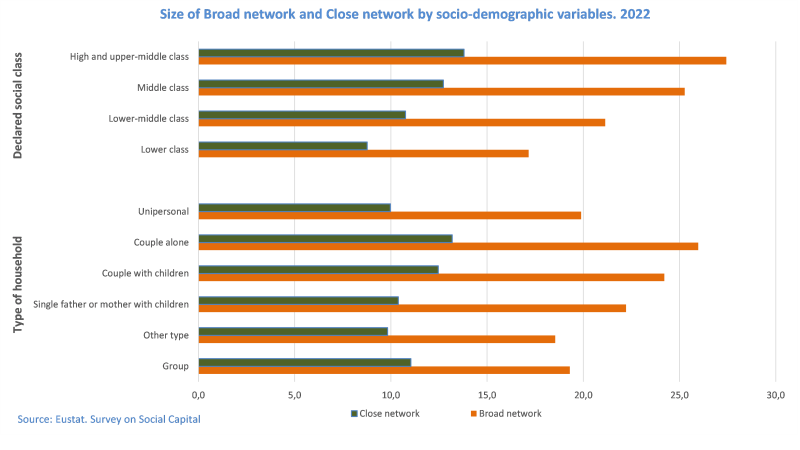
Networks of friends and family comprised around 24 people
With regard to networks made up of family and friends, as in the previous edition, the Basque population had an average of 24 people in their circle, a figure that falls by half when we consider the close circle.
In 2022, there was less homogeneity among groups of friends in terms of religious beliefs, nationality, social standing and political tendencies, and the population reporting a high level of homogeneity among their friends ceased to be the majority (46.1%, 5.1 points less than 5 years ago). The indicator of homogeneity in the population scored 5.4 out of 10 and the greatest differences were found in terms of age and the level of education completed. Young people aged between 25 and 34 had the least homogeneous networks (4.0), whereas those over 65 years of age had the most homogeneous (7.4); by level of education, people educated to primary school level or lower had a more homogeneous network (6.5), while there was greater diversity among the population with university studies (4.7). Comparatively, the indicator has declined over the last 5 years for the population as a whole (5.9 in 2017).
The type of family and declared social class were the socio-economic variables that most affected the number of people in the network of friends and family. Couples with children had the largest network (26 family members and friends on average), while the number dropped to 20 members for single individuals and 19 for those residing in collective establishments. In relation to perceived social class, the upper classes had networks of 27 family members and friends in contrast to the lower classes, where the number was 17. The youngest groups (15-24 years old) also reported having a network of 27 people.
Lastly, the size of the close network (family members and friends with whom close relationships are maintained) registered a slight decrease, going from 13 people in 2017 to 12 in 2022, and networks were larger among those who declared themselves upper class and senior staff (14 members), than among people from abroad and those who declared themselves lower class (9 people).
The indicators of assistance afforded and received remained unchanged, but there was a decline in the indicator of access to financial assistance
Related to networks of family and friends are the indicators of assistance afforded and received in the last six months, as well as access to the three types of assistance (financial, health-related and emotional). In this regard, assistance afforded had an average rating of 3.2 and assistance received scored just 2.0, similar values to those obtained in previous editions. The differences became more apparent as age increased, since people aged 15 to 24 had an index score of 4.4 for assistance afforded and 3.7 for assistance received, while those aged 65 and over had a rating of just 1.7 for assistance afforded and 1.2 for assistance received.
As regards the indicator of access to financial assistance, this is the first time that it has received a less than satisfactory rating (4.9), falling by three tenths in relation to 2017. The most pronounced difference was seen between those who declared themselves upper class, whose average score stood at 5.5, and those who considered themselves lower class, where it was just 3.4, with notable decreases in both indicators compared to the previous edition (6 and 7 tenths, respectively).
This difference was also reflected in the indicator of access to assistance for health problems, with values of 6.4 for those who declared themselves upper class and 4.8 for those belonging to a lower class, as well as in access to emotional assistance, with values of 6 and 4.4, respectively.
Electoral participation continued to be the greatest form of social participation, compared to minimal participation in activities of associations
The social participation of the Basque population primarily focused on electoral participation, with little involvement in associations (0.6). The Basque population continued to report high electoral participation (7.0), although its average score was five tenths lower than in 2017. Once again, the declared social class influenced this participation, with greater participation among those who defined themselves as upper or upper-middle class, with a rating of 7.4, than among those who considered themselves lower class, whose score stood at 4.9, falling by 1.4 points in comparison with the previous edition. Furthermore, it was the retired population that gave the highest score for this indicator (8.6), together with the population aged 65 and over (8.2).
Meanwhile, the public remained interested in socio-political issues (5.9), but their low social and political participation (1.2) has remained unchanged over the last 10 years.
With regards to information on public affairs, the Basque population only considered itself reasonably informed (5.6), despite the variety of information sources at various territorial levels (6.5 on average). However, the frequency with which people accessed different media (5.9) was down 6 tenths on 2017. In this regard, the most notable differences occurred in relation to the level of education completed, as people with university studies reported accessing the media most frequently (6.6), compared to those educated to primary school level or lower, who had the lowest figure of 5.1.
The population considered itself better informed regarding issues closer to home, preferably relating to their neighbourhood or municipality (41.4% and 41.5%, respectively, felt that they were highly informed) or the Autonomous Region (39.5%), whilst it considered itself somewhat less informed with regard to Spain (34% felt that they were highly informed) and Europe (31.1% felt that they had a great deal of information).
Use of the internet and virtual networks remained low, with an average score for this indicator of 2.4, despite the increase of two tenths in relation to the previous edition. Forums and the internet as a means of establishing new personal relationships were not widely used. The main differences in use can be seen in relation to age, as this indicator stood at 3.4 for the younger population (aged 15-24), compared to only 1.2 for the population aged 65 and over. On a related note, students had the highest score for this indicator (3.5) and, continuing on the topic of activity, unemployed people used the internet and virtual networks more (3.0) than pensioners (1.3).
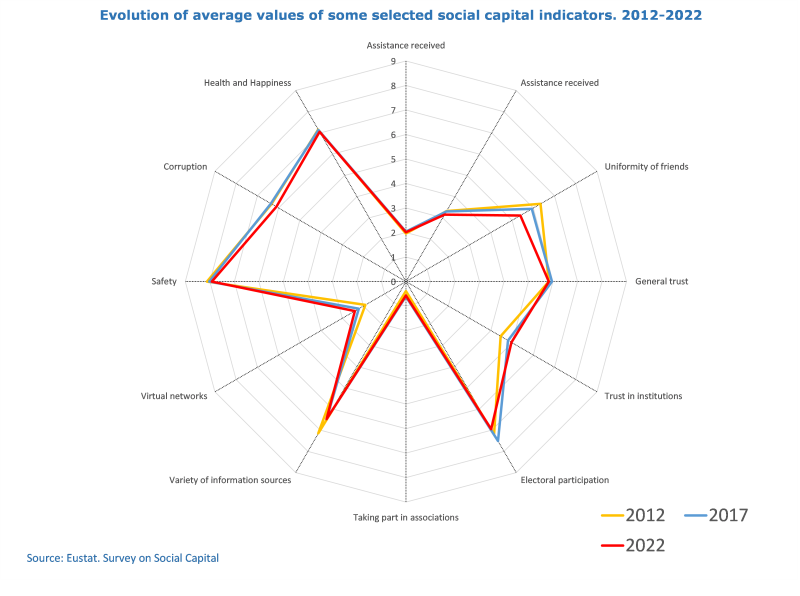
Some social capital indicators by domains. Average values and differences in scale from zero to ten. 2012-2022


| | 2022 | 2017 | 2012 | 2022 - 2017 | 2022 - 2012 |
| Trust and reciprocity | | | | | |
| General trust | 5,8 | 6,0 | 5,8 | -0,2 | 0,0 |
| Trust in networks of family and friends | 7,0 | 7,2 | 7,1 | -0,2 | -0,1 |
| Trust in institutions | 5,0 | 4,8 | 4,5 | 0,2 | 0,5 |
| Trust in professions | 5,6 | 5,5 | 5,2 | 0,1 | 0,4 |
| Social Media | | | | | |
| Size of the broad network (Number) | 23,7 | 23,8 | 22,2 | -0,1 | 1,5 |
| Size of the close network (Number) | 12,0 | 13,0 | 10,6 | -1,0 | 1,4 |
| Help provided | 3,2 | 3,3 | 3,3 | -0,1 | -0,1 |
| Help received | 2,0 | 2,0 | 2,0 | 0,0 | 0,0 |
| Access to financial help | 4,9 | 5,2 | 5,0 | -0,3 | -0,1 |
| Equality and Cooperation | | | | | |
| Electoral participation | 7,0 | 7,5 | 7,2 | -0,5 | -0,2 |
| Political and social participation | 1,2 | 1,2 | 1,2 | 0,0 | 0,0 |
| Taking part in associations | 0,6 | 0,6 | 0,4 | 0,0 | 0,2 |
| Information and communication | | | | | |
| Interest in socio-political questions | 5,9 | 5,9 | 5,5 | 0,0 | 0,4 |
| Information on socio-political themes | 5,6 | 5,6 | 5,3 | 0,0 | 0,3 |
| Use of Internet and Virtual Networks | 2,4 | 2,2 | 1,9 | 0,2 | 0,5 |
| Access to the media | 5,9 | 6,5 | 6,7 | -0,6 | -0,8 |
| Variety of information sources | 6,5 | 6,5 | 7,2 | 0,0 | -0,7 |
| Social cohesion and inclusion | | | | | |
| Safety | 7,9 | 8,0 | 8,1 | -0,1 | -0,2 |
| Corruption | 6,1 | 6,4 | 6,3 | -0,3 | -0,2 |
| Health and Happiness | 7,1 | 7,1 | 7,2 | 0,0 | -0,1 |
Date September 22, 2023
Source: Eustat. Survey on Social Capital
The indicator of health and happiness remained stable, despite the pandemic
The average score for health and happiness was 7.1. This indicator, which provides information on satisfaction with life, health and income, remained practically unchanged with regard to previous editions, although the greatest differences were related to the declared social class, with values ranging from 7.8 for the most privileged to 6.2 for the least privileged. The indicator also saw a gradual decline as age increased, with an average score of 7.3 for young people aged between 15 and 34 and 6.7 for those aged 65 and over.
The perception of corruption remained at a high level (6.1 out of 10), despite being three tenths lower than in the previous edition. People aged between 25 and 49, those with university studies and employed people were those who rated this aspect most negatively, all with a score of 6.4, a figure that contrasts with that given by people aged 65 and over (5.6) and those from abroad (5.3).
Furthermore, the population’s sense of safety remained at a high level (7.9), with people over 65 years old feeling safer (8.4) than young people aged between 15 and 24 (7.4).
The main differences between men and women were seen in the cases of assistance afforded, where the indicator for women was higher than for men (3.3 and 3.0, respectively); assistance received, since women reported receiving more assistance (2.2 compared to 1.8 for men); and use of virtual networks, as men were more active in this area (2.6 compared to 2.3 for women). There were no significant differences in the other indicators.
For further information:
Eustat - Euskal Estatistika Erakundea / Basque Statistics Institute
C/ Donostia-San Sebastián, 1 01010 Vitoria-Gasteiz
Press Service: servicioprensa@eustat.es Tel.: 945 01 75 62