Press Release 23/12/2019
EDUCATION OVERVIEW 2019
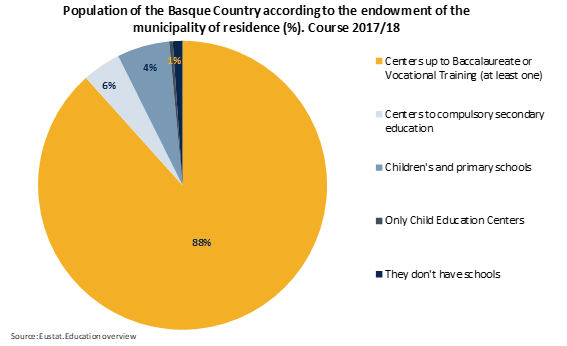
In the Basque Country 88% of the population can complete secondary education in the municipality of residence
Expenditure on education in the Basque Country is similar to that of top European countries
The school infrastructure in the Basque Country allows 98% of its population to reside in municipalities with at least one primary school and 88% in municipalities where it is possible to complete secondary education (upper secondary education or Vocational Training) without needing to travel elsewhere, according to Eustat data.
Resources allocated to education serve to maintain an ample school infrastructure, with a network of 1,427 centres staffed by around 44,000 teaching professionals, of whom 69% are women, and with more than 480,000 students.
The Basque Country spent a total of 3,949 million euros on education in 2018, 5.1% of its GDP. Per inhabitant, expenditure reached 1,808 euros. In relation to non-university education, this volume of resources allowed the Basque Country to reach levels of expenditure per student similar to that of other European countries and according to per capita income. Taking 2016 as a reference, the most recent year available for other surrounding countries, this indicator takes values for the Basque Country very close to countries such as Germany and Sweden.

Schooling increased in pre and post-compulsory levels of education in the Basque Country
Practically all boys and girls aged between 3 and 16 in the Basque Country attended school. As regards the other age groups, since the middle of the last decade net schooling rates have showed an upward trend.
This increase is greater among young people who are above the compulsory school age; for example, in the 16-17 age group, the percentage of the population attending school rose from 87% in the 2004/05 academic year to 98% in the 2016/17 academic year. In the same period, the 18-21 age group increased from 65% to 82%

The presence of foreign students in Basque education centres has also increased over the last two decades. In the 2017/18 academic year, 9 out of 100 students in general education were foreign students. There was a greater incidence in public centres where 12.5 out of 100 students were foreign, and it was lower in private centres, 5 out of 100.
Academic results in formal education in the Basque Country are better than in Spain as a whole
In non-university general education, the academic results of students in the Basque Country are above the national averages. In the 2015/16 academic year only 5.9 out of 100 students repeated a year in compulsory secondary education, whereas in Spain this figure was 10.1. As a consequence, the Basque Country has the third best suitability rate (the percentage of students enrolled in the school year group that corresponds to their age) for students aged 15, only behind Catalonia and Navarra.
In relation to graduation rates, the Basque Country is also in third place for compulsory secondary education and in first place for Upper Secondary Education and Advanced Level Vocational Training
Education improves job prospects and economic prosperity
The evidence demonstrates that education means more options in the job market and higher income. For example, the unemployment rate for people aged between 25 and 65 possessing a higher qualification is 7.3%, much lower than the 16.3% for those with no education or who have only completed primary education. The probability of having a family income below 1,000 euros is also greater among families whose reference person only has primary education.
Women obtain better academic results in pre-university education than men, but there are less women studying Sciences, Technology, Engineering and Mathematics.
The academic performance of women in pre-university education is better than that of men. They exceed men in pass rates and show better suitability rates in all age groups between 9 and 17.
As regards university education, the most significant difference between men and women is in terms of the type of studies chosen. Men most frequently opt to study Sciences, Technology, Engineering and Mathematics (STEM), in which 68% of students are men and 32% women. In contrast, women prefer those related to the fields of Education, Health, Wellbeing and Humanities (EHWH), representing 70% of students. In view of enrolment data from the Basque universities, this trend has hardly changed since the end of the last century.
Note: These and other data can be found in the “2019 Basque Country Education Overview”, a social report resulting from a statistical synthesis operation, based on official statistical sources and carried out by Eustat.
For further information:
Euskal Estatistika-Erakundea / Basque Statistics Institute
C/ Donostia-San Sebastián, 1 01010 Vitoria-Gasteiz
Press Service: servicioprensa@eustat.es Tel: 945 01 75 62