Press Release 20/10/2025
PERSONAL AND FAMILY INCOME STATISTICS. 2023
The average income of the population of the Basque Country increased by 4.8% in 2023
58% of total personal income came from work, 29.6% from social transfers or benefits, 8.1% from capital gains and 4.3% from economic activities
Basque Country residents aged 18 and over obtained an average personal income of 26,271 euros in 2023, which was an increase of 4.8% (1,210 euros more) compared to the previous year, according to Eustat data.
Regarding distribution by province, Gipuzkoa recorded the highest average personal income (with 27,545 euros), followed by Bizkaia with 25,867 euros and Álava with 24,921 euros. Compared to 2022, once again, in Bizkaia the increase in average personal income (5.7%) was higher than that registered in Álava and in Gipuzkoa (5.3% and 3.4%, respectively).
With regard to the provincial capitals, the territorial difference becomes more pronounced, given that the average income of people residing in San Sebastián (31,126 euros) exceeded the Basque average by 4,855 euros, compared to the resident populations of Bilbao (26,598 euros) or Vitoria-Gasteiz (25,221 euros), which saw incomes closer to the Basque average.
Disposable income, calculated as total income minus income tax and social security contributions by workers aged 18 and over residing in the Basque Country, stood at 21,863 euros in 2023, a figure equivalent to 83.2% of the total income. Disposable income increased by 1,008 euros (4.8%) in comparison with 2022, up 4.8%. By province, Gipuzkoa, with 22,912 euros, again achieved a higher disposable income than that obtained in Bizkaia, with 21,508 euros, and in Álava, with 20,828 euros.
In terms of the composition of total personal income received by residents of the Basque Country during the 2023 financial year, 58% of personal income came from work, with an average of 15,227 euros (618 euros more than the previous year), while the rest was distributed among 29.6% from social transfers or benefits (7,772 euros), 8.1% from capital gains, both moveable and immoveable (2,136 euros) and 4.3% from economic activities (1,136 euros).
In 2023, total income rose by 4.8%, as did disposable income (4.8%). All the components increased, with the exception of capital gains, which fell by 3.3%. Transfers were up 8.6% and income from work was up 4.2%.
Average personal income of the Basque Country by type of income, according to historical territory and sex (euros). 2023
| |
Basque Country |
Araba/Álava |
Bizkaia |
Gipuzkoa |
| |
Total |
Men |
Women |
Total |
Men |
Women |
Total |
Men |
Women |
Total |
Men |
Women |
| Total Income |
26,271 |
31,641 |
21,322 |
24,921 |
29,886 |
20,238 |
25,867 |
31,217 |
21,012 |
27,545 |
33,125 |
22,325 |
| Income from work |
15,227 |
18,535 |
12,177 |
14,597 |
17,541 |
11,820 |
15,184 |
18,479 |
12,193 |
15,585 |
19,083 |
12,314 |
| Capital revenue |
2,136 |
2,519 |
1,783 |
1,824 |
2,217 |
1,453 |
2,070 |
2,386 |
1,782 |
2,387 |
2,868 |
1,937 |
| Income from activities |
1,136 |
1,516 |
786 |
1,004 |
1,308 |
716 |
1,104 |
1,504 |
742 |
1,250 |
1,633 |
891 |
| Transfers |
7,772 |
9,071 |
6,575 |
7,496 |
8,819 |
6,248 |
7,509 |
8,848 |
6,295 |
8,323 |
9,542 |
7,184 |
| Disposable income |
21,863 |
26,117 |
17,942 |
20,828 |
24,713 |
17,163 |
21,508 |
25,696 |
17,708 |
22,912 |
27,435 |
18,682 |
Date October 20, 2025
Source: Eustat. Statistics on personal and family income
Regarding the distribution of income amongst the population, more than 1.6 million individuals aged 18 and over received some type of income, that is, 87.2%, whilst 12.8% of the population in these age groups did not receive any type of income during 2023. Furthermore, 58.9% of individuals received an income below the Basque Country average, including those who did not receive any income, whereas 9% had an income that more than doubled the average, that is, incomes over 52,542 euros.
The median, the value that establishes the income that divides the population in two equal parts, stood at 21,577 euros, i.e. in 2023 half of the adult population of the Basque Country had an average annual personal income over 21,577 euros, while the other half received an income below this amount.
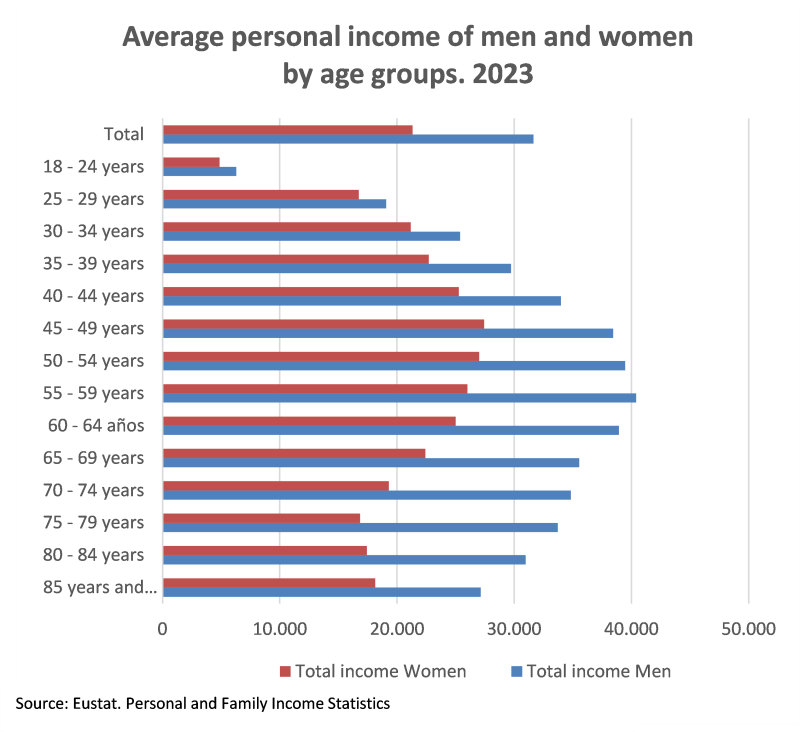
The average personal income varied in terms of age and gender. As regards the first aspect, income increases progressively with age, until reaching its maximum in the 50-54 age group, when it starts to decrease as the age ranges move further away from those associated with the active population.
Regarding sex, the distribution of income between men and women was uneven. Men in the Basque Country received an average income of 31,641 euros, whereas women received an average income of 21,322 euros. In other words, men earned 10,319 euros more than women. The greatest difference was recorded in the 75-79 age group, where the average income for men exceeded that of women by 16,853 euros; this difference increased by 837 euros in 2023 with regard to the previous year and the same age group.
As for the average personal income among young people aged 18-24 (5,605 euros), in 2023 this was up 10.7% in respect of the previous year. In this age range, the average income of men (6,287 euros) increased by 10.8%, while the average income of women (4,876 euros) rose by 10.7%. Although to a lesser degree, the average personal income of young people aged between 25 and 29 (17,930 euros) also increased, up 4.3% in respect of 2022. The increase was lower for men than for women (2.5% and 6.6%, respectively).
Half of families in the Basque Country received an average yearly family income above 42,738 in 2023
Average family income in the Basque Country stood at 52,923 euros in 2023. The total family income is obtained by aggregating the personal incomes of all members of the family including minors. The average income for families overall in the Basque Country was almost double the average personal income. Disposable income (after taxes and transfers) stood at an annual average of 44,019 euros (83.2% of the total income) with an increase of 5.1% in respect of 2022.
Once again, Gipuzkoa, with 55,619 euros, was the province with the highest family income, followed by Bizkaia with 52,310 euros and Álava with 49,270 euros. San Sebastián, with 62,712 euros, was the capital with the highest family income, followed by Bilbao, with 53,052 euros, and Vitoria-Gasteiz, with 49,634 euros.
Regarding regional distribution, there were also differences between the twenty regions of the Basque Country. Eight regions received family incomes higher than the average, with Plentzia-Mungia (63,051 euros) in Bizkaia; Estribaciones del Gorbea (60,271 euros) in Álava; and Urola Kosta (59,020 euros) in Gipuzkoa of particular note. In contrast, the twelve remaining regions had family incomes lower than the average, and the lowest figures of the classification were found in Bajo Bidasoa (51,702 euros) in Gipuzkoa; Encartaciones (46,191 euros) in Bizkaia; and Rioja Alavesa (38,723 euros) in Álava, which was the region with the lowest family income in the Basque Country.
There were inequalities regarding family income depending on the gender of the main earner. Where the main earner was a man, families had an average income of 58,314 euros, with the majority of families being concentrated in the intermediate and high strata, whereas if the main earner was a woman, the average income stood at 45,381 euros. Thus, in 6.2% of families where the main earner is a woman, the family income falls in the range of 15,001 to 18,000 euros.
Around 62.9% of families received an income below the Basque Country average (52,923 euros) or no income at all. 2.1% of families were in the latter situation and did not have any income in 2023. On the other hand, 8.1% of families received incomes approximately double the average (>105,846 euros).
Family income increased progressively as the person who contributed most income to the household got older until the 55 to 59 age group was reached, the age at which a maximum average income of 65,071 euros was attained. This maximum was observed in the case of both men (70,007 euros) and women (57,369 euros). Families with an income above the Basque Country average were those where the main earner was aged between 40 and 69.
Methodological note:
In the Personal and Family Income Statistics for 2023, a maximum limit is set on the total income of each taxpayer of 3 million euros, with the aim of protecting data in smaller geographical areas and preventing distortions in the data. When income exceeds this threshold, it is adjusted to this limit and the various components that make up the total income are modified proportionally to ensure consistency between them.
Personal and family income: main results for the Basque Country. 2023


| | Year 2023 | Variation on year 2022 |
| | Euros | Of the total (%) | Euros | (%) ## |
| PERSONAL INCOME OF THE POPULATION AGED 18 AND OVER | 26.271 | 100 | 1.210 | 4,8 |
| type of rent | | | | |
| Income from Employment | 15.227 | 58,0 | 618 | 4,2 |
| Capital Income | 2.136 | 8,1 | -72 | -3,3 |
| Income from activities | 1.136 | 4,3 | 49 | 4,5 |
| Transfers | 7.772 | 29,6 | 614 | 8,6 |
| Disposable income | 21.863 | 83,2 | 1.008 | 4,8 |
| Province | | | | |
| Araba / Álava | 24.921 | 94,9 | 1.261 | 5,3 |
| Bizkaia | 25.867 | 98,5 | 1.386 | 5,7 |
| Gipuzkoa | 27.545 | 104,8 | 906 | 3,4 |
| Capitals | | | | |
| Bilbao | 26.598 | 101,2 | 1.232 | 4,9 |
| Donostia / San Sebastian | 31.126 | 118,5 | 317 | 1,0 |
| Vitoria-Gasteiz | 25.221 | 96,0 | 1.221 | 5,1 |
| Sex | | | | |
| Men | 31.641 | 120,4 | 1.285 | 4,2 |
| Women | 21.322 | 81,2 | 1.142 | 5,7 |
| Age | | | | |
| 18-34 years | 14.271 | 54,3 | 624 | 4,6 |
| 35-49 years | 30.037 | 114,3 | 1.365 | 4,8 |
| aged 50-64 | 32.708 | 124,5 | 1.446 | 4,6 |
| 65-79 years | 26.663 | 101,5 | 1.517 | 6,0 |
| 80 and more years | 21.914 | 83,4 | 1.422 | 6,9 |
| Percentiles | | | | |
| 25 | 8.690 | 33,1 | 910 | 11,7 |
| 50 | 21.577 | 82,1 | 1.534 | 7,7 |
| 75 | 37.121 | 141,3 | 1.998 | 5,7 |
| 95 | 64.154 | 244,2 | 2.718 | 4,4 |
| | | | | |
| FAMILY INCOME | 52.923 | 100,0 | 2.556 | 5,1 |
| Province | | | | |
| Araba / Álava | 49.270 | 93,1 | 2.728 | 5,9 |
| Bizkaia | 52.310 | 98,8 | 2.872 | 5,8 |
| Gipuzkoa | 55.619 | 105,1 | 1.967 | 3,7 |
| Capitals | | | | |
| Bilbao | 53.052 | 100,2 | 2.663 | 5,3 |
| Donostia / San Sebastian | 62.712 | 118,5 | 702 | 1,1 |
| Vitoria-Gasteiz | 49.634 | 93,8 | 2.728 | 5,8 |
| Sex of the main recipient | | | | |
| Men | 58.314 | 110,2 | 2.968 | 5,4 |
| Women | 45.381 | 85,7 | 2.067 | 4,8 |
| Family Size | | | | |
| 1 person | 30.268 | 57,2 | 1.495 | 5,2 |
| 2 persons | 49.766 | 94,0 | 2.695 | 5,7 |
| 3-5 persons | 72.874 | 137,7 | 3.600 | 5,2 |
| 6-9 persons | 77.635 | 146,7 | 2.878 | 3,8 |
| 10 and more persons | 103.333 | 195,3 | 7.708 | 8,1 |
| Percentiles | | | | |
| 25 | 24.496 | 46,3 | 1.832 | 8,1 |
| 50 | 42.738 | 80,8 | 2.706 | 6,8 |
| 75 | 67.365 | 127,3 | 3.929 | 6,2 |
| 95 | 124.114 | 234,5 | 5.864 | 5,0 |
(*)p.p = Difference in percentage points
Date October 20, 2025
Source: Eustat. Statistics on personal and family income
For further information:
Euskal Estatistika-Erakundea / Basque Statistics Institute
C/ Donostia-San Sebastián, 1 01010 Vitoria-Gasteiz
Press Service: servicioprensa@eustat.es Tel.: 945 01 75 62