Press Release 30/12/2025
HOUSEHOLD PRODUCTION SATELLITE ACCOUNT. 2023
Unpaid domestic work represented 28.8% of GDP in the Basque Country in 2023
Women continue to take on most domestic work, although male participation has grown over recent decades
The value of household production in the Basque Country increased to 26,856 million euros in 2023, amounting to 28.8% of the Gross Domestic Product (GDP) for that year according to Eustat data. This figure highlights the importance of activities performed in the home, most of which are not entered in the GDP accounts, but are essential to collective well-being.
The seventh edition of the Household Production Satellite Account is intended to offer a comprehensive view of the productive activities performed by households, estimating their economic value. The main activities analysed include: provision of accommodation, care and education, food preparation, tasks connected with clothing, and extraordinary activities such as repairs and maintenance.
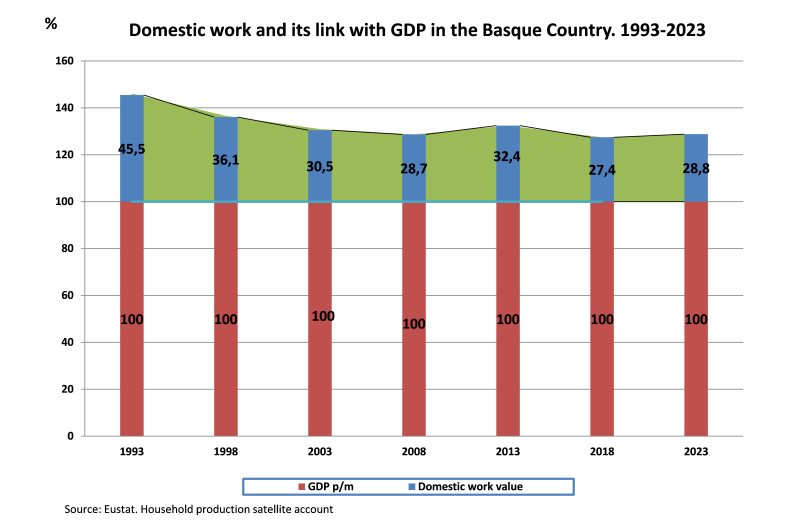
Relationship between the value of unpaid domestic work and GDP of the Basque Country (thousands of euros). 1993-2023
| |
1993 |
1998 |
2003 |
2008 |
2013 |
2018 |
2023 |
| 1.- Unpaid domestic work |
11,579,946 |
13,200,006 |
15,369,164 |
20,001,264 |
21,342,098 |
21,296,076 |
26,856,490 |
| 2.- GDP p/m |
25,462,667 |
36,590,384 |
50,450,411 |
69,791,290 |
65,826,224 |
77,614,139 |
93,242,571 |
| 3.-Household production/GDP (%) |
45.5 |
36.1 |
30.5 |
28.7 |
32.4 |
27.4 |
28.8 |
Base 2022
Date December 30, 2025
Source: Eustat. Household production satellite account
Over the last 30 years there has been a decline in the proportion of GDP corresponding to unpaid household production
The trend over the last thirty years reflects the counter-cyclical nature of household production: during periods of crisis there is a transfer of resources from the market economy to unpaid household work, while during expansive phases, a part of these activities tends to be outsourced. In 1993, unpaid household production amounted to 45.5% of GDP, while in 2023 it accounted for 28.8%, remaining at similar levels to the figures in the previous edition (27.4% in 2018). During this period, its share of GDP dropped continuously, except for 2013, at the height of the economic and financial crisis, when it rose to 32.4%.
Distribution by function: the same priorities remain, but with shifting proportions in 2023
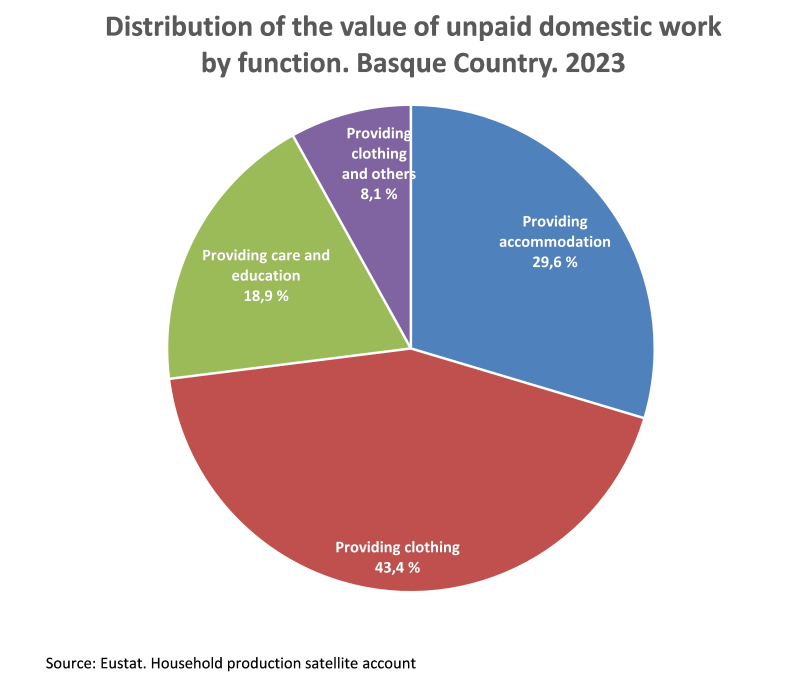
In 2023, the distribution of household production by function reflected the same priorities as in 2018, albeit with certain differences. The function "Provide accommodation" maintained its 29.6% share, the same as five years ago. However, other functions have become more significant: "Provide food" rose to 43.4% (three percentage points higher than in 2018), and "Provide clothing and other activities" rose to 8.1% (up half a point). Meanwhile, the function "Provide care and education" dropped to 18.9%, three and a half percentage points lower than in 2018.
63.5% of household production is performed by women, despite progress in terms of male joint responsibility
In terms of the gender distribution of the value of unpaid household production, a significant gender gap remains: in 2023, 63.5% was performed by women (67.2% in 2018). Nonetheless, the involvement of men has risen by 15.8 percentage points over the course of thirty years, compared with 1993.
This greater involvement on the part of men is unevenly distributed across the different tasks. Among those functions with more notable male involvement, and also greater growth, we find "Provide accommodation", with 42.5% male participation in 2023 (4.5 percentage points up on 2018), and "Provide food", amounting to 37.4%, an increase of 6.5 percentage points. However, the function "Provide care and education" still mainly falls on women, who take on 69.3% of this task, four percentage points higher than in 2018.
In GDP terms, household production by women would amount to 18.3% of GDP, compared with the 10.5% contributed by men.
Distribution of household production by sex. Basque Country (%). 2018-2023
| |
2023 |
2018 |
| |
Man |
Woman |
Man |
Woman |
| Providing accommodation |
42.5 |
57.5 |
38.0 |
62.0 |
| -Providing clothing |
37.4 |
62.6 |
30.9 |
69.1 |
| Providing care and education |
30.7 |
69.3 |
34.7 |
65.3 |
| Providing clothing and others |
23.1 |
76.9 |
17.4 |
82.6 |
| Total household production |
36.5 |
63.5 |
32.8 |
67.2 |
Base 2022
Date December 30, 2025
Source: Eustat. Household production satellite account
The provincial distribution of the value of unpaid household production corresponds to the population size: Bizkaia accounted for 55.2% of household production in the Basque Country, followed by Gipuzkoa with 30.3%, and Álava with 14.5%.
As for differences in participation by gender, Bizkaia stands out in that 37.3% of household labour is performed by men, while the figure for Gipuzkoa is 35.5%, and in Álava they account for 36.1%.
For further information:
Eustat - Euskal Estatistika Erakundea / Basque Statistics Institute
C/ Donostia-San Sebastián, 1 01010 Vitoria-Gasteiz
Press Service: servicioprensa@eustat.eus Tel.: 945 01 75 62