Press Release 04/04/2025
MUNICIPAL GDP 2022
70% of industrial activity in the Basque Country was concentrated in municipalities with fewer than 20,000 inhabitants
Bilbao and San Sebastián, which together accounted for 32.4% of all services generated in the Basque Country, have a tertiary economy profile where in both cases these activities now represent more than 90% of their economic activity
68.8% of all industrial activity generated in 2022 was carried out in municipalities in the Basque Country with fewer than 20,000 inhabitants, according to Eustat data. These municipalities also accounted for nearly all activity in the primary sector (Agriculture, Livestock and Fishing), with 94.8%.
Percentage distribution of the GDP of the Basque Country and its sectors by geographical area. 2022
| | Total | Bilbao | Donostia / San Sebastian | Vitoria-Gasteiz | Municipalities of over 20,000 inhabitants | Municipalities of less than 20,000 inhabitants |
| ACTIVITY SECTORS | | | | | | |
| TOTAL GDP | 100 | 15,3 | 9,5 | 11,5 | 22,5 | 41,1 |
| AGRICULTURE, FORESTRY AND FISHERIES | 100 | 0,2 | 0,4 | 1,9 | 2,8 | 94,8 |
| INDUSTRY AND ENERGY | 100 | 2,4 | 2,1 | 11,1 | 15,6 | 68,8 |
| CONSTRUCTION | 100 | 15,3 | 8,2 | 10,6 | 25,8 | 40,0 |
| SERVICES | 100 | 20,0 | 12,4 | 11,9 | 24,9 | 30,9 |
Date April 4, 2025
Source: Eustat. Municipal GDP
Municipalities with more than 20,000 inhabitants, together with Vitoria-Gasteiz, despite accounting for 15.6% and 11.1% of the entire Industry and Energy sector, respectively, showed a more balanced distribution where both Services and Construction represented a greater share of GDP, due in large part to their greater population. Activity in the primary sector also represented a very small share in these municipalities, accounting for less than 3% of the sector’s total in the Basque Country.
Lastly, if we look at the production structure of Bilbao and San Sebastián, together they generated just 4.5% of all industrial activity. The weight of the Agriculture, Livestock and Fishing sector was also residual. In contrast, these two provincial capitals accounted for 32.4% of all services, a reflection of the significant weight of this sector, which in both cases exceeded 90% of their total economic activity.
Services was the activity sector with the greatest economic weight in the province of Bizkaia
Bizkaia was the province that generated the highest GDP in absolute terms, with a total of 44,068,322 thousand euros, equivalent to 51% of all economic activity in the Basque Country. Meanwhile, Bilbao was the municipality that accounted for the highest volume, generating 13,275,987 thousand euros, which represented 30.1% of economic activity in the province. Among the municipalities with more than 20,000 inhabitants, of particular note were those located in the vicinity of Gran Bilbao, such as Barakaldo, with 2,700,793 thousand euros, Getxo, with 1,833,808 thousand, and Leioa, with 1,808,141 thousand euros in 2022.
If we analyse the contribution of municipalities with fewer than 20,000 inhabitants, we can see that those with the highest GDP were also located in the vicinity of Gran Bilbao, as was the case with Zamudio (1,530,806), Muskiz (1,369,655) and Derio (943,120), although Amorebieta-Etxano, in the region of Duranguesado, also made a significant contribution to Bizkaia’s GDP with 1,553,806 thousand euros.
GDP and its distribution by sector (%) in the municipalities of Bizkaia with the highest GDP. 2022
| | | TOTAL GDP (Thousands euros) | Percentage in GDP of Bizkaia | Breakdown by sector of activity (%) |
| | | | | AGRICULTURE, FORESTRY AND FISHERIES | INDUSTRY AND ENERGY | CONSTRUCTION | SERVICES |
| | | | | | | | |
| | Basque Country | 86.714.411 | | 0,9 | 24,2 | 5,4 | 69,5 |
| | Bizkaia | 44.068.322 | 100 | 1,0 | 20,4 | 5,7 | 72,9 |
| | | | | | | | |
| Municipalities of over 20,000 inhabitants | Bilbao | 13.275.987 | 30,1 | 0,0 | 3,9 | 5,5 | 90,7 |
| | Barakaldo | 2.700.793 | 6,1 | 0,0 | 6,4 | 9,8 | 83,8 |
| | Getxo | 1.833.808 | 4,2 | 0,0 | 2,4 | 6,9 | 90,6 |
| | Leioa | 1.808.141 | 4,1 | 0,0 | 15,6 | 2,5 | 81,8 |
| | | | | | | | |
| Municipalities of less than 20,000 inhabitants | Amorebieta-Etxano | 1.553.580 | 3,5 | 0,3 | 36,0 | 3,1 | 60,5 |
| | Zamudio | 1.530.806 | 3,5 | 0,1 | 44,6 | 4,8 | 50,5 |
| | Muskiz | 1.369.655 | 3,1 | 0,1 | 89,8 | 0,8 | 9,4 |
| | Derio | 943.120 | 2,1 | 0,1 | 16,4 | 5,7 | 77,7 |
| | | | | | | | |
Date April 4, 2025
Source: Eustat. Municipal GDP
Regarding the distribution of economic activity by sector, Bizkaia had a very similar structure to the Basque Country average, where the Services sector, the driving force of its economy, with 72.9% of its total GVA, stood 3.4 percentage points above the average for the autonomous region. The Industry and Energy sector also represented 20.4% of economic activity in the province, slightly below the Basque Country average (24.2%).
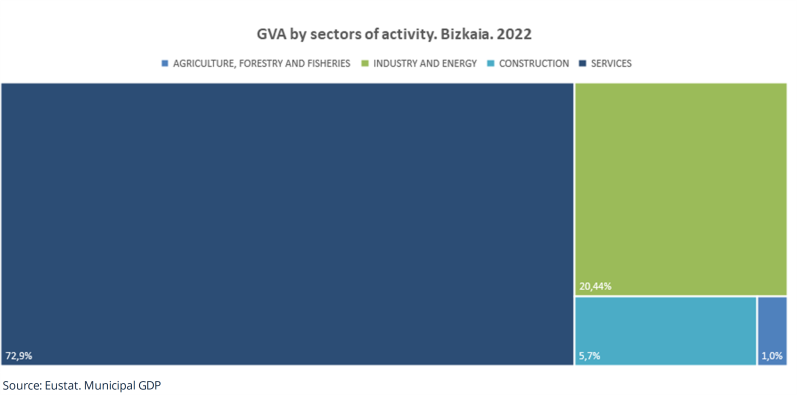
Furthermore, when the same analysis is carried out taking into account the number of inhabitants per municipality, it can be seen that Services activities were closely linked to municipalities with large populations. Of particular note were Bilbao and Getxo, where services accounted for more than 90% of their gross value added, followed by Barakaldo and Leioa, where they also represented more than 80% of the municipality’s total GVA.
As the population decreases, however, the Services sector loses weight to the Industry and Energy sector, as was the case in Zamudio, where services represented 50.5% and industrial activity accounted for 44.6%. Lastly, Muskiz, with a smaller population but strong industrial presence, was characterised by a small Services sector (9.4%), while its significant industrial activity accounted for 89.8% of the municipality’s economic activity. The same effect was also seen in other municipalities with small populations and important industrial establishments, such as Ajangiz and Zierbena.
Gipuzkoa was the province with the most geographically diverse GDP
Gipuzkoa contributed 28,820,064 thousand euros to the GDP of the Basque Country in 2022, 33.3% of the total. As in the other two provinces, the highest volume of GDP was generated in its capital, San Sebastián, with 8,256,021 thousand euros, accounting for 28.6% of economic activity in the province.
GDP and its distribution by sector (%) in the municipalities of Gipuzkoa with the highest GDP. 2022
| | | TOTAL GDP (Thousands euros) | Percentage in GDP of Gipuzkoa | Breakdown by sector of activity (%) |
| | | | | AGRICULTURE, FORESTRY AND FISHERIES | INDUSTRY AND ENERGY | CONSTRUCTION | SERVICES |
| | | | | | | | |
| | Basque Country | 86.714.411 | | 0,9 | 24,2 | 5,4 | 69,5 |
| | Gipuzkoa | 28.820.064 | 100 | 0,7 | 27,5 | 5,6 | 66,2 |
| | | | | | | | |
| Municipalities of over 20,000 inhabitants | Donostia / San Sebastian | 8256021 | 28,6 | 0,0 | 5,3 | 4,7 | 90,0 |
| | Irun | 2.028.204 | 7,0 | 0,1 | 16,8 | 6,5 | 76,7 |
| | Arrasate / Mondragon | 1.099.454 | 3,8 | 0,2 | 27,8 | 3,7 | 68,2 |
| | Hernani | 1.024.686 | 3,6 | 0,3 | 51,4 | 3,1 | 45,2 |
| | | | | | | | |
| Municipalities of less than 20,000 inhabitants | Beasain | 905.576 | 3,1 | 0,2 | 62,9 | 3,3 | 33,6 |
| | Bergara | 664.527 | 2,3 | 0,9 | 50,5 | 3,8 | 44,8 |
| | Tolosa | 551.505 | 1,9 | 0,4 | 15,5 | 5,3 | 78,9 |
| | Azpeitia | 532.647 | 1,8 | 1,1 | 37,0 | 6,2 | 55,6 |
| | | | | | | | |
Date April 4, 2025
Source: Eustat. Municipal GDP
Standing out among the municipalities with more than 20,000 inhabitants was Irun, with a GDP of 2,028,204 thousand euros, followed by Arrasate/Mondragón (1,099,454) and Hernani (1,024,686). As regards the contribution of the main municipalities with fewer than 20,000 inhabitants, Beasain (905,576), Bergara (664,527) and Tolosa (551,505) were those that generated the most economic activity. In the case of Gipuzkoa, unlike what occurred in Bizkaia, the municipalities that generated the highest GDP were not concentrated around the capital, but were more evenly distributed among the different regions of the province.
In terms of sectoral distribution, the province of Gipuzkoa also had a similar structure to that of the Basque Country. Its Services sector, which represented 66.2% of value added, accounted for a slightly lower percentage than the average for the Basque Country as a whole (69.5%), whereas industry had a greater weight, accounting for 27.5% of all activity carried out in the province, which placed it 3.3 percentage points above the figure for the Basque Country.
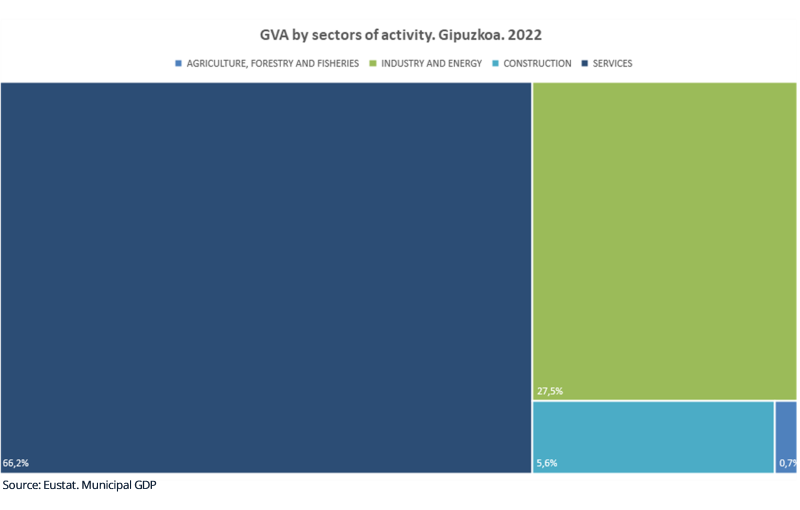
By municipality, services activities predominated primarily in the capital, given that they generated a GVA of 7,477,094 thousand euros, accounting for 90% of its total value added. Outside the capital, of particular note were the municipalities of Irun, where services activities represented 76.7%, and Tolosa, where they accounted for 78.9%.
The distribution of Industry and Energy activities throughout the province was much more diverse and they were concentrated primarily in municipalities with fewer than 20,000 inhabitants. So much so that, of the 81 municipalities in the province with fewer than 20,000 inhabitants, industry accounted for more than 50% of the municipality’s GVA in 34 of them. Standing out in the Agriculture, Livestock and Fishing sector were coastal municipalities linked to fishing activity, such as Hondarribia and Getaria, with 24,230 and 23,307 thousand euros in value added, respectively.
Álava was the province where industry accounted for the highest percentage of GDP
The province of Araba/Álava contributed 13,826,025 thousand euros to the total GDP of the Basque Country, representing 15.9% of all economic activity. As in the previous two provinces, the largest volume of activity was seen in its capital, Vitoria-Gasteiz, with a GDP of 10,021,084 thousand euros, although, in this case, it accounted for a higher percentage (72.5%) of economic activity in the province.
The remaining municipalities in Álava had a much smaller population, which in no case exceeded 20,000 inhabitants, resulting in a different economic structure from the rest of the provinces. Thus, Laudio/Llodio, with a GDP in thousands of euros of 712,384, and Amurrio, with 475,619, were the municipalities with the highest GDP in Álava, accounting for 5.2% and 3.4%, respectively, of the total for the province.
GDP and its distribution by sector (%) in the municipalities of Álava with the highest GDP. 2022
| | | TOTAL GDP (Thousands euros) | Percentage in GDP of Álava | Breakdown by sector of activity (%) |
| | | | | AGRICULTURE, FORESTRY AND FISHERIES | INDUSTRY AND ENERGY | CONSTRUCTION | SERVICES |
| | | | | | | | |
| | Basque Country | 86.714.411 | | 0,9 | 24,2 | 5,4 | 69,5 |
| | Araba/Álava | 13.826.025 | 100 | 1,3 | 29,0 | 4,4 | 65,4 |
| | | | | | | | |
| | Vitoria-Gasteiz | 10.021.084 | 72,5 | 0,1 | 23,1 | 5,0 | 71,7 |
| | | | | | | | |
| Municipalities of less than 20,000 inhabitants | Laudio/Llodio | 712.384 | 5,2 | 0,4 | 34,7 | 1,7 | 63,2 |
| | Amurrio | 475.619 | 3,4 | 1,6 | 54,1 | 3,2 | 41,0 |
| | Legutio | 322.276 | 2,3 | 0,7 | 74,2 | 1,0 | 24,1 |
| | Oyón-Oion | 229.646 | 1,7 | 5,4 | 60,7 | 4,0 | 29,9 |
| | Iruña Oka/Iruña de Oca | 224396 | 1,6 | 0,6 | 28,0 | 3,2 | 68,2 |
| | Agurain/Salvatierra | 215.577 | 1,6 | 1,2 | 27,3 | 2,0 | 69,5 |
| | | | | | | | |
Date April 4, 2025
Source: Eustat. Municipal GDP
By activity sector, Álava also had a structure in which Services was the main sector of economic activity, with 65.4%. However, its branches of industrial activity contributed 29.0% of the province’s value added, which was the highest percentage among the three provinces and 4.8 percentage points higher than the Basque Country average (24.2%). Furthermore, its significant agricultural activity meant that the percentage for the Agriculture, Livestock and Fishing sector reached 1.3%, once again higher than the average (0.9%).
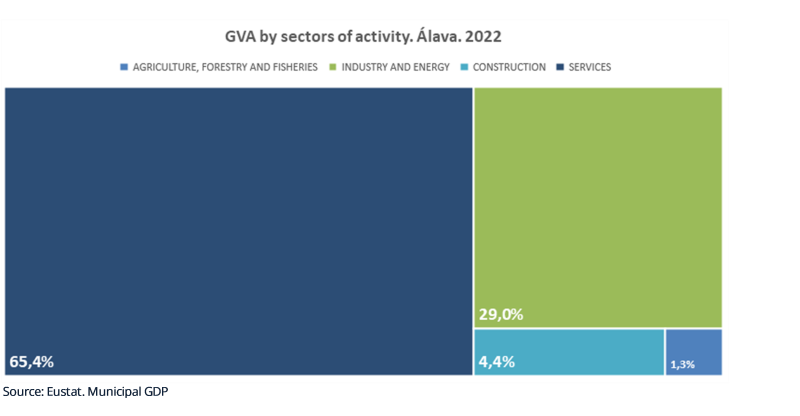
The analysis by municipality revealed peculiarities in this province, given that Vitoria-Gasteiz, which accounted for 75% of the province’s population, also accounted for the most economic activity. The capital combined services activities (71.7%) with a strong industrial presence, which represented 23.1% of its total GVA. The significant weight of Industry and Energy was an element that differentiated it from the other two capitals, where the sector accounted for just 3.9% in the case of Bilbao and 5.3% in San Sebastián.
As for the remaining municipalities in Álava, it is worth noting that none of them had more than 20,000 inhabitants, with Laudio/Llodio being the municipality with the largest population. With regard to the distribution of its activity by economic sector, once again, we can see that in municipalities with a small population such as these, industrial activity had a notable presence. So much so that the municipalities in Álava that made the greatest contribution to the province’s GVA were characterised as having an industrial sector with a higher percentage and a services sector with a lower weight than the average for the Basque Country. In this case, it is also worth highlighting that, although residual, the contribution of the primary sector to the GVA of the most notable municipalities in Álava was higher than that observed in the other provinces.
Methodological note:
Coinciding with the dissemination of the Municipal GDP corresponding to 2022, Eustat has carried out a change of base year (base year 2022), which involves revising both the sources of information and estimation methods used in the calculations made within the Municipal GDP. This change of base year also involves recalculating the economic variables at municipal level, so that they are fully consistent with the macroeconomic magnitudes published annually for the Basque Country and its provinces.
For further information:
Eustat - Euskal Estatistika Erakundea/Basque Statistics Institute
C/ Donostia-San Sebastián, 1 01010 Vitoria-Gasteiz
Press Service: servicioprensa@eustat.eus Tel.: 945 01 75 62