Press Release 20/12/2024
SURVEY ON INNOVATION. 2023
In 2023, 26.2% of companies in the Basque Country were innovating companies, almost nine points more than five years earlier
27.4% of companies carried out innovation with environmental benefits
The percentage of innovating companies in the Basque Country in 2023 stood at 26.2%, 2.4 points more than in 2022 and 8.9 more than in 2018, according to Eustat data. 11.3% with Product innovation and 23.5% with Business process innovation. As for expenditure on innovation by innovating companies, it rose to 3,565 million euros, up 8.7% on the previous year.
The percentage of innovating companies with 10 or more employees in 2023 rose to 38.4% in the Basque Country, 3 points higher than the previous year and as much as 8.3 points more than five years ago, in 2018 (the first of the series with the new methodology). If the two types of innovation observed are analysed, Product innovation was carried out by 23.0% and Business process innovation by 32.9%.
Regarding expenditure by Basque companies on innovative activities in 2023, this exceeded three thousand five hundred million euros, specifically 3,565 (8.3% more than in 2022), despite 60.3% of companies considering that there were factors that made it difficult to undertake innovative activities.
In the case of companies with 10 or more employees, expenditure increased by one point to 9.3%, surpassing three thousand million euros to stand at 3,140 million. This figure represented 88.1% of total expenditure by Basque companies on innovative activities.
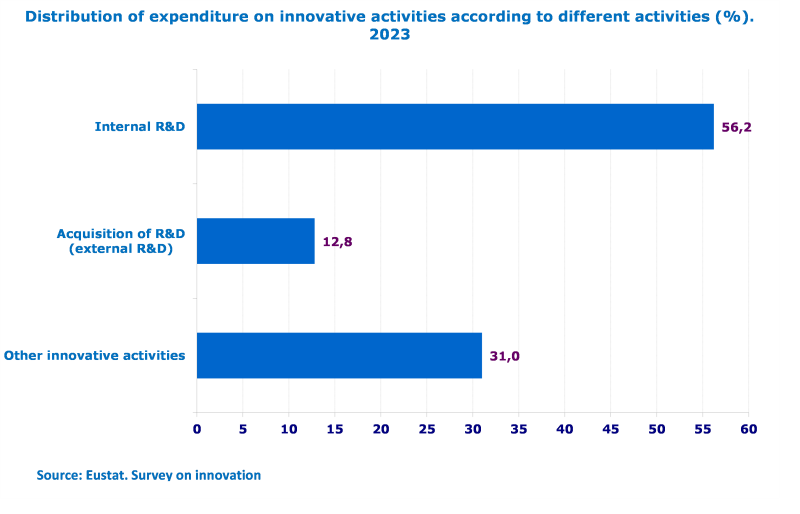
Of these activities, expenditure on internal R&D accounted for 56.2%, R&D Acquisition (external R&D) 12.8%, and Other Innovating Activities(1) the remaining 31.0% in companies as a whole. The distribution was not very different for companies with 10 or more employees: expenditure on internal R&D was 59.7%, R&D Acquisition 13.1% and Other Innovating Activities(1) 27.2%.
33.4% of innovating companies received public funding for innovating activities
Innovating companies can receive support via public funding for innovating activities from one or more public institutions. Thus, 33.4% of these companies received some kind of public funding. If we look at origin, particularly noteworthy is that originating from the Basque Government, which stood at 21.8% of the total for these innovating companies. Provincial Councils and Local Administrations provided 10.4% and 3.4% of funding to these companies, respectively. The State Administration contributed to 14.1% of Basque innovating companies while 10.2% of companies received European Union funding: 2.7% via the Horizon Europe programme and 8.0% from other EU funding.
In the case of companies with 10 or more employees, 52.7% received public funding, with the majority of innovating companies of this size being funded by the Basque Government, specifically 38.9%. Provincial councils and local administrations funded 24.1% and 8.8%, respectively, while State Administration funding stood at 22.9% for companies with 10 or more employees. For its part, the European Union funded 20.0%: 10.2% via the Horizon Europe programme and 12.2% through another type of European funding.
Innovative companies that receive public funding for innovation activities according to their origin (%). 2021-2023
| | Total | 10 or more |
| Receive public funding from (*) | 33,4 | 52,7 |
| Basque Government | 21,8 | 38,9 |
| Local Admin | 3,4 | 8,8 |
| Provincial Councils | 10,4 | 24,1 |
| Central Admin | 14,1 | 22,9 |
| Horizon Europe Programme | 2,7 | 10,2 |
| Other EU funding | 8,0 | 12,2 |
(*)companies can receive financing from more than one entity
Date December 20, 2024
Source: Eustat. Survey on innovation
Innovative products generated 32.2% of turnover in companies with product innovation in the Basque Country in 2023
On average, innovative products generated 32.2% of turnover in companies with product innovation in the Basque Country in 2023, while unaltered or slightly modified products accounted for the remaining 67.8% in these companies.
If we focus on companies with 10 or more employees with product innovation, these percentages vary slightly, in this case the average repercussion of new or considerably improved products on turnover accounted for 30.5%.
Over half of the companies, 60.3%, feel that there are factors hindering innovation
60.3% of companies considered that specific factors existed that made it difficult to innovate. Amongst these factors were: “The existence of other priorities within the company” (47.5%); “Excessively high costs” (38.8%); “A lack of funding within the company” (29.9%); “Too much competition on the market” (28.7%); “Difficulties in obtaining public grants or subsidies” (28.3%); “Uncertainty regarding market demand for these ideas” (27.6%); and “A lack of qualified personnel within the company” or “A lack of funding from external private sources” (26.1% and 23.4%, respectively).
For companies with 10 or more employees, the percentage of those that thought there were factors that made it difficult to undertake innovating activities rose to 67.9%, with the same hindrances highlighted.
27.4% of companies carried out innovation with environmental benefits
27.4% of companies carried out innovation with environmental benefits, both within the company itself (19.5%) and outside the company, i.e. during the consumption or use of the goods or services by the end user (23.8%). Among the former, the internal benefits, of particular note were ‘Recycling waste, water, etc. for own use or sale’ (9.9%), ‘Replacing part of the materials with other less polluting or hazardous materials’ (7.8%), ‘Reducing energy use or CO2 footprint’ (7.4%), ‘Reducing the use of material or water per unit produced’ (6.3%) and ‘Reducing soil, noise, water or air pollution’ (6.1%).
Standing out among the latter, those that have an impact outside the company itself, were ‘Facilitating the recycling of products once used’ (20.2%) and 'Extending the service life of its products through more durable products’ (10.5%).
Among companies with 10 or more employees, the percentage of those with innovation with environmental benefits rose to 35.2%.
Methodological note
Since 2018, the Survey on Innovation has been carried out with the new version of the Oslo Manual 2018. This means that there is a break in the series due to the methodological changes. For this reason, the data published from 2018 is not comparable with that published in previous years.
Note:
Eustat would like to thank all the companies and institutions that have collaborated in preparing this survey, the information for which was gathered between April and October 2024, for their efforts. Without their collaboration it would not have been possible.
� Other innovating activities includes those activities of the company that are subject to being carried out with the intention of innovating in the following six categories:
1. Engineering, design and other creative activities.
2. Marketing and brand creation.
3. Activities relating to intellectual property rights.
4. Activities relating to personnel training.
5. Software development and activities relating to database work.
6. Activities relating to the acquisition or rental of tangible assets.
For further information:
Eustat - Euskal Estatistika Erakundea / Basque Statistics Institute
C/ Donostia-San Sebastián, 1 01010 Vitoria-Gasteiz
Press Service: servicioprensa@eustat.eus Tel.: 945 01 75 62