Press Release 16/12/2024
POPULATION AND HOUSING CENSUS. POPULATION STRUCTURE. 01/01/2024
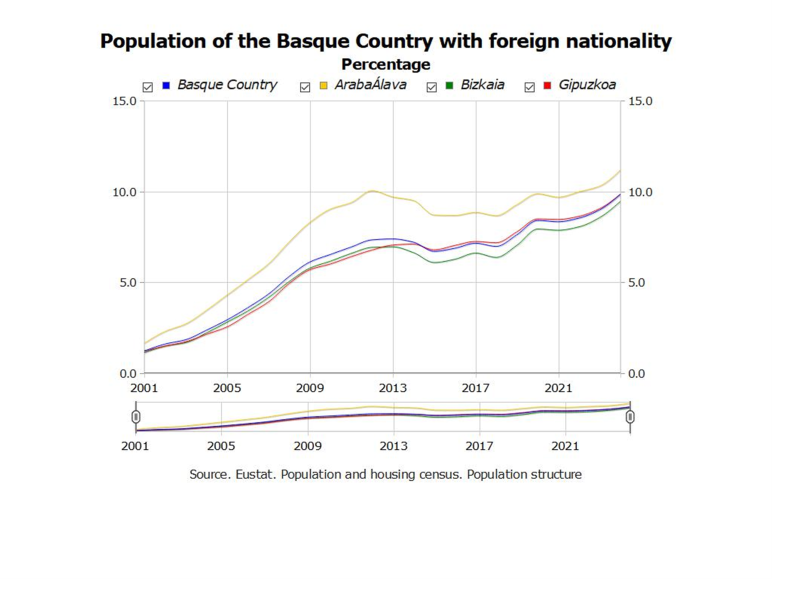
In 2024, 217,489 foreign nationals resided in the Basque Country, 9.9% of the total population
The foreign-born population rose to 298,422, 9.6% more than a year ago
The number of foreign nationals residing in the Basque Country stood at 217,489, 9.9% of the total population on 1 January 2024, a percentage 9 tenths higher than on 1 January 2023, according to Eustat data. The proportion for Spain was 13.4%. Therefore, in this respect, the Basque Country was placed between Andalusia, also with 9.9%, and Cantabria and Castile and Leon, with 7.7%.
On the same date, 298,422 people born abroad resided in the Basque Country, 13.5% of the total population, a higher percentage than a year ago (12.4%), but lower than that for Spain as a whole (18.1%).
The percentage of foreign nationals varied slightly between provinces: Álava had the highest proportion with 11.2% (9 tenths more than in 2023), followed by Gipuzkoa with 9.9% (8 tenths more) and finally, Bizkaia, with 9.5% (9 tenths more).
If we consider the continent, Latin Americans (100,715 people) represented 46.3% of foreign nationals (2.5 points more than in 2023). The countries with the greatest representation in this group were Colombia, Nicaragua, Venezuela, Honduras and Paraguay. Between them, these five countries accounted for 31.6% of the total number of foreign nationals, and 68.2% of Latin American nationals. Regarding sex, 49.8% of foreign residents and 57.8% of Latin American residents were women.
African nationals residing in the Basque Country (53,596 people) accounted for 24.6% of all foreign nationals, 0.6 points less than in 2023, with more than half coming from Morocco (54.6%). This was followed by Algeria, Senegal and Nigeria, at 14.1%, 10.2% and 7.5%, respectively. These four nationalities represented more than 86% of those with African nationality, and over 21% of all foreign nationals. If we look at distribution by sex, there was a predominance of men, with 63.1% of the total.

European countries accounted for 21.3% of the foreign population in the Basque Country (46,287 people), 1.7 points less than in 2023. Romania stood out in this group, representing 8.4% of foreign nationals and 39.6% of Europeans. In second place, albeit at some distance from Romania, was Portugal, making up 13.4% of Europeans in the Basque Country. Ukraine came in third place with 10.2%. In this group, both sexes had a similar presence, the percentage of men being slightly higher.
In last place were nationals from Asia and Oceania (16,891 people), representing 7.8% of foreign residents. Notably, just two countries accounted for 73% of the group: Pakistan, with 39.4%, and China, with 33.5%. In this group, men accounted for 55.4% of the total.
Latin Americans continued to be in the majority in all three provinces, although there were notable differences between them
In Bizkaia, Latin Americans represented the greatest proportion of foreign residents (50.5% of the total), followed by Africans (23.1%) and Europeans (19.0%).
In Gipuzkoa, Latin Americans were once again clearly in the majority, accounting for 43.6% of the total, followed by Europeans (26.5%) and Africans (21.8%).
Meanwhile, in Álava, the percentage of people with Latin American nationality continued to increase, although the proportion of Latin Americans and Africans remained similar (39.2% and 34.6%, respectively). They were followed at some distance by Europeans (17.9%) and Asians (8.3%).
The number of people born abroad exceeded 298,000
On 1 January 2024, the number of people born abroad residing in the Basque Country stood at 298,422 and accounted for 13.5% of the total population. The proportion for Spain was 18.1%. Therefore, in this respect, the Basque Country was placed between Castilla-La Mancha and Andalusia, with 14% and 12.4% of the population born abroad, respectively.
By province, Bizkaia and Gipuzkoa had fairly similar percentages of the population born abroad (13% and 13.4%, respectively), while in Álava it rose to 15.7%.
As regards the provincial capitals, all three had percentages of the population born abroad higher than that of the Basque Country as a whole, with the highest proportion being in Vitoria-Gasteiz, where it stood at 17.1%; in Bilbao it stood at 16.4% and in Donostia/San Sebastián it reached 14.5% of its total population.
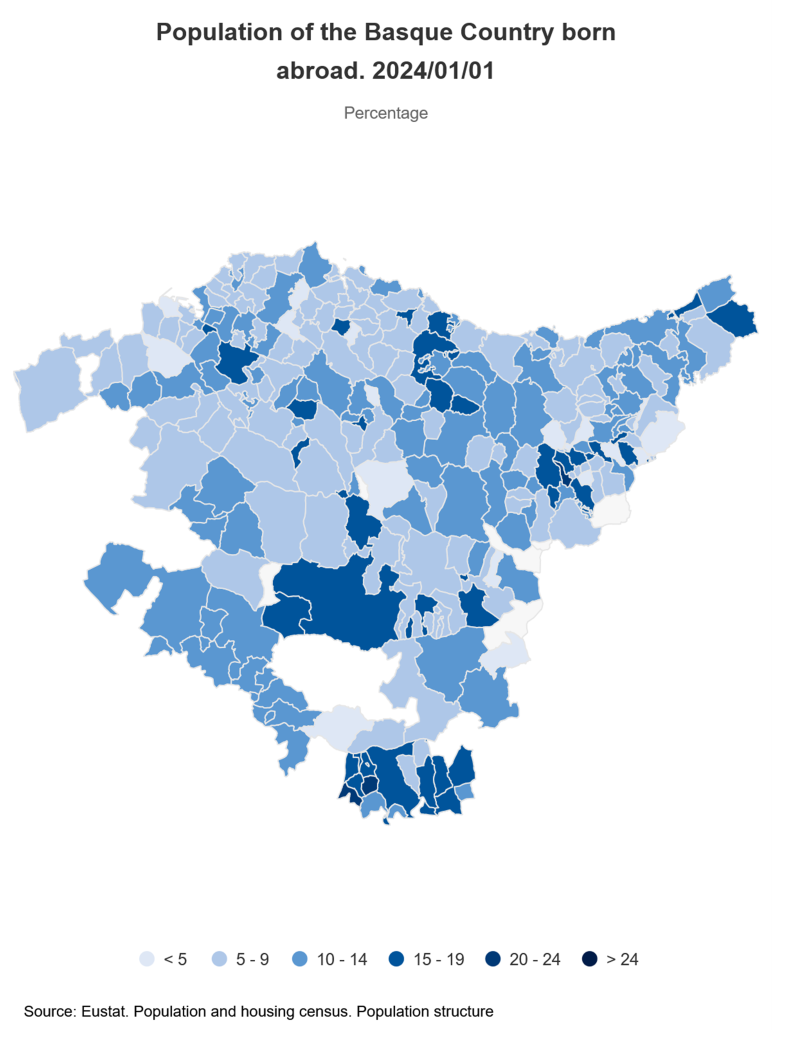
There were significant differences at the regional level and the percentages of people born abroad ranged from over 15% in the regions of Llanada Alavesa, Bajo Bidasoa and Rioja Alavesa to less than 10% in Montaña Alavesa, Cantábrica Alavesa and Plentzia-Mungia.
In more than half of the municipalities of the Basque Country, the proportion of people born abroad remained below 10%. Of the 59 municipalities that had a proportion greater than that of the Basque Country as a whole, only 17 had over 10,000 inhabitants. Navaridas, Baños de Ebro (both in Álava) and Ordizia (in Gipuzkoa) had the highest percentages, with 23.8%, 20.8% and 20.6%, respectively. Meanwhile, there were five municipalities where the percentage was less than 4%: Beizama and Albiztur in Gipuzkoa, Zalduondo in Álava, and Ajangiz and Meñaka in Bizkaia.
97,669 foreign-born residents had Spanish nationality
On 1 January 2024, 97,669 foreign-born residents in the Basque Country had acquired Spanish nationality or already had it due to family or other reasons. Of this number, 67.2% came from Latin America. Among them, three countries accounted for more than 45% of people in this situation: Colombia (21.9%), Bolivia (12.2%) and Ecuador (11%).
Next were people born in African countries, representing 15.3% of the total. Of those, more than half were born in Morocco (55.2%), followed very distantly by those born in Algeria (13.8%).
13.6% of people who acquired Spanish nationality came from other European countries. Of those, almost a third were born in France (30%), 13.8% in Portugal and in third place were those born in Germany, who accounted for 10.9%. They were followed by people born in Russia, representing 8.5% of the total number of Europeans.
Lastly, people born in countries in Asia and Oceania accounted for 3.9% of all people who acquired Spanish nationality. Standing out among them were those born in Pakistan (30.6%), China (28.8%) and the Philippines (13.4%).
The foreign population living in the Basque Country was younger than the Spanish population
The average age of foreign nationals in the Basque Country was 33.7, a significantly lower figure than that of residents with Spanish nationality, which was 47.2. The average age of the Basque population as a whole was 45.9.
Meanwhile, if instead of nationality, we look at place of birth, we can also see significant differences in the average age, depending on whether the place of birth was in the Basque Country, the rest of Spain or abroad. The oldest population, whose average age continued to rise to 65.8, was that born in the rest of Spain. It was followed by the population born in the Basque Country, with an average age of 42.8 and, lastly, people born abroad, with an average age of 38.1.
For further information:
Eustat - Euskal Estatistika Erakundea / Basque Statistics Institute
C/ Donostia-San Sebastián, 1 01010 Vitoria-Gasteiz
Press Service: servicioprensa@eustat.eus Tel.: 945 01 75 62