Press release 29/11/2024
HOSPITAL MORBIDITY STATISTICS. 2023
Hospital admissions rose by 2.1% in the acute care hospitals of the Basque Country in 2023
Respiratory illnesses increased by 17.4% in acute care hospitals
A total of 235,484 hospital admissions were registered in 2023 at acute care hospitals in the Basque Country, a rise of 2.1% compared with the previous year, according to Eustat figures. The main causes of hospital admissions were digestive, respiratory and circulatory diseases, which as a whole accounted for 37.6% of admissions.
For the second consecutive year, hospital admissions for respiratory illnesses rose, specifically by 17.4% compared with 2022, maintaining their place as the third biggest cause of hospital admission and the one that has increased the most among the most common disease groups in the post-pandemic years. By contrast, admissions for Covid-19 continued to decrease (by 66.6% compared with 2022), accounting for 1.2% of hospital admissions in 2023, down from 3.6% and 5.1% in 2022 and 2021, respectively.
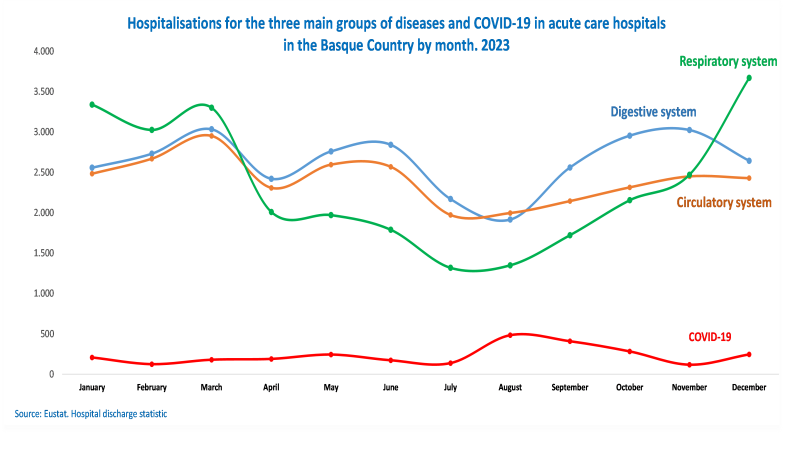
March was the month with the highest number of hospital admissions (9.8%), and January was the month with the most deaths in hospitals (9.8%), both of which coincided with the period of the year in which respiratory illnesses were the main cause of hospital admission. Pneumonia and chronic obstructive pulmonary disease (COPD) especially stood out.
83.8% of cases were treated at public hospitals, and 16.2% privately. In the latter case, the pattern of pathologies treated differed, with musculoskeletal problems being the most frequently treated (almost 21% of hospital admissions); among the most common were osteoarthritis of the knee and hip and internal knee problems.
64.2% of hospital admissions were urgent, a percentage rising to 70.2% for public hospitals (33.2% at private establishments). Of all those discharged, in 90.8% of cases this was because of recovery or improvement, 3.5% due to death, with the remainder being transferred to other centres or discharged for other reasons.
As for the profile of people admitted, the proportion of men (51.2%) was greater than the proportion of women (48.8%), rising to 54.5% if we exclude cases of pregnancy, childbirth and postpartum care. 51.6% were aged 65 or over, with the specific group aged 65-79 accounting for the greatest number of admissions (29.3%), followed by the age bracket 45-64 (25.3%) and those aged 80 or over (22.2%).
By province, 50.7% were resident in Bizkaia, 31.6% in Gipuzkoa, 15.2% in Alava, 1.8% in neighbouring provinces, 0.4% in the rest of the provinces and 0.3% abroad.
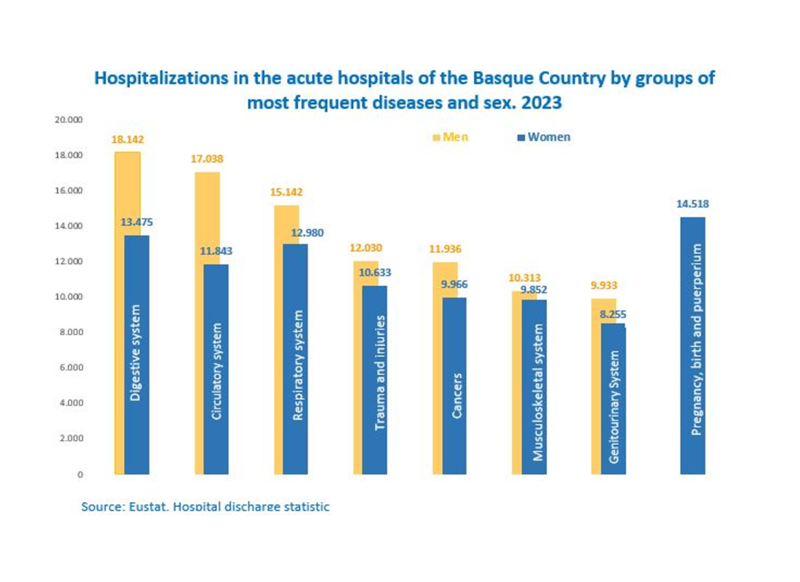
In terms of large groups of illnesses, digestive and circulatory conditions were the two main causes of hospital admissions in 2023 (with 13.4% and 12.3%, respectively), followed closely by respiratory illnesses in third place (11.9%), then trauma and injuries (9.6%) and tumours (9.3%).
Among women, excluding cases of pregnancy, childbirth and postpartum care, which accounted for 12.6% of admissions, the greatest number of cases handled involved digestive tract illnesses (11.7%), followed by respiratory (11.3%) and circulatory (10.3%) conditions.
Among men, the three main causes of hospitalisation were the same as for women (excluding pregnancy, childbirth and postpartum care), although the frequency of hospital admissions was higher for all of these: digestive tract illnesses (15.1%), circulatory conditions (14.1%) and respiratory conditions (12.6%).
Hospitalizations in the acute hospitals of the Basque Country by groups of most frequent diseases and COVID 19 according to sex and age groups. 2023


| | Total | % (*) | Rate of change (%) 2023/2022 | Sex (%) | Age (%) |
| | | | | Man | Woman | 0-14 | 15-44 | 45-64 | 65-79 | 80 and more |
| LARGE DIAGNOSTIC GROUPS | | | | | | | | | | |
| Total | 235.484 | 100 | 2,1 | 100 | 100 | 100 | 100 | 100 | 100 | 100 |
| Digestive system | 31.617 | 13,4 | 4,1 | 15,1 | 11,7 | 8,7 | 11,0 | 16,4 | 14,1 | 12,1 |
| Circulatory system | 28.881 | 12,3 | -1,1 | 14,1 | 10,3 | 0,8 | 2,3 | 10,7 | 15,3 | 20,8 |
| Respiratory system | 28.122 | 11,9 | 17,4 | 12,6 | 11,3 | 25,3 | 7,8 | 8,5 | 11,3 | 17,4 |
| Trauma and injuries | 22.663 | 9,6 | 4,1 | 10,0 | 9,2 | 7,6 | 10,6 | 10,8 | 7,9 | 10,2 |
| Tumors | 21.902 | 9,3 | -0,9 | 9,9 | 8,7 | 1,0 | 3,9 | 12,0 | 13,5 | 7,0 |
| Musculoskeletal system | 20.165 | 8,6 | 9,9 | 8,6 | 8,6 | 2,8 | 7,1 | 12,3 | 10,2 | 4,6 |
| Genitourinary System | 18.188 | 7,7 | 5,5 | 8,2 | 7,2 | 3,7 | 6,4 | 8,8 | 8,9 | 6,8 |
| Pregnancy, birth and puerperium | 14.518 | 6,2 | -1,6 | - | 12,6 | 0,0 | 32,6 | 0,3 | - | - |
| COVID-19 | 2.786 | 1,2 | -66,6 | 1,2 | 1,1 | 0,6 | 0,2 | 0,6 | 1,3 | 2,7 |
(*)The percentage has been calculated on the total number of hospitalizations
ICD -10 : International Classification of Diseases, 10th version
Date November 29, 2024
Source: Eustat. Hospital discharge statistic
Looking at groups of illnesses, and within them the specific causes that resulted in more hospital admissions, for the population aged under 15 it was respiratory illnesses (hypertrophy of tonsils and adenoids and acute bronchiolitis); for those aged 15 to 44, apart from pregnancy and childbirth care, it was digestive problems (acute appendicitis) and trauma and injuries (dislocation and sprain of knee joints and ligaments); in the 45-64 age group, digestive illnesses continued to dominate: cholelithiasis in women (gallstones) and inguinal hernia in men.
In the age group of 65 years and older, circulatory system diseases (heart failure and stroke) prevailed; and in the largest group, the elderly (65-79 years), in addition to the circulatory diseases mentioned above, digestive diseases (again inguinal hernia and gallstones) and tumours (bladder, prostate, bronchus and lung) also stood out.
The average length of stay decreased to 5.5 days
People admitted to hospital caused 1,293,433 stays (in other words, the days that elapsed from the date of the patient's admission until the date of discharge), which represented a drop of 1.1% compared with 2022, and the average stay was 5.5 days (5.7 in 2022); for men, it was 5.7 days, and for women 5.3; by age group, the longest stays were seen in the beginning and end stages of life: 0 years old (almost 8 days) and 80 years and older (6.5 days).
Looking at groups of illnesses, those that caused the longest stays were mental and behavioural disorders (13.8 days), together with illnesses originating in the perinatal period (9.4 days) and infectious and parasitic diseases (8.8 days).
Methodological note
For reasons of comparability with Spanish and international statistics, the hospital admissions mode only takes into account admissions with a stay equal to or greater than 1 day, that is, admissions with 0 days are not counted. The length of stay is calculated as the number of days between the date of admission and the date of discharge, without taking into account the time of admission or discharge.
Hospital admissions to medium-stay and long-stay hospitals and psychiatric hospitals are not included.
For further information:
Eustat - Euskal Estatistika Erakundea / Basque Statistics Institute
C/ Donostia-San Sebastián, 1 01010 Vitoria-Gasteiz
Press Service: servicioprensa@eustat.eus Tel.: 945 01 75 62