Press Release 14/06/2024
POPULATION AND HOUSING CENSUS. POPULATION STRUCTURE. 07/01/2023
The population of the Basque Country grew by 4,717 people in the first half of 2023, and exceeded 2,200,000 inhabitants for the first time
This rise was based on the increase in the number of foreign residents, which was up by 6,360 people, and now represents 9.5% of the total population
The population of the Basque Country stood at 2,201,462 people on 1 July 2023, representing an increase of 4,717 people compared to January, and a year-on-year increase of 10,994 people (July 2022 to July 2023), according to Eustat data. This confirms the trend of 2022, in which the population increased by 10,228 people, after several years of decline (6,682 fewer people in 2021, and 6,612 fewer in 2020).
All three provinces saw their population grow between January and July 2023. The greatest increase in absolute terms occurred in Bizkaia, with an increase of 2,623 residents, taking the total to 1,146,642. This was followed by Álava, whose population stood at 333,921 residents, 1,070 more people than in January. Gipuzkoa, with a population of 720,899 inhabitants, also saw its population rise by 1,024 people.
In percentage terms, Álava was the province with the highest growth (0.32%), followed by Bizkaia (0.23%) and Gipuzkoa (0.14%). The Basque capitals also saw population numbers recover, especially Vitoria-Gasteiz, with 993 more inhabitants than at the beginning of the year, while in Bilbao there were 704 more people and 75 more in Donostia-San Sebastián.
Evolution of the population of the Basque Country by territorial area (1). 07/01/2023
| | January 2023 | July 2023 | Increase (num.) | Increase (%) |
| Total | 2.196.745 | 2.201.462 | 4.717 | 0,21 |
| Historic Territories | | | | |
| Araba/Álava | 332.851 | 333.921 | 1.070 | 0,32 |
| Bizkaia | 1.144.019 | 1.146.642 | 2.623 | 0,23 |
| Gipuzkoa | 719.875 | 720.899 | 1.024 | 0,14 |
| Capitals | | | | |
| Bilbao | 342.484 | 343.188 | 704 | 0,21 |
| Donostia / San Sebastian | 182.641 | 182.716 | 75 | 0,04 |
| Vitoria-Gasteiz | 250.100 | 251.093 | 993 | 0,40 |
(1)Provisional data
Date June 14, 2024
Source: Eustat. Population and housing census. Population structure
As regards the remaining municipalities in the Basque Country, it is worth noting that over the last six months of the year, more than half saw their population increase. The biggest absolute increases occurred in Barakaldo (525) and Irún (340), followed by Urduliz (167), Sestao (139), Bermeo (138) and Leioa (136).
At the other extreme, Getxo in Bizkaia and, above all, Hernani in Gipuzkoa saw the greatest decreases (91 and 220 fewer inhabitants, respectively).
If we take into account the districts, it is once again Greater Bilbao that has seen the largest absolute increase, with 1,918 more residents. There was also a significant increase in Llanada Alavesa (1,047 more inhabitants).
Only 3 of the 20 districts studied saw population decline – Rioja Alavesa, Montaña Alavesa and Markina-Ondarroa – with decreases much lower than 1%; two districts maintained almost the same population – Añana and Encartaciones – each with 3 more residents; and population increased in the remaining 15 districts.
The number of people over 65 years old continued to rise
The average age of the population of the Basque Country stood at 45.8, 0.2 years higher than at the beginning of the year. The difference between the sexes remained stable at around 3 years: 44.3 for men and 47.3 for women.
As for the provinces, the average age increased slightly in all three: Álava continued to have the lowest average age (45.0), followed by Gipuzkoa (45.4) and, finally, Bizkaia (46.3).
The average age in the provinces reflected their age structure. In July 2023, the population aged 65 and over reached 523,908 people (7,870 more than in January). This group represents 23.8% of the population in the Basque Country as a whole: 22.6% in Álava, 23.6% in Gipuzkoa and 24.3% in Bizkaia.
Looking at the districts, this percentage varied from 19.2% in Plentzia-Mungia and 20.4% in Gorbeialdea to 25.5% in Markina-Ondarroa and 26.2% in Montaña Alavesa.
The disparity between municipalities was much greater and the figure varied from 8.8% in Baliarrain to 37.9% in Lagrán. On 1 July 2023, there were 11 municipalities where the proportion of the population over 64 years old was below 15%, whereas there were 7 municipalities with a proportion of over 30%.
The population increase was driven by the rise in the immigrant population
This increase of 4,717 inhabitants in the total population of the Basque Country in the first six months of the year was based on a rise of 6,360 people in the number of foreign residents. Meanwhile, the Spanish population followed the same trend seen in recent years, falling by 1,643 people.
Foreign nationals went from representing 9.3% of the population on 1 January to 9.5% on 1 July. The percentage varied slightly between provinces: Álava had the highest proportion with 10.9% (0.3 percentage points more than in January), followed by Gipuzkoa with 9.6 (0.3 more points) and, lastly, Bizkaia with 9.1% (0.3 more points).
If we look at the continent of nationality, Latin Americans accounted for 45.6% of foreign nationals, an increase of 1.6 points compared to January. They were followed by those from African countries, at 24.5% (0.7 points less than in January), Europeans, who represented around 22.1%, (0.8 points less) and, finally, foreign nationals from Asia and Oceania, with around 7.8%.
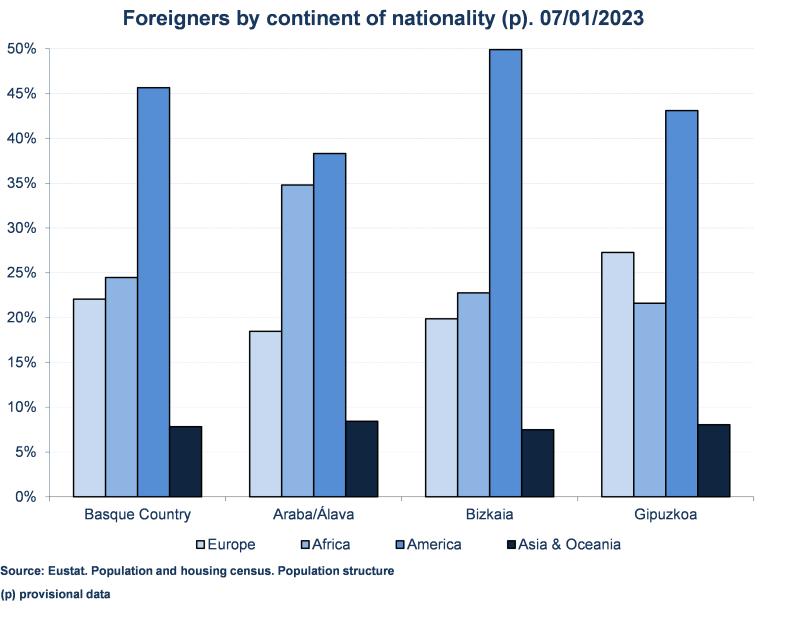
This trend was seen in all three provinces.
In Bizkaia, Latin Americans represented the greatest proportion of foreign residents (49.9% of the total), followed by Africans (22.8%) and Europeans (19.9%).
In Gipuzkoa, Latin Americans were once again clearly in the majority, accounting for 43.1% of the total, followed by Europeans (27.3%) and Africans (21.6%).
Meanwhile, in Álava, the percentages of people with Latin American and African nationality were similar (38.3% and 34.8% respectively), followed at some distance by Europeans (18.5%) and Asians (8.4%).
For further information:
Eustat - Euskal Estatistika Erakundea / Basque Statistics Institute
C/ Donostia-San Sebastián 1, 01010 Vitoria-Gasteiz
Press Service: servicioprensa@eustat.es Tel.: 945 01 75 62