Press release 12/06/2024
SURVEY ON PERSONAL WELL-BEING 2023
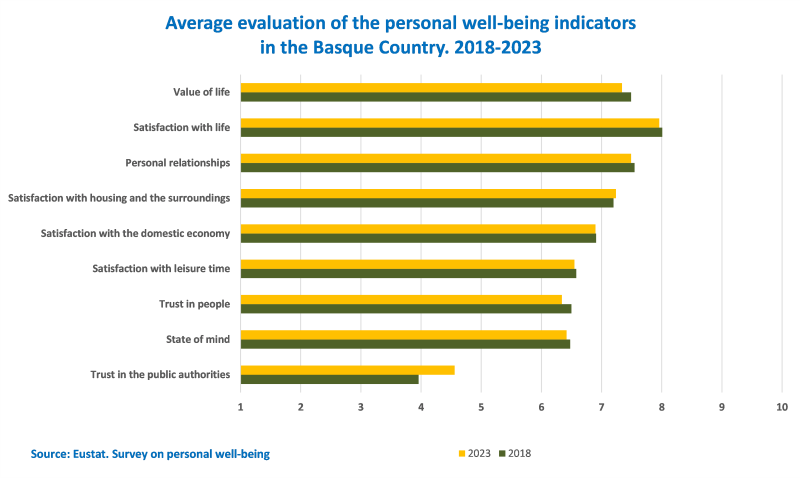
Life satisfaction stood at 7.3 in the Basque Country in 2023
Life rating (8.0), Personal relationships (7.5) and Housing and neighbourhood satisfaction (7.2) scored higher than 7
The population of the Basque Country rated life satisfaction in general at 7.3 in 2023 on a scale of nought to ten, according to Eustat data. The score was two tenths lower than in 2018, when it stood at 7.5.
This data is provided in the Survey on Personal Well-Being, which offers detailed information on the perception of well-being among the population aged 16 and over residing in family dwellings, through a series of questions that primarily measure aspects of quality of life aside from the material dimension.
The highest life satisfaction was observed among people who considered their health to be very good (7.9), compared to those reporting bad or very bad health, who score the lowest (5.5). Young people, aged 16 to 24, also presented a very high average score (7.8). The ratings for this indicator increased in proportion to the educational attainment level of the respondents.
By type of household, couples without cohabitant children scored 7.5, compared to single-person households or single parents with children (7.0 and 7.1, respectively).
Men (7.4) were more satisfied with their lives than women (7.3), while at provincial level, Álava (7.4) topped Gipuzkoa and Bizkaia by one tenth (7.3 in both cases). Focusing on place of birth, the rating was the same for all respondents (7.4), with the sole exception of people born in other provinces, who scored lowest (7.2).
In terms of activity, people in employment registered one of the highest scores (7.4), in contrast to unemployed people, who gave the lowest rating (6.8).
Another factor that influences this indicator is disability; individuals without a disability were most satisfied with life (7.4), compared to those who have some form of disability (6.5).
Average assessment of personal well-being indicators by province of residence of the Basque Country. 2018-2023
| | Basque Country | Araba/Álava | Bizkaia | Gipuzkoa |
| | 2018 | 2023 | 2018 | 2023 | 2018 | 2023 | 2018 | 2023 |
| Satisfaction with life | 7,5 | 7,3 | 7,5 | 7,4 | 7,5 | 7,3 | 7,6 | 7,3 |
| Value of life | 8,0 | 8,0 | 7,9 | 8,1 | 8,0 | 8,0 | 8,1 | 7,9 |
| Satisfaction with leisure time | 6,6 | 6,6 | 6,6 | 6,5 | 6,6 | 6,6 | 6,6 | 6,6 |
| Satisfaction with housing and the surroundings | 7,2 | 7,2 | 7,3 | 7,4 | 7,1 | 7,2 | 7,2 | 7,2 |
| Satisfaction with the domestic economy | 6,9 | 6,9 | 7,0 | 6,9 | 6,8 | 6,9 | 7,0 | 6,9 |
| State of mind | 6,5 | 6,4 | 6,4 | 6,5 | 6,5 | 6,4 | 6,5 | 6,4 |
| Personal relations | 7,6 | 7,5 | 7,5 | 7,5 | 7,6 | 7,5 | 7,6 | 7,5 |
| Trust in people | 6,5 | 6,3 | 6,4 | 6,3 | 6,4 | 6,3 | 6,7 | 6,4 |
| Trust in the public authorities | 4,0 | 4,6 | 4,0 | 4,5 | 4,0 | 4,6 | 3,8 | 4,5 |
Date June 12, 2024
Source: Survey on personal well-being
The Value of life indicator received the highest score: 8
Life rating, that is, each person’s view of how worthwhile their life is, remained at the same level as 2018, with an average score of 8. 68.8% of the population gave a high score, compared to 2.5% who gave a low score.
Men gave their life a rating of 8, slightly higher than women (7.9), while at provincial level the residents of Álava (8.1) assigned their life the highest score, ahead of Gipuzkoa and Bizkaia (8 and 7.9, respectively).
As regards activity, people in employment rated their life the highest (8.0) in contrast to unemployed respondents (7.7), who registered an indicator one tenth of a percentage point lower than in 2018.
The results for this indicator worsened in proportion to perception of health, with a variation of almost two points between respondents reporting very good health (8.5) and people who regarded their health as poor or very poor (6.6). There were also differences in the score for people who have some kind of disability (7.2) and those who do not (8.0).
Lastly, the score tended to fall in proportion to increases in age, although no major differences were registered.
Personal relationships were the aspect with the second-highest rating
Personal relationships, one of the top-rated aspects (7.5), scored highest among people who stated they were in very good health and those aged 16 to 24 (7.7 in both cases), while the lowest score (7.0) was registered among respondents reporting poor or very poor health.
Unemployed people (7.4) rated personal relationships lower than employed or inactive respondents, who registered the same score (7.5), while no differences were observed between men and women or provinces of residence (7.5 in all cases).
By place of birth, people born in Álava and Gipuzkoa, with 7.6, scored higher than respondents from Bizkaia, who registered 7.5, while the lowest rating was given by people born abroad (7.4).
Housing and neighbourhood satisfaction registered a good average score and was high across virtually all groups
The highest ratings for the Housing and neighbourhood satisfaction indicator (7.2) were registered among people reporting very good health (7.5), followed by men (7.4), who were more satisfied than women (7.1).
By province, people living in Álava scored higher (7.4) than residents of Bizkaia and Gipuzkoa (7.2 in both cases). Lastly, people reporting poor or very poor health gave the lowest rating (6.7).
State of mind was linked to perceived health
The State of mind indicator stood at an average of 6.4 for the population as a whole (one tenth less than in 2018), with the lowest score registered among people reporting poor or very poor health (5.4) and the highest given by respondents who rated their health as very good (6.9).
The second highest score corresponded to the groups comprising respondents aged over 65 and inactive people, who gave a rating of 6.7.
At provincial level, residents of Álava reported having a more positive state of mind, with an average rating of 6.5, compared to people living in Bizkaia and Gipuzkoa (both 6.4). Focusing on place of birth, people born abroad had a less positive state of mind (6.2).
As regards family structure, couples without children scored highest (6.6), in contrast to single person households and couples with cohabitant children (6.2 in both cases). Lastly, it is worth highlighting that this indicator scored higher among men (6.6) than women (6.3).
Elderly and inactive people were the most satisfied with their leisure time
The average rating for Satisfaction with leisure time was 6.6, with the highest score for this indicator assigned by people aged 65 and over (7.6), while the lowest was given by respondents aged 35 to 49 (5.7).
High scores were also given by respondents in both the inactive (7.6) and unemployed (7.1) groups, in contrast to people in employment, who assigned this indicator a rating of 5.8.
Men (6.6) were slightly more satisfied than women (6.5), as were residents of Gipuzkoa and Bizkaia (6.6), compared to people living in Álava (6.5).
Focusing on type of household, the best score (7.1) was registered by couples without cohabitant children, compared to 6.2 for couples with children.
Unemployed respondents and people reporting poor or very poor health were the least satisfied with their household economy
The Satisfaction with household economy indicator (6.9) increased in proportion to perceived health, ranging from 6.1 among people stating they were in poor or very poor health to 7.3 for respondents reporting very good health.
Unemployed people (6.2), with an increase of five tenths compared to 2018, were less satisfied than respondents who were in employment (6.9) or inactive (7.0).
By province of residence, all respondents were equally satisfied (6.9), but differences based on origin were observed. As such, people born in Gipuzkoa and Bizkaia rated their satisfaction with their domestic economy at 7.0, compared to those born in Álava (6.9) and, above all, respondents born abroad, who registered the lowest score (6.6).
As regards age, the highest rating (7.2) corresponded to people between 16 and 24, four tenths above respondents between 50 and 64 (6.8) and three higher than the other age groups (6.9).
By type of household, couples without children scored 7.1, in contrast to single-person households and couples with children (6.6 in both cases). The ratings for this indicator increased in proportion to the educational attainment level of the respondents, with no differences registered between women and men (6.9).
Trust in people was related to place of origin and subjective health
The Trust in people indicator (6.3) fell by two tenths compared to 2018 and registered the highest score among people stating they were in very good health and those aged 16 to 24 (6.6 in both cases), while people originating from abroad (5.7) and respondents reporting poor or very poor health (5.8) obtained the lowest ratings.
Trust in people was "high" for 32% of the population, whilst it was "low" for 15.9%. Women (6.4) were slightly more trusting than men (6.3), and residents of Gipuzkoa (6.4) registered higher levels of trust than people living in Álava and Bizkaia (6.3 in both provinces).
People born abroad were the only respondents who rated public authorities at 5 or above
Only 5.6% of the population trust public authorities "a lot", compared with 45.2% who have "little" trust in them. Despite being the only indicator that did not score 5 or above (average of 4.6), it registered a significant increase in all the groups analysed compared to the 2018 edition, with a result that was six tenths higher on average.
Focusing on place of origin, the highest scores corresponded to people originating from abroad (the only group that rated public authorities 5 or above, at 5.3), and respondents born in other regions (4.7). In this regard, people born in Álava registered the lowest score (4.3).
In terms of age, people aged over 65 and those between 16 and 24 (4.9 and 4.6, respectively) have the greatest trust in the political and judicial system and the police, while respondents between 25 and 34 registered the worst result (4.3)
Men had less trust (4.4) than women (4.7). In addition, this indicator fell progressively in inverse proportion to the educational attainment level of the respondents.
For further information:
Eustat - Euskal Estatistika Erakundea / Basque Statistics Institute
C/ Donostia-San Sebastián, 1 01010 Vitoria-Gasteiz
Press Service: servicioprensa@eustat.es Tel.: 945 01 75 62