Press Release 19/07/2024
UNIVERSITY STATISTICS 2023
71,142 people enrolled in universities in the Basque Country in the 2022/23 academic year, 0.9% more than the previous year
Private universities accounted for 30% of enrolments, while public establishments adapted to the growing demand for dual degrees
In the 2022/23 academic year, there were 71,142 enrolments at universities with centres located in the Basque Country, 0.9% more than in the previous year, according to Eustat data. This represents a continuation of the upward trend observed over the last six years. The rise was due to an increase of almost one thousand students taking bachelor’s degrees, compensating for the slight drop in enrolments in both master's and doctoral programmes.
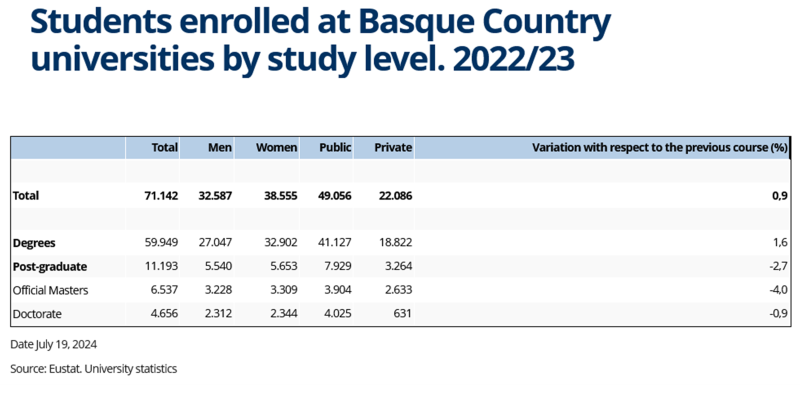
Public universities continued to be the choice of most students, specifically 69%. Nevertheless, the trend in the distribution of enrolments between public and private establishments leans towards the latter. After over 20 years of a stable division of approximately 76% for public institutions and 24% for private, the 2010/11 academic year represented the high point for the Basque public university system, with four out of every five enrolments. However, a gradual drop has been recorded since then, resulting in the current levels. The 2022/23 academic year was the first since records began in which the students enrolled in public universities accounted for less than 70% of the total.
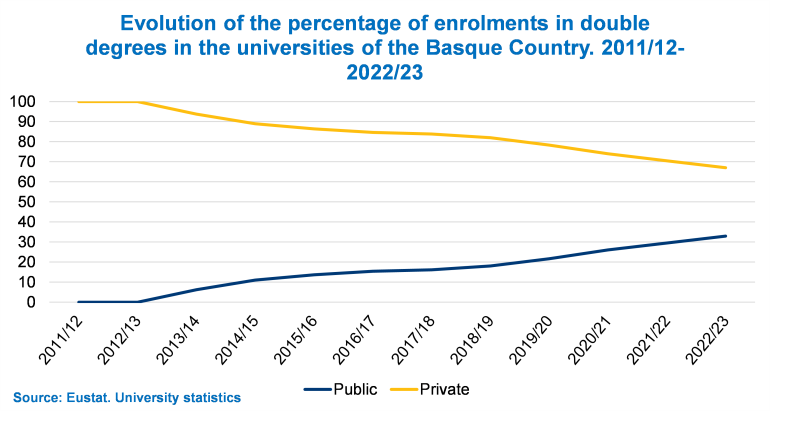
By contrast, public universities are making progress in adapting their offering to the growing demand for dual degrees. While a decade ago dual degrees were the exclusive domain of private universities, as public universities did not even offer them, there has been significant growth, with one in three dual degree students opting for a public establishment in the 2022/23 academic year.
Half of bachelor's degree enrolments were concentrated in 12 qualifications
A wide variety of bachelor’s degrees are offered at universities with centres in the Basque Country. In the 2022/23 period, undergraduates were studying for 106 different qualifications. However, it is notable that half, almost 30,000 students, were concentrated in just 12 degree courses. In other words, 11% of bachelor's degree courses accounted for 50% of all registrations. The most popular courses were Business Administration and Management, Primary Education, Law, Psychology and Early Childhood Education. They all had over 2,200 students, but Business Administration and Management is particularly noteworthy, with 5,714 enrolments, almost 10% of all undergraduates.
Uneven distribution of sexes depending on the field of study
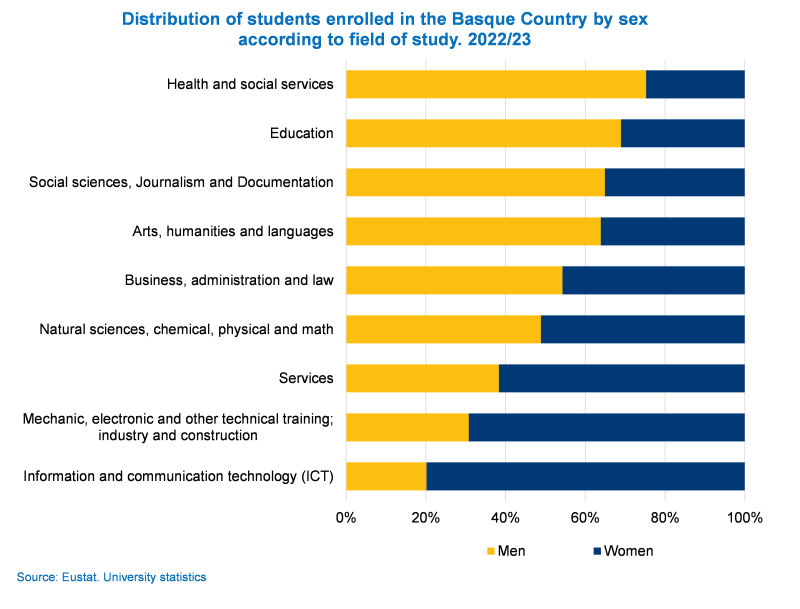
Women made up 54% of the total student body, a proportion that has remained virtually constant over time. However, there were courses where the distribution of sexes was very uneven. If the qualifications are grouped in the fields of study established in the International Standard Classification of Education (ISCED-F), it is clear that gender still has a major influence on students’ preference when choosing an academic discipline.
As such, courses in the field of health and social services were entirely female-dominated, as three out of every four people who took them were women. At the other end of the scale were information and communication technology studies, with men accounting for 80% of students. The natural sciences, chemistry, physics and mathematics sector, by contrast, showed no sign of gender gaps and had an even distribution of sexes.
More women obtain bachelor’s degrees and more men gain doctorates
14,266 people finished their courses in 2023, 1.5% more than the previous year. Of them, 9,932 obtained a bachelor's degree, 3,715 completed a master's and 619 read their doctoral theses.
The gender distribution of graduates varied according to the academic level achieved. The number of women (5,739) far outstripped men (4,193) among graduates. In relative terms, they represented 58%. Among master's graduates, the difference between men and women was smaller, although they were still the majority, 53%. By contrast, the opposite was the case for students who obtained a doctorate, with women accounting for 48%.
Over 12,700 people passed university entrance exams
13,071 people sat entrance exams for the University of the Basque Country in 2023. Only 300 failed, representing 2.3%. There were no variations in the results compared to the previous year and the average grade for the general stage of the exam, which is mandatory for all candidates, remained at 7 points. After the general stage grade was weighted with the average marks from upper secondary studies, the average grade stood at 7.4 points.
There were differences by gender in both the proportion of students taking the exams and the results. 1,657 more women than men took the first sitting of the exam, representing 57%. However, the distribution was reversed and men were the majority (53%) at the second sitting, which was taken by 1,189 people. In terms of grades, the average for girls was 0.4 points higher than for boys.
Candidates who registered for university entrance exams to take Biochemistry and Molecular Biology, Medicine or the dual degree combining Physics and Electronic Engineering achieved the highest grade, 8.9 points.
For further information:
Euskal Estatistika-Erakundea / Basque Statistics Institute
C/ Donostia-San Sebastián, 1 01010 Vitoria-Gasteiz
Press Service: servicioprensa@eustat.eus Tel.: 945 01 75 62