Press Release 22/03/2024
SCHOOL ACTIVITY STATISTICS. 2023
The number of students enrolled in non-university education in the Basque Country fell by 0.6% in the 2022/2023 academic year
Almost a third of the student population, more than 114,000 students, received grants or financial aid for studying from the Basque
There was a total of 405,460 enrolments in formal non-university education in the 2022/2023 academic year, 0.6% less than in the previous academic year, according to Eustat data.
Both Early Childhood and Primary Education continued to follow the downward trend seen in recent years and saw student numbers fall by 3.4% and 1.4%, respectively, compared to the 2021/22 academic year. Compulsory Secondary Education, on the other hand, had nearly 1,800 more students, which contributed to the gradual increase in Compulsory Secondary Education in recent years and led to an additional 20,000 students since the 2007/08 academic year.
All Specialised Education registered an upturn in student numbers, with the exception of Sports Education, where the number of enrolments fell by more than 300. In relative terms, this meant a drop of 28% in respect of the previous academic year.
Students enrolled in non-university education in the Basque Country by study level, according to ownership of centre. 2022/23


| | Total | Public | Private | Variation with respect to the previous course (%) |
| TOTAL | 405.460 | 226.164 | 179.296 | -0,6 |
| General teaching | 377.251 | 199.039 | 178.212 | -0,6 |
| Infant education | 73.766 | 39.630 | 34.136 | -3,4 |
| Primary education | 124.151 | 64.388 | 59.763 | -1,4 |
| Obligatory secondary education | 88.889 | 42.035 | 46.854 | 2,1 |
| Basic vocational training | 4.905 | 1.432 | 3.473 | 3,4 |
| Baccalaureate | 32.476 | 15.403 | 17.073 | -0,5 |
| Professional Training middle grade | 16.029 | 10.099 | 5.930 | -1,6 |
| Intermediate vocational training courses | 59 | 37 | 22 | 78,8 |
| Professional Training higher grade | 23.706 | 13.712 | 9.994 | -0,2 |
| Higher degree FP specialization courses | 254 | 200 | 54 | 130,9 |
| Special education | 1.686 | 946 | 740 | 3,9 |
| Adult education | 11.330 | 11.157 | 173 | 2,4 |
| Special teaching | 28.209 | 27.125 | 1.084 | -0,4 |
| Language studies | 23.843 | 23.843 | - | 0,4 |
| Artistic studies - music | 2.537 | 1.837 | 700 | 1,6 |
| Artistic studies - dance | 138 | 138 | - | 0,0 |
| Plastic arts and design teachings | 799 | 541 | 258 | 9,8 |
| Sports studies | 829 | 703 | 126 | -28,0 |
| Arts Education in dramatic art | 63 | 63 | - | 5,0 |
Date March 22, 2024
Source: Eustat. School activity statistics
As regards the nature of the place of study, in General Education, the distribution of students remained stable with respect to that observed in previous academic years. Thus, almost 53% of students chose to study at public centres, compared to 47% who preferred to study at a privately owned centre.
The upward trend in Vocational Training was primarily due to the increase in the number of men enrolled
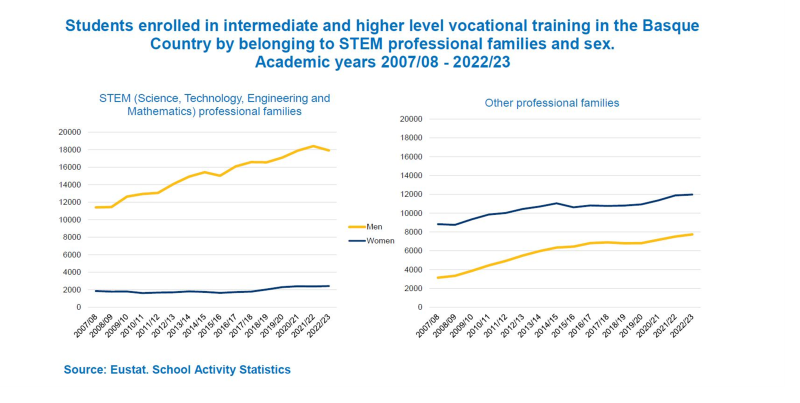
Total figures for enrolment in Intermediate and Advanced Level Vocational Training, including new specialisation courses, registered a slight decrease in the 2022/23 academic year. Specifically, 133 fewer people enrolled, but, despite this, the number of students once again exceeded 40,000, as was the case in the previous edition.
However, the overall evolution of Vocational Training over the last fifteen years has clearly been positive. This trend was seen among both men and women, although the male student population has always predominated. Compared to the 2007/08 academic year, the number of men enrolled grew by 76.4%, while the number of women was up 34.8%.
Furthermore, in the 2022/23 academic year, students enrolled in Vocational Training were distributed equally between training courses belonging to occupational families linked to STEM (Science, Technology, Engineering and Mathematics) professions and those that do not fall within this science and technology field. However, within these groups, the gender distribution was very different. While in STEM studies the gender gap was particularly wide and women accounted for just 12% of the total, in the other occupational families the distribution was less uneven and six out of ten students enrolled were women. This phenomenon was not unique to the 2022/23 academic year and has occurred repeatedly over time.
Private centres led the way in terms of teaching in foreign languages
21.6% of students in the Basque Country were taught in a foreign language. These were students who studied a subject (other than a foreign language itself) in languages such as English, French or German. This learning method was mainly used in Primary Education (31.4%), Compulsory Secondary Education (37.1%) and Upper Secondary Education (14.4%). Its use at other levels was inconsequential.
Significant differences were observed according to the nature of the centre. A third of students enrolled in the private sector were taught in languages other than Basque or Spanish. In the public system, however, this only occurred in 9.4% of cases. It should be noted that these figures include foreign centres authorised to follow education systems in place in other countries, which teach in the languages of those countries.
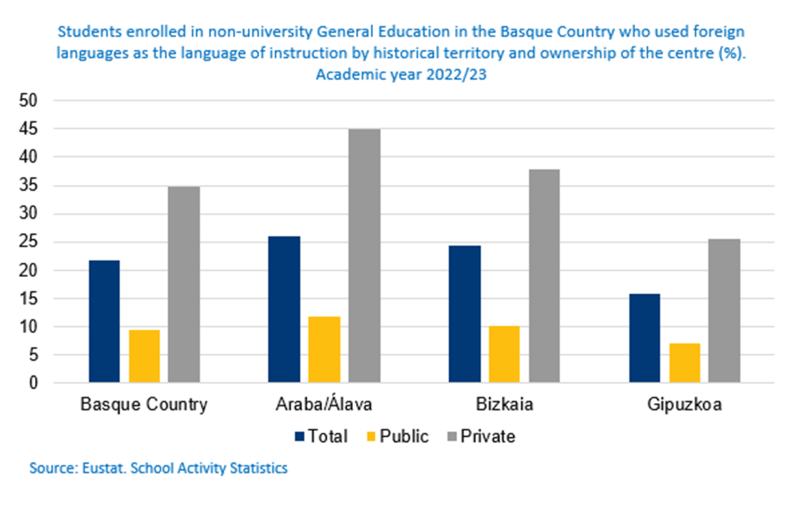
Although less noticeable, the data analysed also showed provincial differences. Álava was the province where foreign languages were most widely used, followed by Bizkaia. In both provinces, approximately a quarter of students were taught in other languages as part of their learning. In Gipuzkoa, this figure barely reached 16%.
The Basque Government allocated 72.7 million euros to grants and financial aid for studying
Almost a third of the student population received grants or financial aid for studying from the Basque Government’s Department of Education, which, in absolute figures, translates into more than 114,000 students.
The proportion of students with grants was higher among those enrolled in the public sector at all levels, except for Intermediate and Advanced Level Vocational Training. In this regard, the largest gap between the public and private sectors was in Primary Education. 48.4% of pupils enrolled in primary education at public centres received some kind of grant or financial aid for studying, 24 percentage points more than among those enrolled at privately owned centres.
The amount allocated for grants exceeded 72.7 million euros, 9 million more than in the previous academic year. Most of this increase was a direct result of the application of Royal Decree 14/2022, which regulated certain economic sustainability measures. With regard to education, the aforementioned law established an amount of 400 euros for all beneficiaries of grants and financial aid available for those studying beyond the compulsory level. In the Basque Country, the number of people who received this amount stood at 20,037.
For further information:
Euskal Estatistika-Erakundea / Basque Statistics Institute
C/ Donostia-San Sebastián, 1 01010 Vitoria-Gasteiz
Press Service: servicioprensa@eustat.es Tel.: 945 01 75 62