Press Release 19/12/2023
INDICATORS FOR ANALYSING DEMOGRAPHIC PHENOMENA. 2022
Life expectancy in the Basque Country fell in 2022 and stood at 2017 levels
Even so, the life expectancy of women exceeded that of the European Union as a whole by 2.7 years
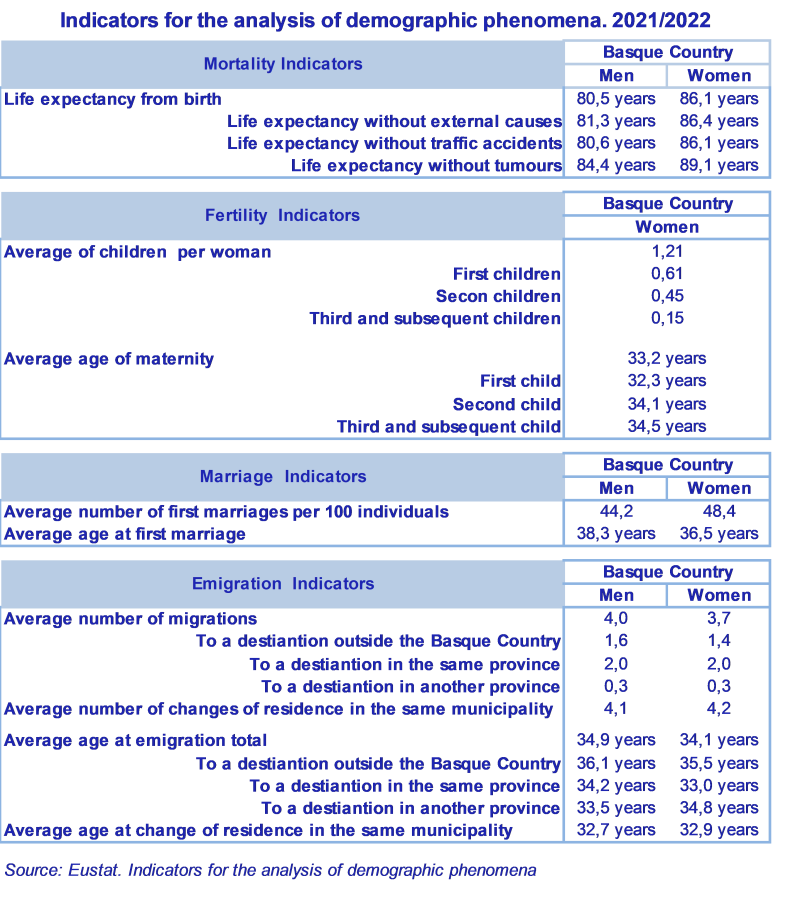
Life expectancy in 2022 stood at 80.5 years for men, two tenths less than the year before, while it fell by three tenths for women, reaching 86.1 years, five tenths less than in 2019, according to Eustat data. This drop was due to the excess mortality caused by the COVID-19 pandemic between January and June 2022, as well as the heatwave in July 2022.
Despite this decrease in life expectancy, it was still higher than that of the European Union as a whole, exceeding it by 2.5 years in the case of men and 2.7 years in the case of women. Life expectancy in Spain, which was one of the highest in Europe, was one tenth lower for men and 2 tenths lower for women.
Both men and women in the Basque Country saw an increase in their life expectancy, despite the drop in recent years. Compared to the indicators observed in 1976 (a life expectancy of 69.6 years for men and 76.9 years for women), life expectancy increased by 9.2 years for women and 10.9 years for men. Men gained 2.8 more months of life per year, reaching 80.5 years, while women enjoy 2.4 more months per year, reaching 86.1 years. The gap between the life expectancies of the two sexes narrowed to 5.6 years, from a maximum difference of 8.7 years in 1991.
Tumours were the main threat to years of life expectancy. If tumours were to be completely eliminated, men would prolong their lives by 3.9 years and women by 3 years. If we make the comparison including the COVID-19-free life expectancy (85.4 years for men and 89.8 for women), the increase for men would be 4.9 years and for women it would be less, 3.7 years. External causes of death, however, were less detrimental, taking 8 months from the lives of men and 3 months from women. These figures dropped to just 1 month in the case of traffic accidents for men and a negligible amount for women. The combination of the absence of external causes with that of deaths due to COVID-19 would produce an increase of 1.5 years in the life expectancy of men and of 0.9 years in that of women.
There was a slight decrease in fecundity and the average age of maternity remained high
Fecundity in the Basque Country was at exceptionally low levels in comparative terms, given that in 2022 the average number of births per woman was 1.21, four tenths less than in the previous year, and below the 1.53 seen in the European Union (latest data, 2021) and a long way from the average of 2.7 births in 1976 and the 2.1 required for generational replacement. The lowest rate was in Bizkaia, with 1.12 births per woman, while in Álava and Gipuzkoa it stood at 1.28.
On the basis of the data from the Indicators for analysing demographic phenomena, it was predicted that women would have an average of 0.61 first children, assuming that almost a third of women would have none; 0.45 second children; and 0.15 third or subsequent children. In other words, in the latter case, fewer than two out of ten women will give birth to a third or subsequent child, representing a decrease of 81% compared to 1976.
Another characteristic of the fecundity of Basque women was their high average maternity age, which stood at 33.2 years, more than 2 years above the European Union average (latest data, 2021) and 4.6 years more than in 1976. The average maternity age was slightly lower in Álava (32.8 years) than in the other two provinces, whilst in Bizkaia it stood at 33.7 years and in Gipuzkoa it was 33.2. The very low level of fecundity has meant that average age at the birth of the first child was almost 7 years higher than in 1976, standing at 32.3.
The marriage rate almost reached pre-COVID-19 levels
The percentage of first marriages according to the marriage rates for 2022 stood at 44.2% for men and 48.4% for women. These rates were significantly higher than those for 2020 and 2021, which were the lowest since 1977, due to COVID-19 confinements; specifically, there was an increase of 12.5 percentage points for men and 14.8 points for women compared to 2021. It could be assumed that some of the marriages postponed in the two previous years would take place in 2022 and that added to the marriages celebrated in a normal year, the rates would exceed those for 2019, but this was not the case. The rates for 2019 were 2.5 percentage points higher for men and 2.1 points higher for women.
An analysis of the marriage rate showed that the age for marriage continued to rise. The average age at which people enter their first marriage was 38.3 for men and 36.5 for women. However, this average age was 0.9 years higher for men and 1 year higher for women than in 2019, the last year before the pandemic, which is a significant rise, given that in recent decades the increase from one year to the next was 2 or 3 months.
As in the case of fecundity, a considerable number of marriages took place at specific ages. In just 10 years, between the ages of 30 and 39, 53% of men and 52% of women got married.
On average, an inhabitant of the Basque Country will emigrate almost 4 times in their lives
Normally, emigration is intra-provincial. In other words, the municipality of destination is in the same province as the municipality of origin. Such is the case of more than half of the migrations (2 out of a total of 4 for men and 2 out of a total of 3.7 for women). In contrast, on average men emigrated 1.6 times to destinations outside of the Basque Country, which represented 40% of the total number of emigrations, whereas women emigrated in this way 1.4 times, which represented 38% of the total.
By province, there was quite a pronounced difference in the case of men between Bizkaia and Álava: Álava had an average number of emigrations of 3.2, whilst in Bizkaia it was 4.2 per person; Gipuzkoa was in the middle with 3.9 emigrations. These differences among men were due to intra-provincial mobility, as Bizkaia had 2.4 movements, whereas men in Álava had just 0.9 movements on average. Álava stood out in terms of movements between provinces, with 0.5 per person, double those in Bizkaia (0.2); Gipuzkoa was in the middle with 0.3. Women had the same ratios, but with lower rates.
Among women, as the distance covered by the emigrants increased, their average age rose. Thus, those who emigrated outside of the Basque Country were the oldest (35.5 years old), and those who moved within the same province did so with an average age of 33. Among men, those who emigrated outside of the Autonomous Region continued to be the oldest at over 36 years old, but the youngest were those who moved between the provinces, at 33.5 years old, 7 months younger than those who moved within their province.
With regards to changes of residence within the same municipality, the men and women of Álava showed the highest mobility rate, with 4.8 on average for both sexes, some way ahead of Bizkaia and Gipuzkoa, with averages of around 4 moves per person.
For further information:
Eustat - Euskal Estatistika Erakundea / Basque Statistics Institute C/ Donostia-San Sebastián, 1 01010 Vitoria-GasteizPress service: servicioprensa@eustat.es Tel.: 945 01 75 62