Press Release 11/10/2023
MUNICIPAL STATISTICS ON INHABITANTS. 01 January 2023
In 2023, after 2 years of decline, the Basque population increased by 10,228 people
Growth was distributed across the three provinces
On 1 January 2023, the population of the Basque Country stood at 2,196,745 people, an increase of 10,228 (+0.5%) compared with 2022, according to Eustat data. This reverses the trend of the last two years, with decreases of 6,682 people in 2022 and 6,512 in 2021.
In absolute terms, the greatest population increase was in Bizkaia, with 4,810 more residents than in 2022 (+0.4%); followed by Gipuzkoa, with a resident population of 719,875, 3,259 more people than the previous year (+0.5%); and lastly, Álava, where the increase was 2,159 inhabitants, rising to 332,851 (+0.7%).
The analysis over a broader period, between 2003 and 2023, indicates that Álava increased its resident population by 41,813, an increase of 14.4%, followed by Gipuzkoa, with growth of 6%, in other words 40,812 more people. As for Bizkaia, it added 24,170 inhabitants during this period, 2.2% of its population.
All three Basque provincial capitals saw their population increase between 2022 and 2023. Bilbao saw the greatest rise, with 2,029 more inhabitants, followed by Vitoria-Gasteiz with 1,994, and lastly San Sebastian, with 872 more people. Looking back to 2003, we find that the population of Bilbao has dropped by 3,291 people over the last 20 years (-1%), and San Sebastian has seen a slight increase in its population, of 2,611 people (+1.5%). Meanwhile, Vitoria-Gasteiz has increased its population over these two decades by 30,517 people, or 13.9%, rising from 219,583 to 250,100 inhabitants.
As for the other municipalities of the Basque Country, it should be noted that over the last year 145 of them regained population, while 99 lost residents. The municipalities registering the greatest population increases were Barakaldo (479 inhabitants), Santurtzi (364 inhabitants), Leioa (309 inhabitants) and Sestao (282 inhabitants), all within the Gran Bilbao region. Meanwhile, the municipality with the greatest decline in absolute terms for the year was once again Getxo, losing 199 inhabitants, although the drop is significantly lower than in recent years (-0.3%). Elduain, Lanestosa and Kuartango are the municipalities with the greatest percentage decline, in all three cases slightly more than 5%.
Between 2003 and 2023, Portugalete, Getxo, Basauri and Sestao in the Gran Bilbao region were the municipalities that saw the greatest decline in their population, with an overall loss of 16,766 people. Arrasate and Eibar in Gipuzkoa and Ondarroa in Bizkaia also suffered decreases of more than 1,000 inhabitants each.
Looking at the regions, it was specifically Gran Bilbao which registered the greatest population growth over the past year, adding 3,678 inhabitants, followed by Llanada Alavesa, with 2,076, and Donostialdea, up by 1,924. Among the remainder, it should be pointed out that only 4 of the 20 regions lost population, all by a relatively small percentage: Markina-Ondarroa, with 143 fewer inhabitants, saw a decrease of 0.6%; Bajo Deba, losing 88 inhabitants, fell by 0.2%; Montaña Alavesa, with 35 fewer inhabitants, was down 1.1%; and Añana, with 20 fewer inhabitants, dropped 0.3%.
Looking back to 2003, we find that Llanada Alavesa registered by far the greatest increase, of more than 35,000 people, followed by Donostialdea, with an additional 15,742 inhabitants, and Plentzia-Mungia, gaining 12,800. Only two regions have lost population over the past 20 years: Gran Bilbao down by 2,720 people, and Markina-Ondarroa, losing 778.
The proportion of people aged 65 and over continues to increase in the Basque Country
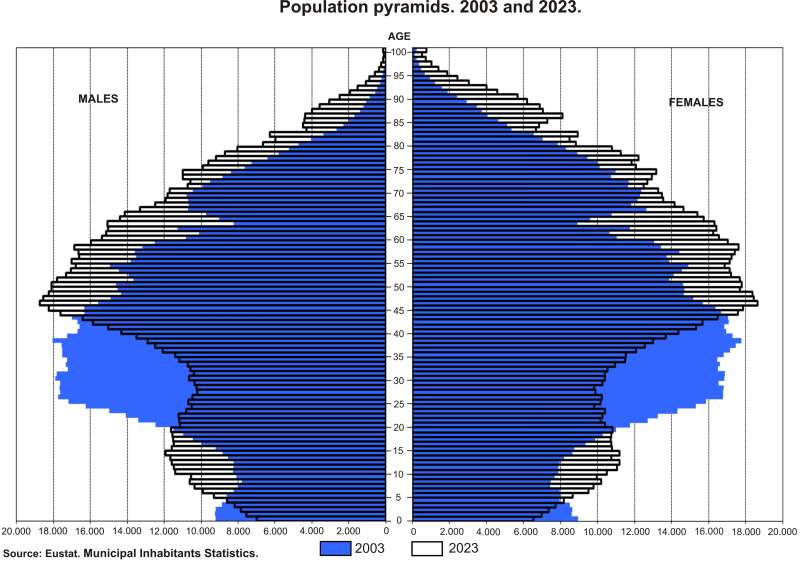
The average age of the population of the Basque Country stood at 45.6 years in 2023, almost 2 years older than in Spain as a whole. Compared to 2003, the average age increased by 3.4 years. The difference between the genders stands at 3.1 years, as men have an average age of 44 and women 47.1, because of the greater volume of female population of more advanced ages. The average age in the provinces reflected their age structure: Álava had an average age one year younger than the Basque Country average (44.6 years old); Gipuzkoa was close to that average, but just below at 45.1; and Bizkaia exceeded it, reaching 46.1 years.
In 2023 the proportion of the population of the Basque Country aged 65 and over (23.5%) was greater than in Spain (20.1%). Only 3 autonomous regions had higher percentages: Asturias (27.5%), Castile-Leon (26.5%) and Galicia (26.3%). If we take gender into account, the proportion of women aged 65 or over was 26.1% compared to 20.7% of men.
In 2023, the number of municipalities with a higher than average percentage population aged over 64 in the Basque Country was 85, while 166 presented the same or a lower percentage. The former include Bilbao, San Sebastian, Barakaldo and Getxo, home to 31.8% of the overall population of the Basque Country. In 2003 the percentage of the population aged over 64 was 18.4% and 154 municipalities had a percentage higher than the average. Furthermore, between 2003 and 2023, there were 95 municipalities in which the proportion of those aged over 64 decreased, although they are home to just 4.8% of the total population.
Population of the Basque Country by province, according to large age groups . 01/01/2023


| | Total | 0 - 19 | 20 -64 | >= 65 |
| | | Number | % | Number | % | Number | % |
| Total | 2.196.745 | 399.011 | 18,2 | 1.281.696 | 58,3 | 516.038 | 23,5 |
| Historic Territories | | | | | | | |
| Araba/Álava | 332.851 | 64.249 | 19,3 | 194.808 | 58,5 | 73.794 | 22,2 |
| Bizkaia | 1.144.019 | 198.250 | 17,3 | 671.528 | 58,7 | 274.241 | 24,0 |
| Gipuzkoa | 719.875 | 136.512 | 19,0 | 415.360 | 57,7 | 168.003 | 23,3 |
| Capitals | | | | | | | |
| Bilbao | 342.484 | 53.884 | 15,7 | 203.466 | 59,4 | 85.134 | 24,9 |
| Donostia / San Sebastian | 182.641 | 30.546 | 16,7 | 105.374 | 57,7 | 46.721 | 25,6 |
| Vitoria-Gasteiz | 250.100 | 47.566 | 19,0 | 146.483 | 58,6 | 56.051 | 22,4 |
| Districts | | | | | | | |
| Añana | 6.309 | 1.234 | 19,6 | 3.698 | 58,6 | 1.377 | 21,8 |
| Arabako Errioxa / Rioja Alavesa | 11.762 | 2.478 | 21,1 | 6.832 | 58,1 | 2.452 | 20,8 |
| Arabako Kantaurialdea / Cantábrica Alavesa | 34.368 | 6.517 | 19,0 | 19.573 | 57,0 | 8.278 | 24,1 |
| Arabako Lautada / Llanada Alavesa | 268.014 | 51.688 | 19,3 | 157.286 | 58,7 | 59.040 | 22,0 |
| Arabako Mendialdea / Montaña Alavesa | 3.208 | 549 | 17,1 | 1.842 | 57,4 | 817 | 25,5 |
| Arratia-Nerbioi / Arratia-Nervión | 24.135 | 4.758 | 19,7 | 14.137 | 58,6 | 5.240 | 21,7 |
| Bidasoa Behea / Bajo Bidasoa | 77.220 | 14.114 | 18,3 | 44.814 | 58,0 | 18.292 | 23,7 |
| Bilbo Handia / Gran Bilbao | 856.313 | 142.921 | 16,7 | 502.577 | 58,7 | 210.815 | 24,6 |
| Debagoiena / Alto Deba | 62.735 | 11.929 | 19,0 | 35.540 | 56,7 | 15.266 | 24,3 |
| Debarrena / Bajo Deba | 54.775 | 10.474 | 19,1 | 30.800 | 56,2 | 13.501 | 24,6 |
| Donostialdea | 330.342 | 59.056 | 17,9 | 192.116 | 58,2 | 79.170 | 24,0 |
| Durangaldea / Duranguesado | 99.295 | 19.135 | 19,3 | 58.405 | 58,8 | 21.755 | 21,9 |
| Enkartazioak / Encartaciones | 32.055 | 5.731 | 17,9 | 18.891 | 58,9 | 7.433 | 23,2 |
| Gernika-Bermeo | 46.386 | 8.572 | 18,5 | 26.587 | 57,3 | 11.227 | 24,2 |
| Goierri | 68.316 | 14.232 | 20,8 | 38.796 | 56,8 | 15.288 | 22,4 |
| Gorbeialdea / Estribaciones. del Gorbea | 9.190 | 1.783 | 19,4 | 5.577 | 60,7 | 1.830 | 19,9 |
| Markina-Ondarroa | 25.626 | 4.557 | 17,8 | 14.600 | 57,0 | 6.469 | 25,2 |
| Plentzia-Mungia | 60.209 | 12.576 | 20,9 | 36.331 | 60,3 | 11.302 | 18,8 |
| Tolosaldea | 49.720 | 10.491 | 21,1 | 28.622 | 57,6 | 10.607 | 21,3 |
| Urola Kosta | 76.767 | 16.216 | 21,1 | 44.672 | 58,2 | 15.879 | 20,7 |
Date October 11, 2023
Source: Eustat. Municipal Inhabitant Statistics
There is some considerable disparity in terms of the age of the resident population across the Basque municipalities, and more specifically with regard to the percentage of those aged 65 and over, ranging from 9.7% in Baliarrain to 36.1% in Lagrán.
Aside from the former, there were another 6 municipalities with percentages below 13%: Irura, Arakaldo, Alegría-Dulantzi, Astigarraga, Larraul and Iruña de Oca. The combined population of the 7 municipalities stood at 16,818 inhabitants. Meanwhile, aside from Lagrán, there were 3 municipalities with a percentage above 30%: Valle de Arana, Elantxobe and Sukarrieta. Overall, these four had a total of 1,131 residents.
Focusing on the regional level, there were two regions where the population aged over 64 exceeded 25% of the total: Bajo Bidasoa (25.5%) and Markina-Ondarroa (25.2%). Meanwhile, the region with the lowest percentage was once again Plentzia-Mungia, where it was below 19%.
If we look at older age groups, people aged 85 and above went from constituting 1.9% of the total population in 2003 to 4.1% of the total population in 2023, although this percentage was very unevenly distributed between men and women: 2.7% of the male population in the Basque Country were aged 85 or over, while this proportion rose to 5.5% among women. This process has been very dramatic for the centenarian population, with a rise in the number of centenarians from 269 in 2003 to 883 twenty years later, 85.7% of whom were women.
In the Basque Country, there were 1.7 people aged 65 and over for every minor aged under 16, exceeding the ratio for Spain as a whole, which was 1.4, but still far from that for Asturias, which was 2.5.
By region, Gran Bilbao and Montaña Alavesa revealed the highest proportion, with almost two people aged over 64 for each minor aged under 16, while in Plentzia-Mungia, the ratio was 1 to 1.
In municipal terms, 88 municipalities were above average, with such extreme cases as Sukarrieta, Valle de Arana and Lagrán, with a ratio of more than 3 to 1. At the other end of the scale we have municipalities such as Baliarrain, Irura and Arakaldo, with 2 young people aged between 0 and 15 years for each person aged 65 or over. 49 municipalities had at least one person aged under 16 for each person aged over 64.
For further information:
Eustat - Euskal Estatistika Erakundea / Basque Statistics Institute
C/ Donostia-San Sebastián, 1 01010 Vitoria-Gasteiz
Press Service: servicioprensa@eustat.es Tel.: 945 01 75 62