Press Release 10/08/2023
MUNICIPAL HOUSING STATISTICS. 2022
The family housing stock in the Basque Country registered growth of 0.4% as of 1 January 2022, with 4,125 more homes
There was a notable increase in dwellings under lease, 5.7%, with 7,040 more homes, amounting to 14.2% of the total
On 1 January 2022 the total housing stock in the Basque Country comprised 1,079,201 units, according to Eustat data. Over half of these homes, a total of 559,235, were located in Bizkaia, representing 51.8% of the housing stock. In Gipuzkoa there were 351,356 homes, 32.6% of the total, while the remaining 168,610 homes were located in Álava, comprising 15.6% of the total stock.
The increase of 4,125 homes registered between 2021 and 2022 represents a relative increase of 0.4% in the Basque Country's housing stock. There was significant growth in Bizkaia, with 2,531 additional units, representing a growth of 0.5%. Gipuzkoa, meanwhile, registered 1,070 more homes, an increase of 0.3%. Likewise, Álava also experienced an increase of 0.3%, with 524 additional homes.
Source: Eustat. Municipal Housing Statistics
From 2010 to 2022, the housing stock in the Basque Country recorded sustained growth, with a total of 73,461 additional units, up 7.3% compared to 2010. It is worth highlighting the province of Álava with the greatest relative growth, 11.3% compared to 2010, representing 17,110 more homes. Gipuzkoa registered an increase of 22,445 homes, 6.8% more, while Bizkaia recorded 33,906 additional units, representing growth of 6.5%.
More than 4 out of every 5 dwellings were used as primary residences in the Basque Country
85.2% of the family housing stock was used for primary residence, while the remaining 14.8% of dwellings were used as second homes or were unoccupied. This percentage distribution has remained largely constant over time.
There were slight variations in the proportion of family homes used as primary residences by province: 83.2% in Álava, 85% in Gipuzkoa (two tenths of a point higher than in 2021 in both cases) and 85.9% in Bizkaia (the same value as a year ago). As such, Álava was the province with the highest proportion of second and/or empty homes, 16.8%, while Gipuzkoa recorded 15% and Bizkaia 14.1%.
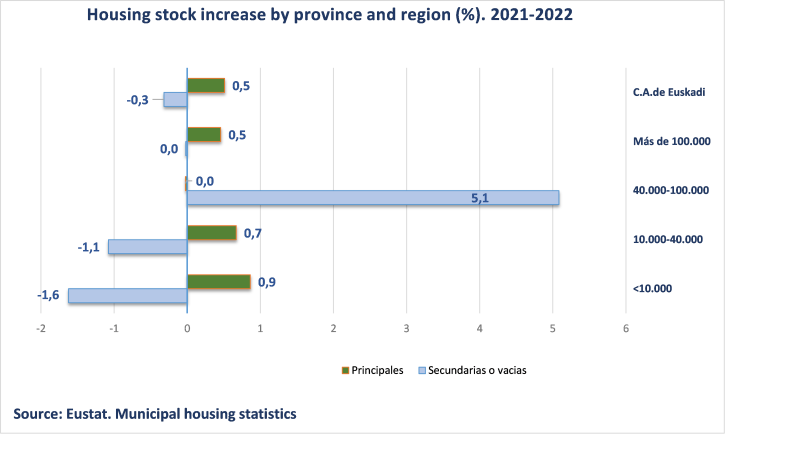
An analysis of the use of housing according to municipality size reveals that the stratum with fewer than 10,000 residents was particularly noteworthy. In this group, the stock of primary family homes recorded an increase above the average for the Basque Country compared to the previous year (0.9% compared to an average of 0.5%). There was also a decrease in the number of second or empty homes in this stratum (-1.6% compared to an average of -0.3%).
This pattern of loss of non-primary dwellings and growth in the number of habitual homes is repeated to a lesser extent in the remaining categories, except in the stratum of municipalities with a population between 40,000 and 100,000 residents, including Barakaldo, Basauri, Getxo, Irun, Portugalete and Santurtzi. In these municipalities as a whole, the percentage of primary residences remained constant while the number of second or empty homes increased by 5.1% compared to 2021.
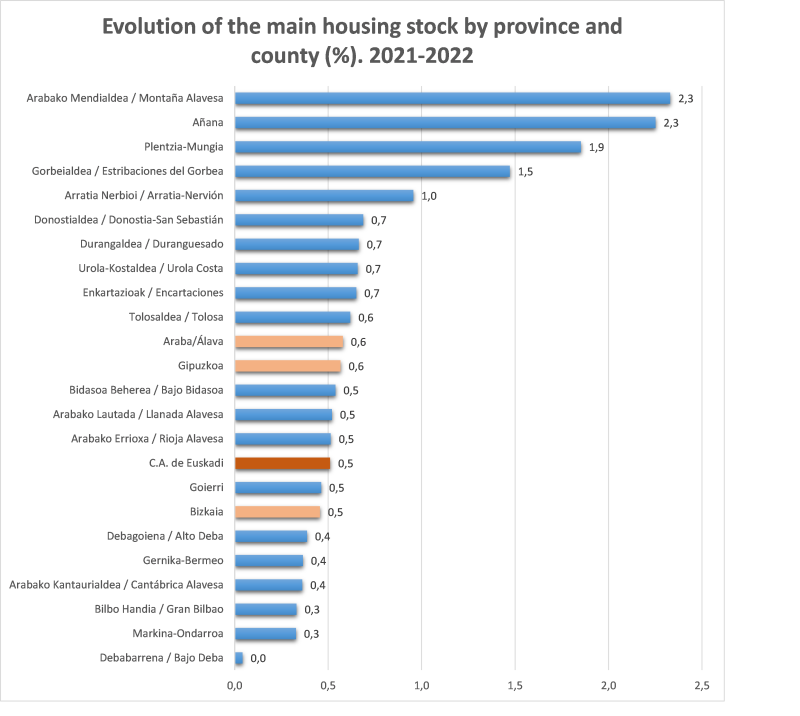
Uneven growth of primary housing stock in districts compared to 2021
As regards districts, slight increases were observed in most of them, with variations in the number of primary residences ranging from a 0.3% increase in Encartaciones and Gran Bilbao to 2.3% growth in Montaña Alavesa and Añana. Bajo Deba was the only district that did not register any variation in this category.
Source: Municipal housing statistics (EMV)
Significant increase in dwellings under lease between 2021 and 2022, up 5.7%
In the Basque Country, the most common form of tenancy among the 918,484 primary family homes in 2022 was ownership, representing 83.8% of the total. It is worth highlighting the province of Bizkaia where home ownership was one percentage point above the average for the Basque Country. By contrast, in Gipuzkoa 82.4% of homes were owned and Álava was in an intermediate position, albeit below the average with 83.5%.
As regards homes under lease, 130,519 dwellings under lease were recorded, representing 14.2% of the total, while the remaining 2%, 18,081 homes, correspond to other types of tenancy, with granting of use rights being the most common. By province, Gipuzkoa and Álava are above the average for leases with 15.6% and 15%, respectively, while 13.1% of homes in Bizkaia are under lease.
In 2022, 7,040 more dwellings under lease were recorded, an increase of 5.7%. This growth was registered in both Álava (4.3%) and Gipuzkoa (5.5%), but above all in Bizkaia (6.3%). The same order is reflected in the provincial capitals: Bilbao registered the highest percentage increase in dwellings under lease (7.7%), followed by San Sebastián (6.4%) and Vitoria-Gasteiz (4.5%).
Home tenancy classification varied significantly, depending on the size of the municipalities. In the stratum of below 10,000 inhabitants, there was a higher proportion of owned homes, 86%, representing an increase of 2.2 percentage points compared to the average for the Basque Country. This stratum is also noteworthy for having the lowest percentage of homes under lease, 11.9%.
Conversely, in municipalities with over 100,000 inhabitants, the proportion of dwellings under ownership fell to 81.4%. The municipality of Vitoria-Gasteiz is notable as the city with the highest percentage of housing units under ownership, 82.7%. By contrast, it is worth highlighting San Sebastián, where 20% of primary residences were under lease, 3.2 percentage points above the average for its stratum, 4.4 percentage points more than the average in its province and 5.8 points higher than the average for the Basque Country.
Growth in single-member households and decrease in homes with three or more cohabitees between 2021 and 2022
In 2022 the average number of people occupying a family home in the Basque Country was 2.4. Single-member households comprised 30% of the total number of primary family homes, up 0.6 percentage points compared to the previous year, representing an increase of 7,284 units. 51% of the total number of new single-member households were in Bizkaia, with 3,717 additional units in this province.
However, homes occupied by two people remained stable compared to the previous year. By contrast, family units with three or more residents fell by an average of seven tenths of a percentage point. The province of Bizkaia recorded the greatest drop in this category, with a fall of 0.8 points. Gipuzkoa decreased in line with the average, while Álava registered a lower reduction, 0.4 percentage points.
On average, Basque family homes are 47.9 years old with an area of 87.4 m2, 4 to 5 rooms and 1.4 bathrooms
The average age of the family housing stock in the Basque Country was 47.9. At provincial level, the most modern housing stock corresponded to Álava at 41.8 years old, followed by Gipuzkoa with an average age of 48.4, whereas Bizkaia, with 49.5, was the province with the oldest housing stock.
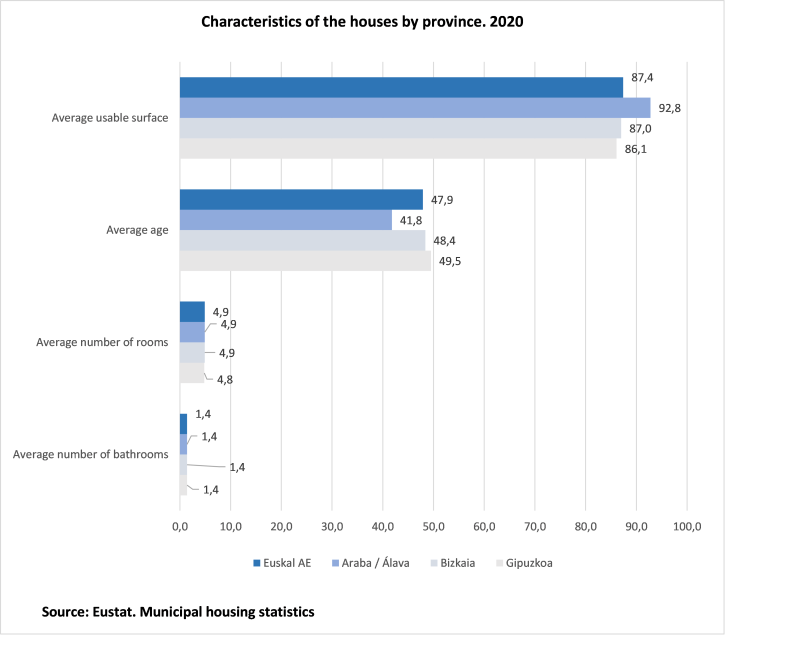
The average usable floor area of dwellings in the Basque Country as a whole was 87.4 m2. Álava had the largest family homes with an average of 92.8 m 2, followed by Gipuzkoa with 87 m2 and Bizkaia with 86.1 m2.
As regards the number of rooms, three quarters of Basque family homes had 4 or 5 rooms (including bedrooms, living room and kitchen) and an average of 1.4 bathrooms. Virtually all the dwellings had at least one bathroom (99.7%).
Lastly, in 2022, 82.9% of primary dwellings in the Basque Country had piped gas in the building. In addition, 73.8% of all primary homes had a lift. These results represent an increase of three and four tenths of a percentage point, respectively, in relation to the presence of these facilities in 2021.
For further information:
Eustat - Euskal Estatistika Erakundea / Basque Statistics Institute
C/ Donostia-San Sebastián, 1 01010 Vitoria-Gasteiz
Press Service: servicioprensa@eustat.eus Tel.: 945 01 75 62